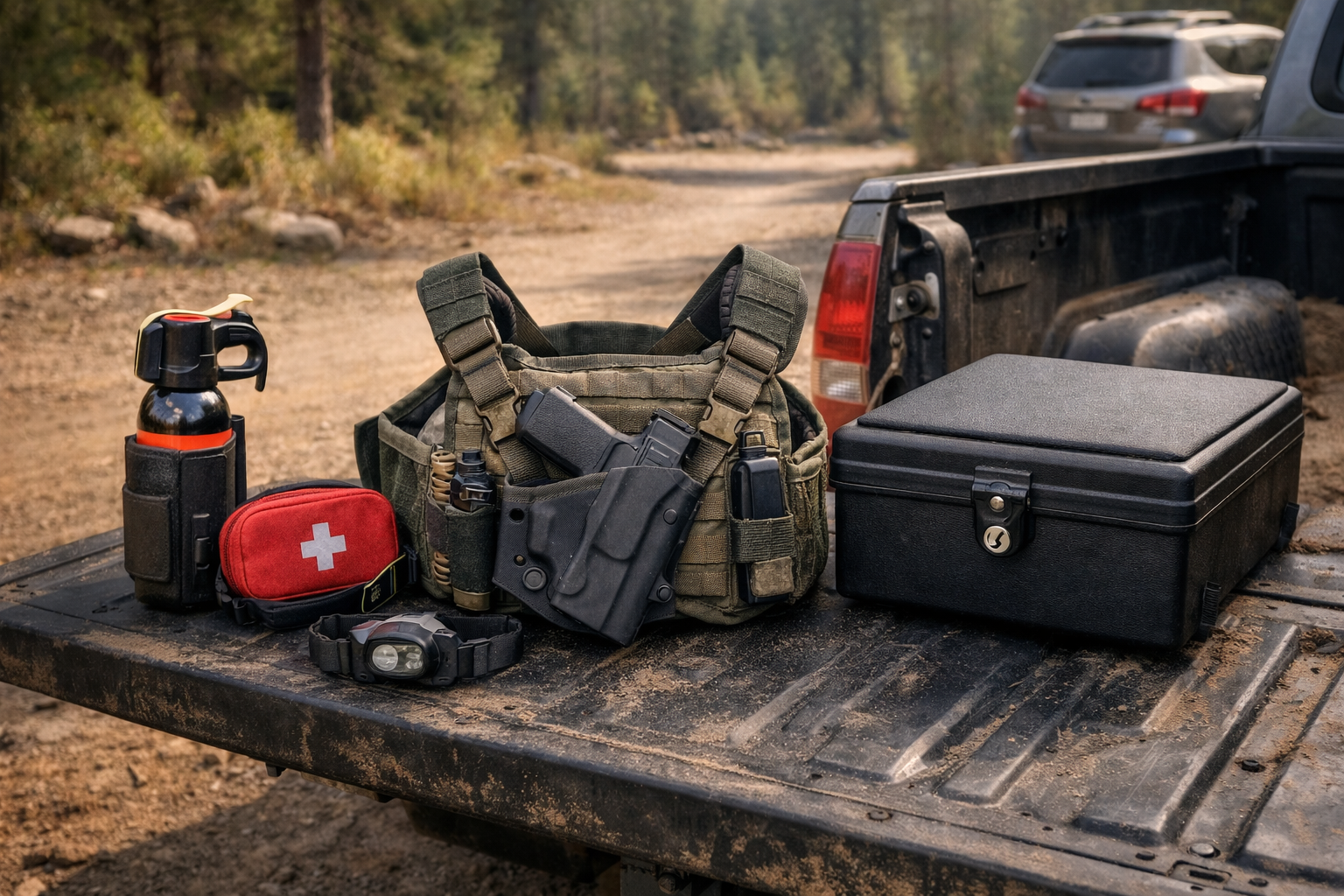
Truck Gun or Trail Gun? How to Set Up a Practical Backcountry Defensive Firearm (Legally and Safely)
This guide walks through a backcountry defensive firearm setup the way real outdoors people live it: packs that eat your beltline, sweat and rain that chew up gear, dusty trailheads, visitor centers with federal rules, and the uncomfortable truth that vehicle break-ins are a thing. We’ll cover threat profiles, trail carry vs camp carry vs truck storage, retention, weight, environmental exposure, and the legal “don’t be that guy” checklist—without turning it into intimidating internet cosplay.
Safety + legality note: This is educational, not legal advice. Laws vary by state, land manager, and even by specific facilities inside parks. Verify rules before you travel.
Quick Answer
A responsible backcountry defensive firearm setup is built around what you can carry comfortably and control safely—while tired, wet, cold, and distracted.
- Trail (on-body): If you’re wearing a backpack with a real hip belt, chest carry or pack-strap carry often beats belt carry because the beltline gets blocked.
- Bear country: Bear spray should be accessible (not buried). Many parks recommend bear spray and treat both bear spray and firearms as “last tools,” not confidence boosters.
- Vehicle storage: If it’s in a truck, lock it and anchor it. “Under the seat” isn’t storage; it’s a theft prize.
- Legality: National parks generally follow state possession laws, but firearms are prohibited in many federal facilities (visitor centers, ranger stations, etc.).
Bottom line: The best backcountry defensive firearm setup is the one you’ll actually carry, retain, and manage legally—with layered safety tools doing most of the heavy lifting before a firearm ever enters the conversation.
Quick View: Trail vs Camp vs Truck
| Use Case | Primary Problems | What Works Best | Common Failure |
|---|---|---|---|
| Trail carry | Pack blocks belt, sweat/rain, falls, brush | Chest/strap carry + strong retention + spray accessible | Belt holster pinned under hip belt |
| Camp carry | Kids/guests, darkness, “set it down” risk | On-body when awake; locked container when not | “It’s nearby” (until it isn’t) |
| Truck storage | Theft, heat/cold cycling, transport rules | Anchored lockbox/vault + out of sight | Vehicle break-in turns into stolen gun |
Why This Is Trending
More people are camping, overlanding, hiking, and fishing remote areas. As a result, search behavior has shifted from “should I prepare?” to “how do I do it responsibly?” That’s the right question—because the backcountry changes the math: you’re farther from help, more exposed to weather, and often stuck with a pack that makes “normal carry” less normal.
Meanwhile, the problem set is broader than wildlife. Isolation affects response time, trailheads attract opportunistic theft, and you can run into posted federal facilities inside otherwise legal areas.
Threat Profiles
Here’s the honest hierarchy: in most places, you’re more likely to deal with weather, injury, and navigation mistakes than a dramatic “attack.” However, wildlife and two-legged threats aren’t imaginary either. So the goal is to build a backcountry defensive firearm setup that fits reality, not fantasy.
1) Wildlife
In bear country, many parks recommend carrying bear spray and explicitly frame bear spray and firearms as “last tools” that shouldn’t create a false sense of security. That matters, because it pushes you toward prevention and accessibility—not just possession.
2) Two-Legged Problems
Most “human problems” are avoided with awareness, lighting, communication plans, and not telegraphing valuables. Still, you’re often alone, so your plan needs a final layer. That’s where a backcountry defensive firearm setup can fit—quietly and responsibly.
3) Medical
Falls happen. Sharp things exist. Rivers are cold. Your first aid and warmth layers may save you far more often than anything else you carry.
When cell service drops, your decision-making has to get better—not worse. Therefore, a smart setup includes a check-in plan and (if you’re frequently remote) a satellite messenger or PLB.
Layered Safety Stack
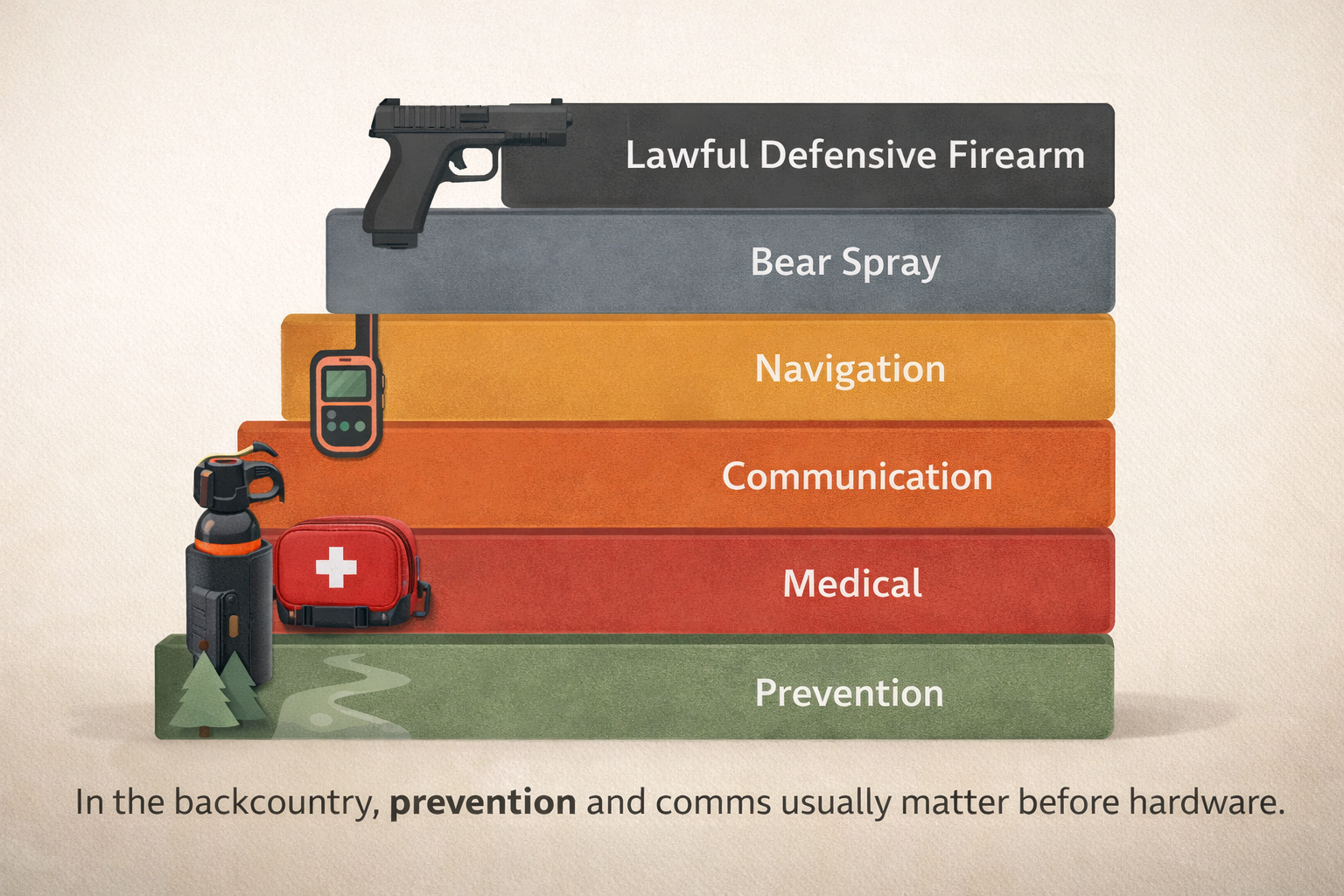
People want to talk about “truck gun vs trail gun,” but the smarter question is: “What layers reduce risk before anything goes sideways?” That’s why a responsible backcountry defensive firearm setup includes prevention, navigation, communication, medical, and non-lethal deterrence.
Definitions: Trail Gun vs Camp Gun vs Truck Gun
“Truck gun” and “trail gun” are different tools for different problems:
- Trail gun: On-body carry while moving away from the vehicle. Comfort, pack compatibility, and retention decide everything.
- Camp gun: The tool you may have around camp—where people, darkness, and distractions create unique safety risks.
- Truck gun: A firearm stored in a vehicle—where theft risk and transport rules dominate the conversation.
In other words, a backcountry defensive firearm setup changes shape based on where the firearm lives: on you, near you, or stored.
Backcountry Defensive Firearm Setup: Legal Basics
This is where people get burned—not because they’re malicious, but because they assume “public land” means “same rules.” It doesn’t.
National Parks: Possession vs Federal Facilities
The National Park Service explains that visitors may possess firearms within national park units if they comply with federal, state, and local laws. However, federal law prohibits firearms in many federal facilities (visitor centers, ranger stations, fee collection buildings, maintenance facilities, etc.), and those locations are posted.
Federal facilities are tied to federal law (18 U.S.C. § 930). Translation: you can be fine on the trail and still violate the rules by walking into a posted building.
National Forests and BLM Land: Allowed Until Restricted
USFS guidance generally states target shooting is allowed on national forests/grasslands unless restricted, and it emphasizes checking local forest orders and restrictions. BLM likewise emphasizes checking local offices for closures/restrictions and safety.
Fire Restrictions Can Affect Shooting Access
Seasonal fire restrictions can change what’s allowed quickly. That means your “normal” plan may need adjustment depending on local orders.
Park + Public Land Links You Should Actually Use
Bookmark these and you’ll avoid most “I didn’t know” problems:
- NPS: Firearms in National Parks (general): rules overview + federal facilities reminder.
- NPS: Bear Spray & Firearms: bear spray recommendation + “last tools” framing + park regulation warning.
- NPS FAQs (PDFs): plain-English Q&A used by parks.
- USFS: Shooting Sports & Ranges: baseline guidance + “check local restrictions.”
- BLM: Recreational Shooting: baseline guidance + local office checks.
- BLM: Fire Restrictions: for seasonal changes that can affect activities.
- Superintendent’s Compendium (example): rules can be park-specific; compendiums are where details live.
That’s not busywork. It’s how you keep a backcountry defensive firearm setup legal across different land managers and facilities.
Selection Criteria That Matter Outdoors
Backcountry gear lives in sweat, grit, and awkward positions. Therefore, what matters most is:
- Carry comfort: If it’s miserable, you’ll “just leave it in the truck.”
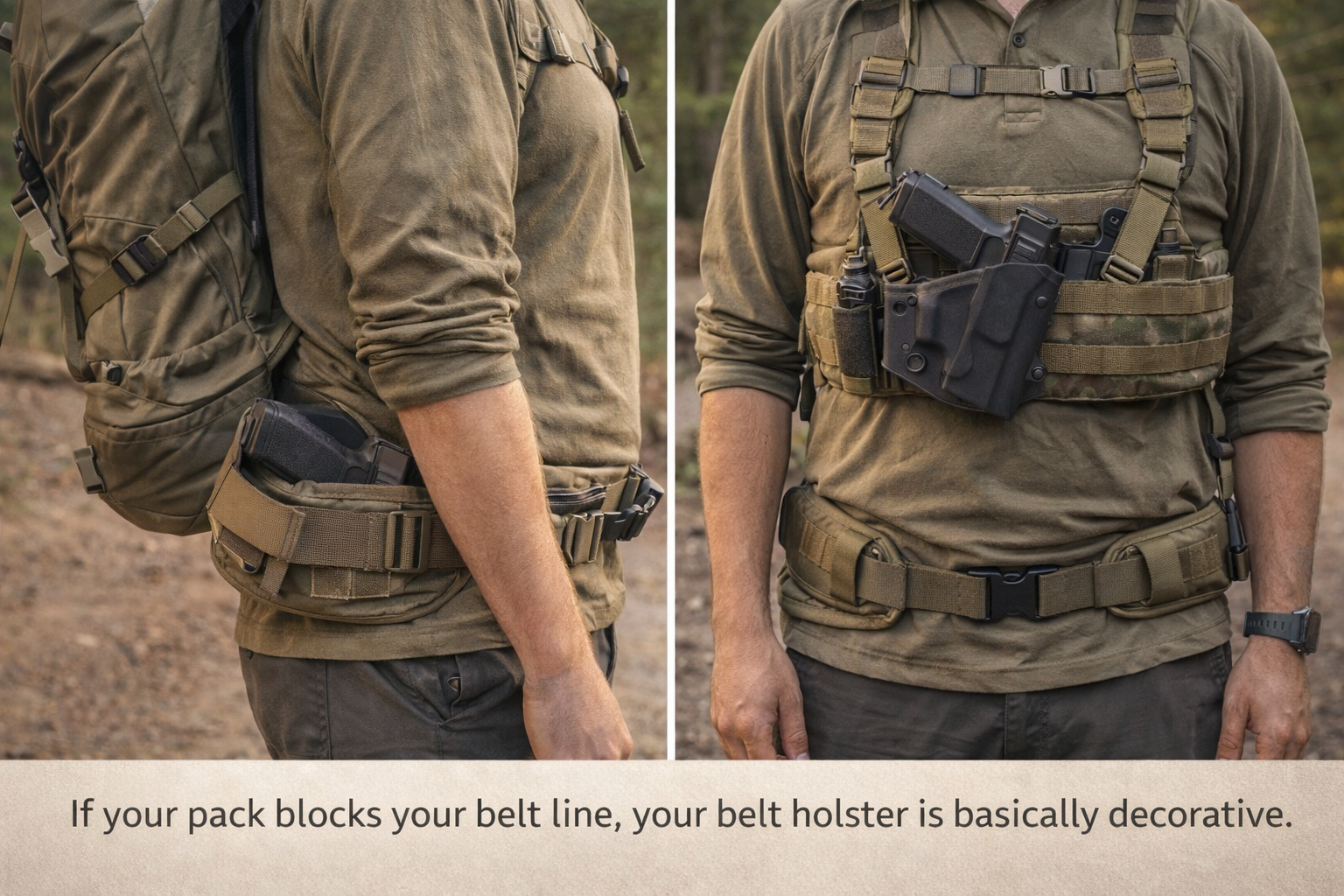
- Pack compatibility: Hip belts kill belt holsters. Test your actual pack.
- Retention + safety: Brush, falls, and climbing demand secure carry.
- Corrosion resistance: Sweat and rain don’t care about your feelings.
- Holster ecosystem: If you can’t get solid chest/strap carry options, your plan falls apart.
This is also where internet aesthetics die. A backcountry defensive firearm setup isn’t a photoshoot. It’s a system you can run when your hands are cold and you’re thinking about getting back before dark.
Backcountry Defensive Firearm Setup: Carry Methods That Work With Backpacks
Belt Carry
Belt carry can work on casual hikes with minimal pack interference. However, a real hip belt often blocks access and turns your draw into a wrestling match. Additionally, wet waist belts and layered clothing make reholstering less friendly. If you run belt carry, you must test it with your actual pack fully loaded.
Chest Carry
Chest carry stays accessible with a pack and keeps the tool out of the mud and brush more often. Consequently, it’s a common foundation for a backcountry defensive firearm setup that actually gets carried.
Pack-Strap Carry
Pack-strap carry can work if it’s stable and retained. Still, it can bounce, snag trekking poles, or shift under rain gear—so it needs testing and adjustment.
Carry Method Comparison
| Carry Method | Pack Friendly? | Retention Potential | Best For | Most Common Fail |
|---|---|---|---|---|
| Belt | Sometimes | High with good holster | Light packs / day hikes | Hip belt blocks access |
| Chest | Yes | High | Packs, waders, brush | Poor fit causes chafing |
| Pack strap | Yes | Medium–High | Minimalist setups | Bounce / snag issues |
| Off-body bag | Yes | Varies | Special cases | Set-down risk + slow access |
Retention Rules
In the backcountry you slip, crawl, climb, and get shoved by brush. So retention is not optional. A safe backcountry defensive firearm setup uses a holster that (1) covers the trigger guard fully, (2) retains the tool during movement, and (3) allows controlled access without gymnastics.
- Test retention: jog lightly, climb stairs, bend, kneel, crawl under something—does it shift or loosen?
- Test with layers: rain jacket, gloves, pack straps, chest strap, hip belt.
- Practice safe handling: reholstering should be controlled and deliberate—especially with cold hands.
Dust, Sweat, Rain, Mud: Weatherproofing + Maintenance
Outdoor carry is a constant corrosion and grit experiment. Therefore, the best plan is a simple one you’ll actually do:
- Wipe exterior contact points after each trip (sweat is salty).
- Dry straps/holsters completely (don’t store damp gear).
- Inspect hardware (screws loosen; straps wear).
- Keep a tiny “wipe-down kit” in your vehicle or gear bin.
That’s boring. Good. Boring is reliable.
Truck / Vehicle Storage
This is where “truck gun” ideas go to die—or become responsible. Gun theft from vehicles is widely discussed in both policy and firearms communities. Industry guidance encourages secure storage devices when temporarily leaving firearms in vehicles, emphasizing locked storage and keeping it hidden. Additionally, pro-2A commentary has highlighted how vehicle theft numbers can be misunderstood and politicized, while still underscoring that theft from vehicles is a real risk.
The One Rule
If it’s not on your body, it should be locked—and ideally anchored. Otherwise, you’re gambling that nobody notices your truck at the trailhead.
What “Good” Vehicle Storage Looks Like
- Rigid lockbox/vault (not flimsy)
- Anchored (bolted or robust cable)
- Out of sight
- Clear personal policy for loaded/unloaded that follows local law
Vehicle Storage Options Comparison
| Option | Theft Resistance | Access Speed | Best Use | Reality Check |
|---|---|---|---|---|
| Glove box / console | Low | Fast | Not recommended | Easy target in break-ins |
| Portable lockbox (not anchored) | Medium | Fast–Medium | Short stops | Can be stolen as a whole |
| Anchored lockbox | High | Fast–Medium | Trailheads / travel | Best practical balance |
| Vehicle vault system | Very High | Medium | Frequent travel / overlanding | Costs more, works more |
Note: If you plan to enter posted federal facilities (visitor centers, ranger stations), you need a legal “secure it before you walk in” plan.
Camp Storage
Camp introduces kids, guests, darkness, and distractions. Therefore, “it’s nearby” is not a plan.
- Awake + moving: on-body carry with retention.
- Sleeping / away from it: secured in a locked container.
- Night rule: if you can’t identify it, you can’t justify it—so prioritize light, comms, and awareness.
Accessibility: Mobility Limits, Pack Fit, and “Real Life” Constraints
This part matters and gets ignored online: some people can’t comfortably run belt carry, can’t twist easily, or can’t manage a heavy setup for hours. So a backcountry defensive firearm setup must match the person, not the comment section.
- Mobility limitations: chest carry is often easier to access than belt carry if bending/twisting is difficult.
- Pack fit: your setup has to work with your actual pack straps, sternum strap, and layers.
- Weight budget: if the setup forces you to leave it behind, it fails.
- Hands busy: trekking poles, fishing rods, dog leash—access and retention both matter more.
Setup Recipes
These are patterns, not prescriptions. Adjust for local law, experience, and environment.
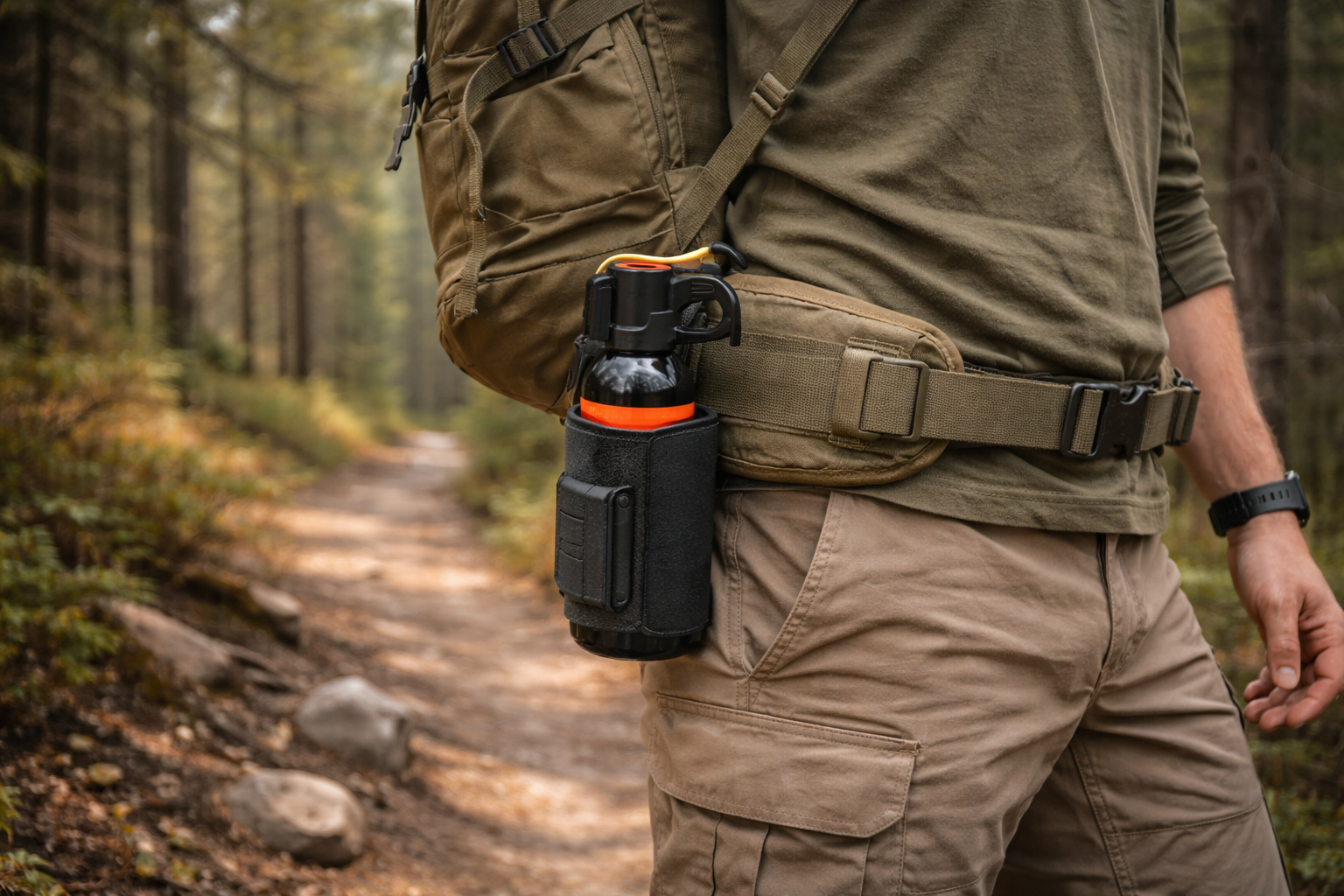
Recipe 1: Day Hike in Bear Country
- Bear spray in quick-access holster (primary deterrent)
- Navigation + backup nav
- Comms plan (sat messenger if frequently remote)
- Medical + warmth layer
- Trail firearm carried chest/strap with secure retention
Recipe 2: Overlanding + Remote Trailheads
- Anchored lockbox/vault in vehicle
- On-body option for outside-vehicle movement
- Lighting tools for trailhead transitions
- Clear legal plan for facilities + state lines
Recipe 3: Remote Riverbank Fishing
- Water-friendly carry placement (chest often wins)
- Holster that won’t become a mud bucket
- Bear spray reachable
- Simple post-trip wipe-down routine
The pattern is consistent: prevention, comms, medical, non-lethal, then firearm. That’s a grounded backcountry defensive firearm setup.
Pros & Cons
✅ Pros
|
❌ Cons
|
FAQs
Does “backcountry defensive firearm setup” mean I should bring a gun everywhere?
No. It means if you choose to carry, you do it legally, safely, and as part of a layered plan. In many situations, prevention, awareness, communication, and non-lethal tools solve the real problems first.
Can I carry in a national park?
In general, the NPS explains possession follows federal, state, and local law. However, firearms are prohibited in many posted federal facilities (visitor centers, ranger stations, etc.). Plan accordingly.
Why all the focus on lockboxes?
Because theft from vehicles is a known risk discussed across firearms and policy communities. Responsible storage protects your rights and prevents stolen guns from entering criminal pipelines.
What’s the best carry method with a backpack?
For many people, chest carry is the most pack-friendly. Belt carry can work on light hikes, but hip belts often block access.
Final Verdict
A responsible backcountry defensive firearm setup isn’t about looking cool. It’s about staying legal, keeping tools accessible, retaining them safely in real terrain, and securing them when they’re off-body. If your plan doesn’t include park facility rules and vehicle theft prevention, it’s incomplete.
One-sentence rule: Carry what you can carry all day, secure what you can’t, and verify the rules before you roll.
Sources
- NPS – Firearms in National Parks (possession + federal facilities): NPS article
- NPS – Bear Spray & Firearms (“last tools,” some parks restrict spray): NPS article
- 18 U.S.C. § 930 (federal facilities weapons law): Cornell LII
- NPS Fact Sheet (2010) – firearms prohibited signage in federal facilities: NPS PDF
- NPS Firearms FAQ (park PDF example): NPS PDF
- USFS – Shooting Sports & Ranges (allowed unless restricted; check local orders): USFS page
- BLM – Recreational Shooting (closures/restrictions; check local office): BLM page
- BLM – Fire Restrictions (seasonal restrictions impacting activities): BLM page
- NSSF – Storing Firearms in Your Vehicle Responsibly (secure storage guidance): NSSF article
- NSSF – Vehicle secure storage PSA announcement: NSSF article
- CrimeResearch.org – analysis/discussion of vehicle gun theft claims (pro-2A): CrimeResearch.org
- Ammoland – vehicle lockbox policy discussion + theft as a national problem: Ammoland
- DOJ – Safe Storage of Firearms (lock box notes; general guidance PDF): DOJ PDF
- Guntalk – truck gun considerations (security/storage emphasis): GunTalk