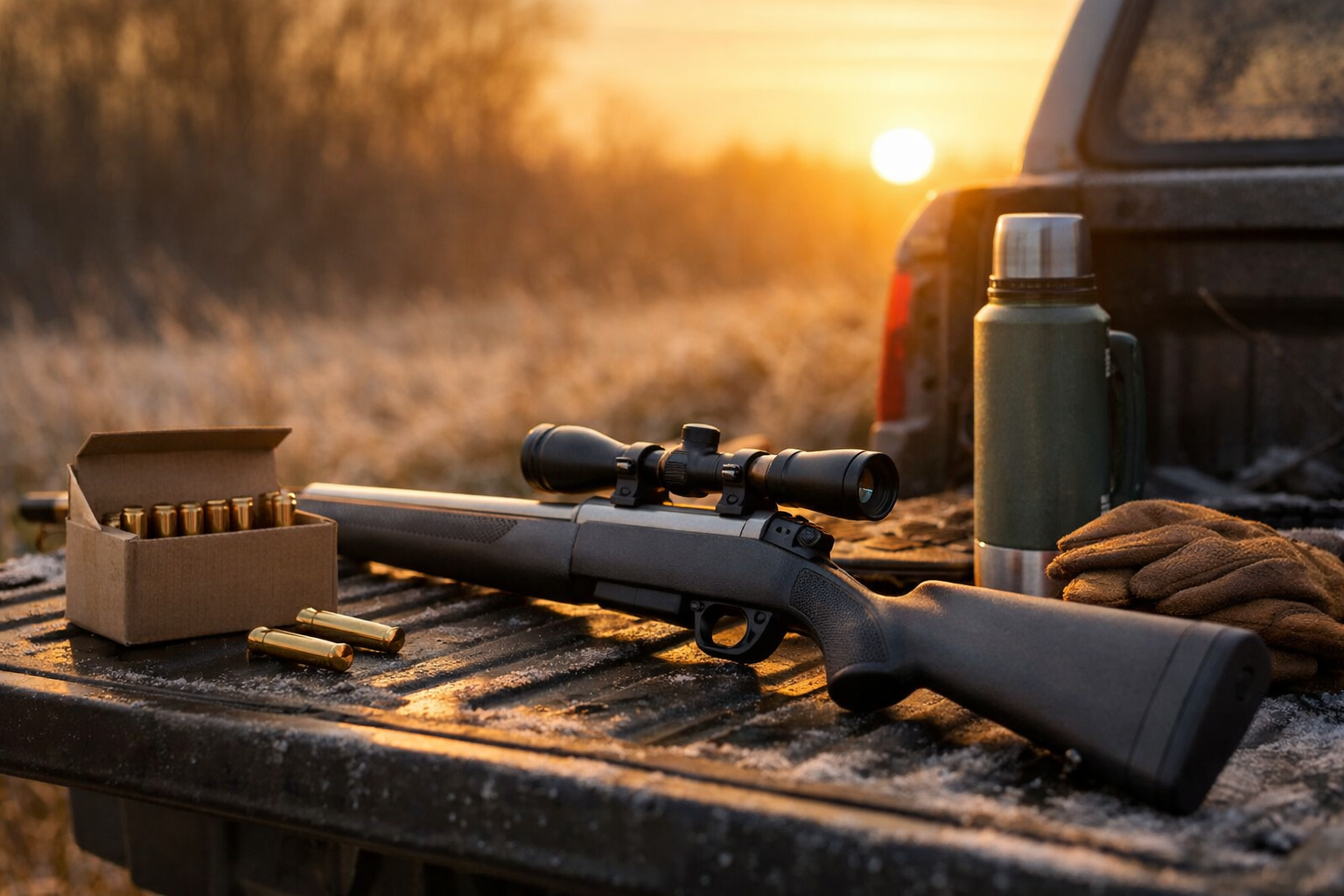
Slug guns still work. They’ve always worked. But in 2026, more deer camps are swapping
heavy, thumpy shotguns for lighter, easier-shooting straight-wall rifles—and they’re doing it
because it flat-out helps real hunters shoot better, practice more, and recover more deer.
Let’s break down real ballistic performance, recoil, effective range, and the rifle/optic setups
that actually make a difference.
Always verify your local rules before buying ammo or sighting in. I’m going to cite the relevant agency/manufacturer pages in the Sources section,
but your final authority is the current regulation where you hunt.
Quick Answer: the best straight wall cartridge for deer hunting
If you want one straight-wall cartridge that’s easy to shoot, widely available, accurate in lightweight rifles,
and plenty for typical Midwest deer distances, it’s hard to beat .350 Legend.
It’s the “practice more, flinch less, kill clean” option for the most people—especially adult-onset hunters and anyone tired of slug-gun punishment.
When I’d choose something else:
• Want more frontal area and heavy thump inside 200? .450 Bushmaster.
• Want lever-gun vibes with modern straight-wall legality? .360 Buckhammer (where legal).
• Hunting thick timber and you already own it? .45-70 still hits like a dump truck—just accept more recoil and rainbow trajectory.
with an ethical zero, and with enough confidence that you don’t yank the shot when a buck finally shows up.
Comfort and consistency beat “bigger number” every single season.
Why this is trending in 2026
This shift isn’t happening because deer suddenly evolved into armor-plated elk. It’s happening because
rules changed, gear improved, and hunters got honest about recoil.
The Midwest created “shotgun / muzzleloader / straight-wall” cultures for safety and range management.
But modern straight-wall rifles bring something slug guns never did:
rifle ergonomics + practical accuracy + manageable recoil in a lighter package.
1) Rules opened the door
Illinois now allows single-shot rifles for deer (effective Jan. 1, 2023), including straight-walled
centerfire cartridges of .30 caliber or larger, with additional criteria spelled out by IDNR. (If you hunt Illinois, read that page twice and don’t “assume.”)
Indiana expanded legal deer rifles on both public and private land: rifles firing bullets
5.56mm (.219″) or larger are permitted for deer (per Indiana DNR’s deer equipment page), which is a big deal for how many “rifle-style” setups become reasonable for new hunters.
Michigan’s Limited Firearm Zone uses a straight-walled case length window (1.16″ to 1.80″)
and even provides example cartridges that fit, including modern straight-walls and classic big-bores.
Ohio specifies straight-walled cartridge rifles from .357 to .50 and limits shotguns and straight-wall rifles to three shells total loaded.
cartridges with more controlled range profiles than high-velocity bottlenecks—then manufacturers responded with purpose-built deer rounds.
2) The slug gun got tired of being everyone’s chiropractor
A 12-gauge slug will absolutely kill deer. It will also absolutely convince some folks to stop practicing after
three rounds. That’s not a character flaw; it’s physics and pain tolerance.
The “new” deer camp logic goes like this:
- Practice is part of ethics. If recoil prevents practice, you’re borrowing trouble.
- Accuracy is comfort. A calmer shooter makes better decisions under adrenaline.
- Lightweight rifles aren’t just for hiking. They’re for aging shoulders, beginners, and anybody who wants to shoot well all day.
3) New hunters want a setup that doesn’t feel like punishment
More adult-onset hunters are stepping into the woods with limited time and a “please don’t bruise me” preference.
They want simple optics, simple ammo, and a rifle they’ll actually shoot.
Straight-wall rifles check those boxes. They’re not “better than everything.”
They’re better than the alternative for a whole lot of real-world hunters.
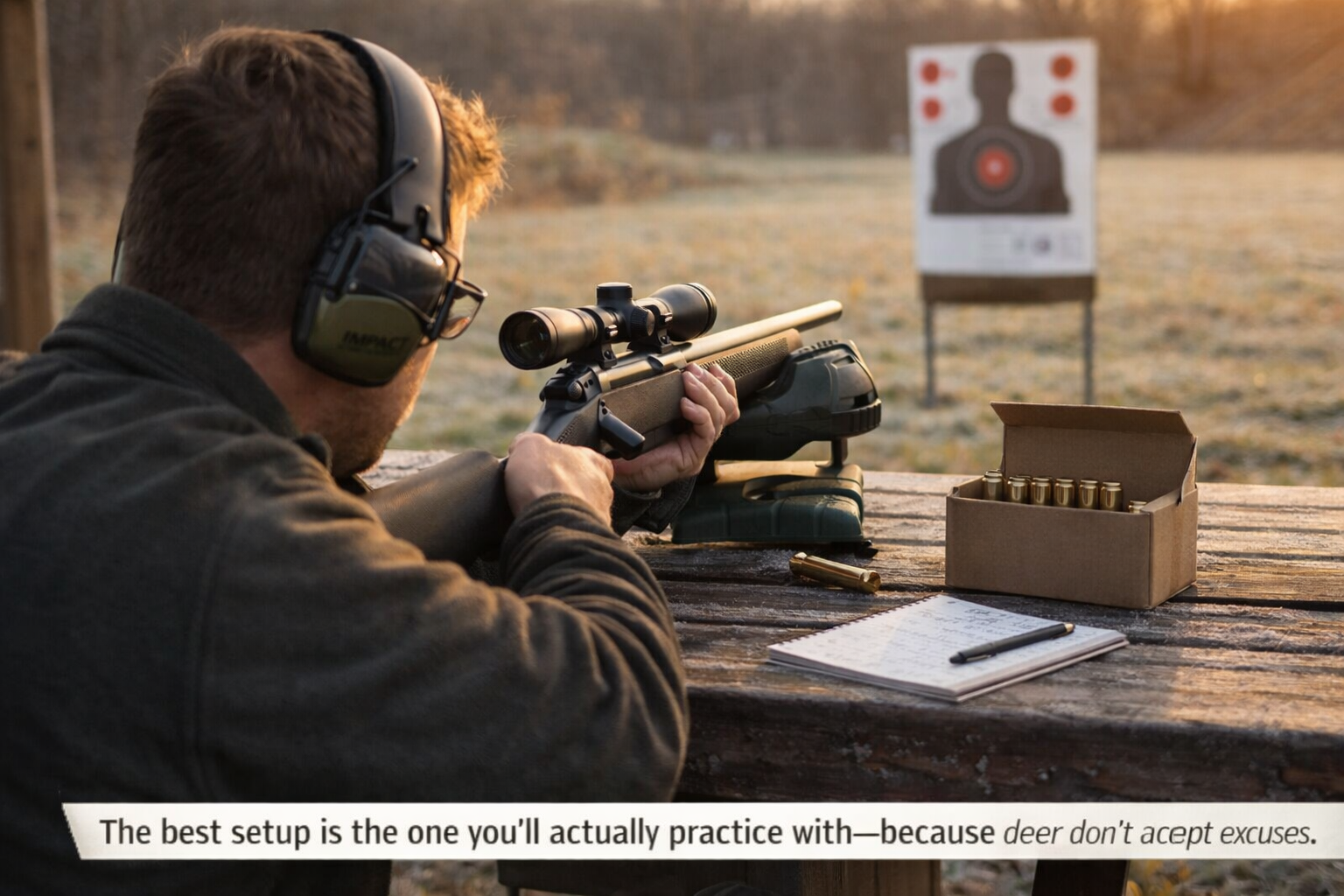
Straight-wall 101: what it is, what it isn’t
A “straight-wall” cartridge case has little to no taper compared to classic bottleneck rifle cartridges.
The case diameter stays relatively consistent from base to mouth.
That design tends to pair with:
- Moderate velocities (compared to bottlenecks) and heavier bullets
- Steeper trajectories at distance (more “rainbow” than “laser”) — though modern straight-walls are flatter than old-school slugs
- Effective performance inside practical whitetail ranges when paired with the right bullet and good placement
Some states define it by caliber, some by case length windows, some by both, and some by equipment type.
Don’t buy ammo based on a Facebook comment. That way lies regret.
Why states like straight-walls
It’s not because they hate fun. It’s about managing range and risk in flatter farmland, mixed-use areas, and higher hunter density.
Straight-walls, generally speaking, reduce the incentive (and practical ability) to take long shots compared to high-velocity bottleneck cartridges.
That supports safety planning and aligns with typical Midwest deer distances.
Why hunters like straight-walls
In a modern rifle platform, straight-walls give you:
better triggers, better ergonomics, better optics mounting, and often
better practical accuracy than many “rifled slug gun” setups—especially for newer hunters.
Midwest rules snapshot: the door that got kicked open
I’m not going to paste full regulations here (they change, they’re long, and nobody wants a blog that reads like a DMV form).
But here are the rule shapes that explain the trend:
Illinois: single-shot rifles + defined cartridge criteria
Illinois IDNR’s FAQ explains that Public Act 102-0932 is effective Jan. 1, 2023 and lays out legal rifle caliber categories,
including straight-walled centerfire cartridges .30 caliber or larger (plus additional requirements like factory availability and published energy at the muzzle).
Indiana: rifles 5.56mm/.219″ and up, public + private
Indiana DNR states that deer hunters may use rifles with bullets 5.56mm (.219″) or larger on both public and private land,
which is a major expansion in practical rifle options for deer seasons.
Michigan: case length windows in the Limited Firearm Zone
Michigan’s Limited Firearm Zone allows straight-walled cartridges .35 caliber or larger with a case length between 1.16″ and 1.80″,
and provides example cartridges that fit that window.
Ohio: straight-walls .357–.50, plus a 3-round loading limit
Ohio’s hunting regulations list straight-walled cartridge rifles from .357 to .50 (including .350 Legend),
and specify that shotguns and straight-wall rifles can be loaded with no more than three shells total in chamber + magazine combined.
And once you’ve hunted with a 6.5–7.5 lb rifle that you can actually carry all day,
it’s hard to get excited about hauling a heavy slug cannon unless you really love shoulder soreness.
The modern straight-wall shortlist
Straight-wall deer hunting in 2026 mostly revolves around a handful of cartridges.
Some are “new-school,” some are “grandpa’s lever gun,” and a few are basically “slug gun replacement with better manners.”
Here’s what matters for whitetails: bullet construction, impact velocity at typical ranges, recoil in real rifles, and trajectory you can manage under stress.
.350 Legend: the balanced workhorse
The .350 Legend is popular because it’s shootable.
Factory loads are designed for deer, rifles are common, and recoil is typically noticeably milder than big-bore straight-walls.
Hornady’s 150 gr InterLock Black load, for example, lists muzzle velocity 2500 fps and includes downrange velocity/energy/trajectory data from a 24″ test barrel.
Who it’s for
- New hunters who want confidence without flinch
- Anyone hunting mixed woods/edges inside ~200 yards
- Hunters who value practice as much as “the moment”
.360 Buckhammer: lever-gun energy with straight-wall legality
The .360 Buckhammer was built with straight-wall seasons in mind and pairs naturally with lever actions and handy carbines.
Federal lists a 180 gr Power-Shok load at 2375 fps and provides specs including ballistic coefficient.
The appeal is simple: classic handling, modern legality (where it fits your state’s definition), and deer-appropriate bullet weights.
Who it’s for
- Hunters who want a compact lever rifle that carries like a dream
- Woods and brush country where shots are often under 150–200 yards
- Folks who love quick follow-ups and simple manual of arms
.450 Bushmaster: the sledgehammer
.450 Bushmaster brings big frontal area and heavy energy at close-to-mid distances.
Hornady’s 250 gr FTX Black load lists 2200 fps muzzle velocity and provides trajectory/energy to 300 yards.
This cartridge can be an excellent choice when you expect closer shots and want more “authority” on impact—but you need to respect recoil, especially in lightweight rifles.
Who it’s for
- Hunters who prioritize heavy impact at typical straight-wall distances
- Those comfortable with more recoil (or who choose a heavier rifle / better recoil pad)
- Thick cover deer where quick anchoring matters
.45-70 Government: timeless, powerful, and not subtle
The .45-70 is the “old soul with a new driver’s license.” It has serious power, many bullet options,
and lever-action rifles that handle beautifully in timber.
Hornady’s 325 gr FTX LEVERevolution load lists 2000 fps at the muzzle and publishes downrange velocity/energy/trajectory to 300 yards.
The tradeoff is trajectory and recoil—especially if you go light on rifle weight.
Who it’s for
- Hunters who love lever guns and want a proven big-bore
- Woods hunters who keep ranges realistic
- Anyone who says “I don’t need flat… I need effective” and actually means it
Honorable mentions
- .44 Magnum (in rifles) — surprisingly effective at close ranges with proper bullets; trajectory is steeper
- .357 Magnum (in rifles) — very shootable; best for closer woods distances and disciplined shot placement
- 12-gauge slugs — still a valid baseline, especially where rifles aren’t allowed; modern slug loads publish solid trajectory tables
It might widen the “margin” a little, but it does not replace practice, patience, or picking the right angle.
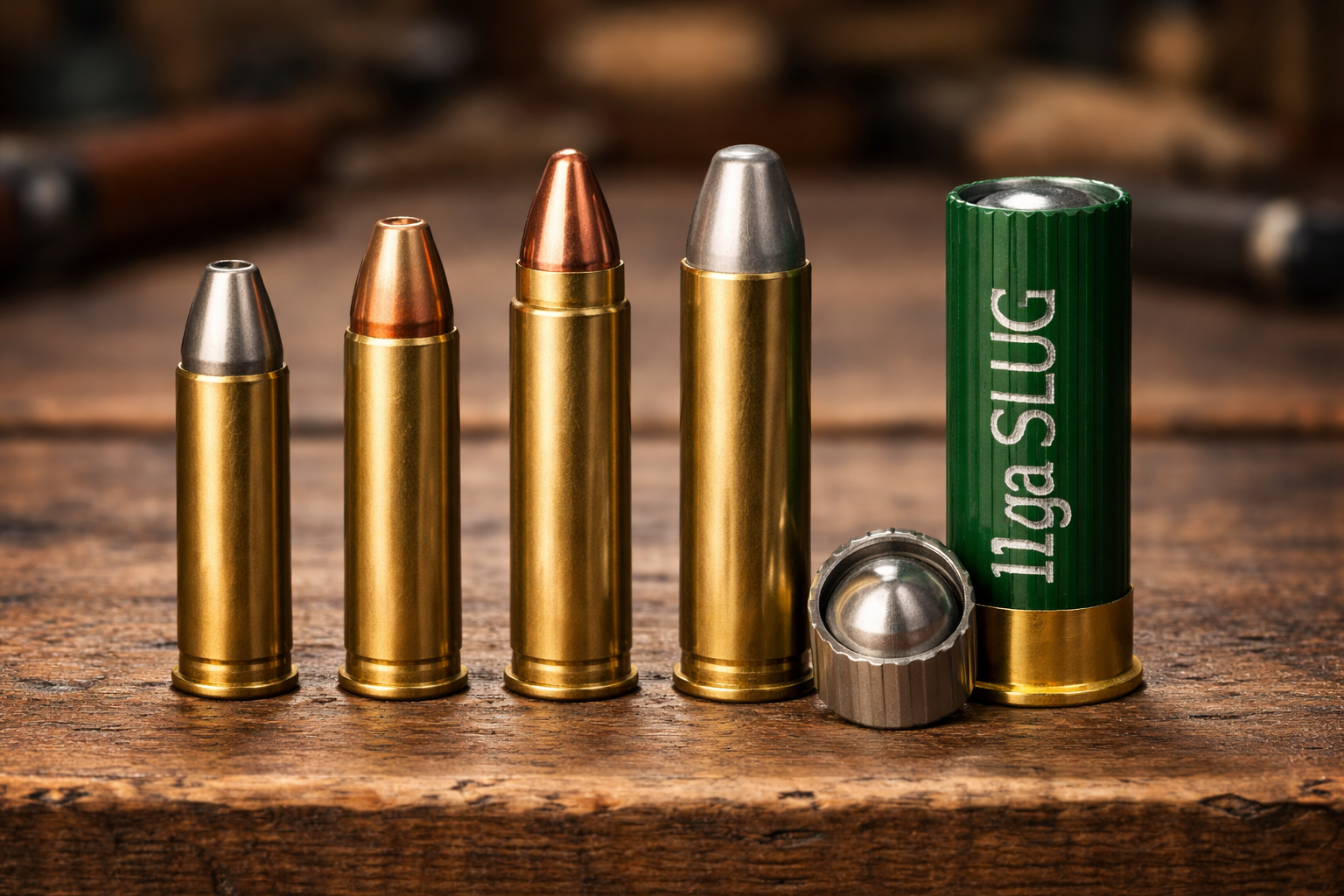
Real-world ballistics: velocity, energy, trajectory, and what matters
Let’s say the quiet part out loud: most deer are killed inside distances where your heartbeat is the biggest ballistic variable.
But ballistics still matter—because they shape your holdover, your bullet performance,
and your confidence.
The 3 ballistic numbers that actually matter in the field
- Trajectory you can manage under adrenaline (simple holds beat complicated math).
- Impact velocity in your typical distance band (bullets are designed to expand within certain speed windows).
- Your hit probability from real positions (kneeling, leaning on a tree, shooting sticks, blind window).
What matters is what the bullet is doing at the distance you actually shoot—and whether you can put it in the boiler room every time.
Side-by-side factory ballistics
These are example factory tables from manufacturers (see Sources).
Different loads can vary—this is to show the shape of performance, not to crown a single brand as king of the woods.
| Cartridge / Load (example) | Test barrel | Muzzle (fps / ft-lb / traj) | 100 yd (fps / ft-lb / traj) | 200 yd (fps / ft-lb / traj) | 300 yd (fps / ft-lb / traj) | What it means in plain English |
|---|---|---|---|---|---|---|
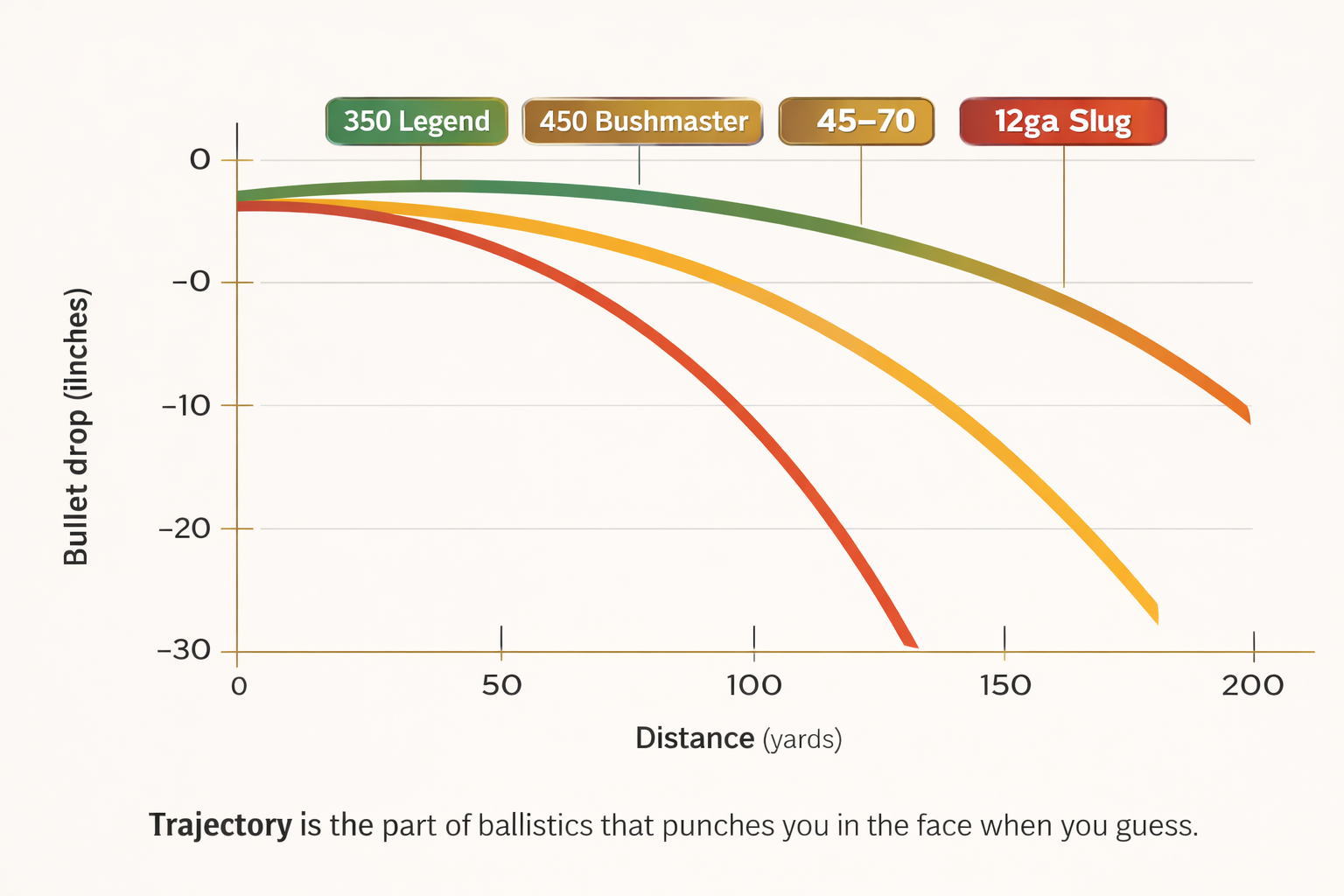
| .350 Legend (150 gr InterLock, Hornady BLACK) | 24″ | 2500 / 2082 / -1.5″ | 2069 / 1425 / +3.4″ | 1686 / 946 / 0″ | 1364 / 620 / -15.8″ | Flat enough for a simple 200-yd zero. Mild recoil encourages practice. Keep range honest; holds at 250–300 matter. |
| .450 Bushmaster (250 gr FTX, Hornady BLACK) | 20″ | 2200 / 2687 / -2.4″ | 1835 / 1868 / +4.1″ | 1515 / 1274 / 0″ | 1255 / 874 / -19.3″ | More energy and bigger frontal area, but more recoil. Trajectory drops faster past 200—don’t “wing it.” |
| .45-70 Govt (325 gr FTX, Hornady LEVERevolution) | 24″ | 2000 / 2886 / -1.5″ | 1685 / 2049 / +5.5″ | 1413 / 1441 / 0″ | 1197 / 1035 / -23″ | Serious punch, classic lever-gun vibe. Great inside 200; at 250–300 you must know your drops and your limits. |
Slug baseline
Hornady’s standard ballistics chart includes shotgun slug trajectories and energies.
Here’s the 12-ga 300 gr SST 2¾” slug example (zero/trajectory table as published by Hornady).
| Load (example) | Muzzle | 50 yd | 100 yd | 150 yd | 200 yd | Reality in the woods |
|---|---|---|---|---|---|---|
| 12 GA SST 2¾” 300 gr FTX | 2000 fps / 2664 ft-lb / -1.5″ | 1814 / 2192 / +1.9″ | 1641 / 1795 / +2.6″ | 1483 / 1465 / 0″ | 1342 / 1199 / -6.5″ | Modern slugs can shoot well, but recoil is still real. Many hunters simply shoot rifles more accurately than slug guns. |
The difference is less about “can it kill” and more about “can you shoot it well repeatedly.”
Effective range: ethical distance is about hits, not internet arguments
“Effective range” isn’t a magic number stamped on a cartridge.
It’s a moving target based on:
- Your accuracy from field positions
- Your ability to judge distance (or use a rangefinder responsibly)
- Wind, angles, and buck fever
- Bullet performance at the impact velocity you’ll actually see
A better definition: your “6-inch guarantee distance”
The heart/lung vital zone on a whitetail is roughly “paper plate” size (give or take, depending on deer size and angle).
In practical terms, a lot of hunters do best when they define a personal standard like:
Only take shots at distances where you can keep every realistic shot (cold barrel, hunting clothes, field rest)
inside a 6-inch circle at that distance on demand.
Where straight-walls usually live
Most straight-wall deer success happens in the 50–200 yard world:
tree lines, creek bottoms, timber edges, CRP breaks, and those “I can’t believe that’s a deer” moments at last light.
Yes, some straight-wall setups can reach farther in skilled hands.
But the trend isn’t “shoot farther.” The trend is “shoot better.”
Energy: use it as context, not as a superstition
You’ll hear rules like “1,000 ft-lb for deer.”
Here’s the problem: deer are killed cleanly every season with arrows and bullets carrying less energy than that.
Energy matters, but it’s not the only lever. Bullet design and placement matter more.
Use energy to understand the cartridge’s “feel” and margin—then make your ethical choice based on what you can hit.
If you can’t call your shot and you can’t explain your hold, your range is too far. Period.
Recoil comparison: the math + the “feel”
Recoil is the reason this whole blog exists.
Not because hunters are weak. Because human nervous systems do what they do.
If your rifle teaches your brain to brace, your groups open up, your confidence drops, and your practice sessions get shorter.
A deer cartridge that you enjoy shooting is a deer cartridge you get good with.
Free recoil: approximate comparison
The table below shows approximate free recoil energy in foot-pounds for representative loads in common hunting rifle weights.
Real recoil varies with stock design, recoil pads, muzzle devices, suppressors (where legal), and how you hold the rifle.
But this is a good “shape of reality” snapshot.
| Load (representative) | 6.5 lb rifle | 7.5 lb rifle | 8.5 lb rifle | 9.0 lb rifle | What you’ll notice |
|---|---|---|---|---|---|
| .350 Legend (150gr @ ~2500) | ~10.8 ft-lb | ~9.4 ft-lb | ~8.3 ft-lb | ~7.8 ft-lb | Very manageable for most hunters; practice-friendly. Great “no flinch” trainer. |
| .360 Buckhammer (180gr @ ~2375) | ~18.4 ft-lb | ~15.9 ft-lb | ~14.0 ft-lb | ~13.2 ft-lb | Noticeably more push than .350; still controllable, especially in lever guns with good pads. |
| .450 Bushmaster (250gr @ ~2200) | ~26.4 ft-lb | ~22.9 ft-lb | ~20.2 ft-lb | ~19.0 ft-lb | Big push; some shooters develop flinch quickly in light rifles. Weight + pad helps a lot. |
| .45-70 Govt (325gr @ ~2000) | ~34.8 ft-lb | ~30.2 ft-lb | ~26.6 ft-lb | ~25.0 ft-lb | Classic thump. Not “unmanageable,” but it will punish sloppy fundamentals and thin recoil pads. |
| 12ga slug (300gr @ ~2000) | ~31.8 ft-lb | ~27.5 ft-lb | ~24.3 ft-lb | ~22.9 ft-lb | Heavy recoil + different ergonomics. Many hunters shoot rifles better for the same money and effort. |
Why recoil feels different than the number
- Stock geometry: A comb that slaps your face makes recoil feel worse than it is.
- Recoil pad quality: A good pad can make a “never again” rifle into an “okay, one more group” rifle.
- Rifle weight distribution: A rifle that balances well often feels calmer in recoil.
- Muzzle devices / suppressors: Where legal and appropriate, these can dramatically reduce felt recoil and improve practice volume.
Straight-walls thrive because they let more hunters practice without hating life.
Lightweight rifles: the sweet spot
Lightweight rifles are taking over for two reasons:
comfort and mobility.
But there’s a trap: a rifle can get so light that it becomes hard to shoot well.
That’s especially true with bigger straight-walls.
The sweet spot by cartridge
| Cartridge | “Carry all day” rifle weight (bare) | “Shoot all day” rifle weight (with optic) | Why |
|---|---|---|---|
| .350 Legend | ~6.0–7.0 lb | ~7.0–8.0 lb | Mild recoil; lightweight rifles remain controllable and practice-friendly. |
| .360 Buckhammer | ~6.5–7.5 lb | ~7.5–8.5 lb | More recoil than .350; a little weight improves follow-up shots and comfort. |
| .450 Bushmaster | ~7.0–8.0 lb | ~8.0–9.5 lb | Going too light gets punishing fast; weight + pad = better accuracy for most shooters. |
| .45-70 | ~7.0–8.0 lb | ~8.5–10.0 lb | Big-bore recoil rewards a steadier platform. Lightweight + big-bore can become a flinch factory. |
Rifle features that matter more than brand
- Trigger you can control: clean break, consistent pull, no surprises
- Stock fit: proper length of pull, comb height that matches your optic, pad that isn’t a brick
- Balance: a rifle that points naturally is easier to shoot quickly and safely
- Simple magazine / loading: don’t let your gear become a puzzle at sunrise
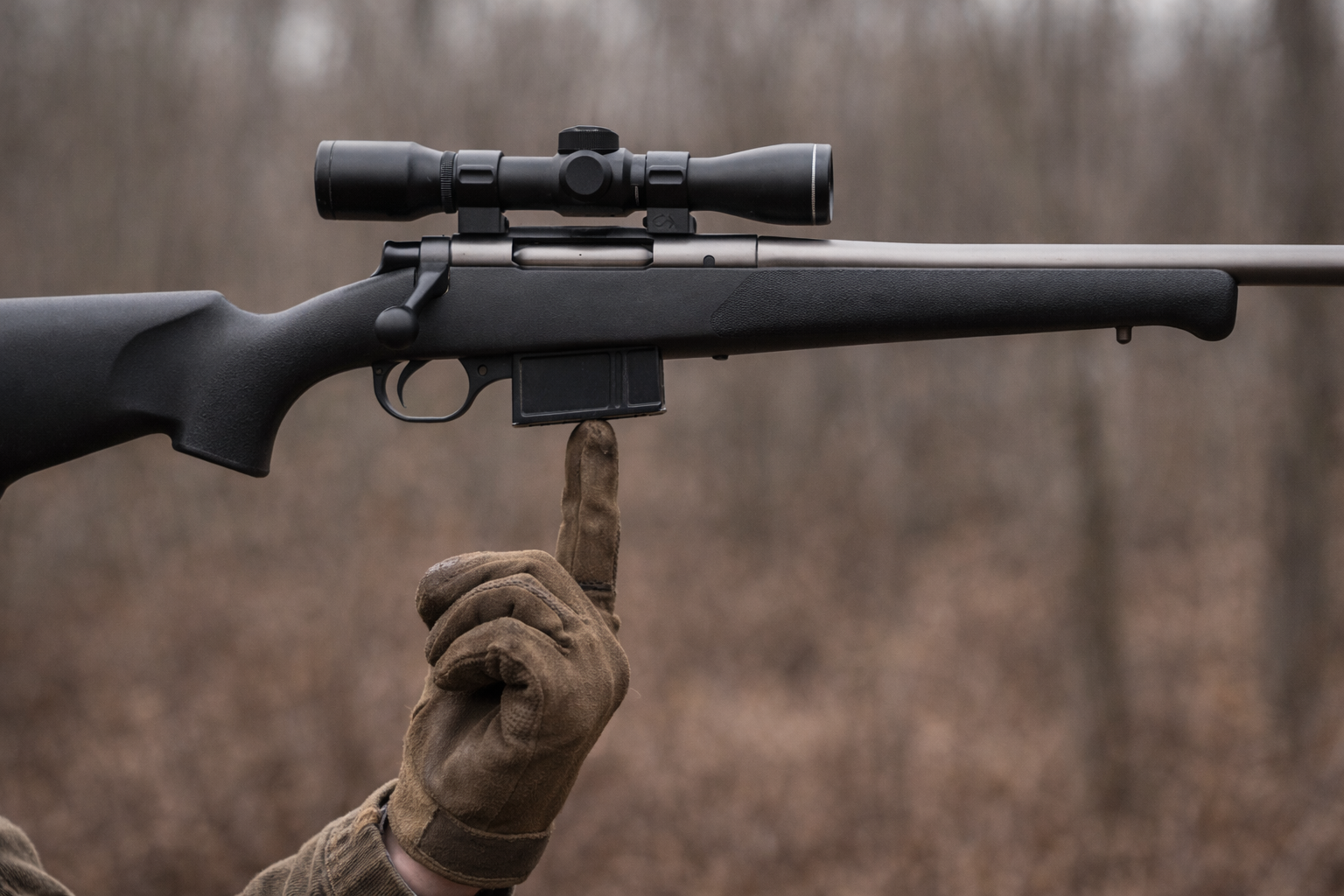
you didn’t buy a hunting rifle—you bought a shoulder-training device. Pick weight you can live with.
Optics choice: red dots, LPVOs, and simple hunting scopes
Straight-wall rifles didn’t “replace slugs” by accident.
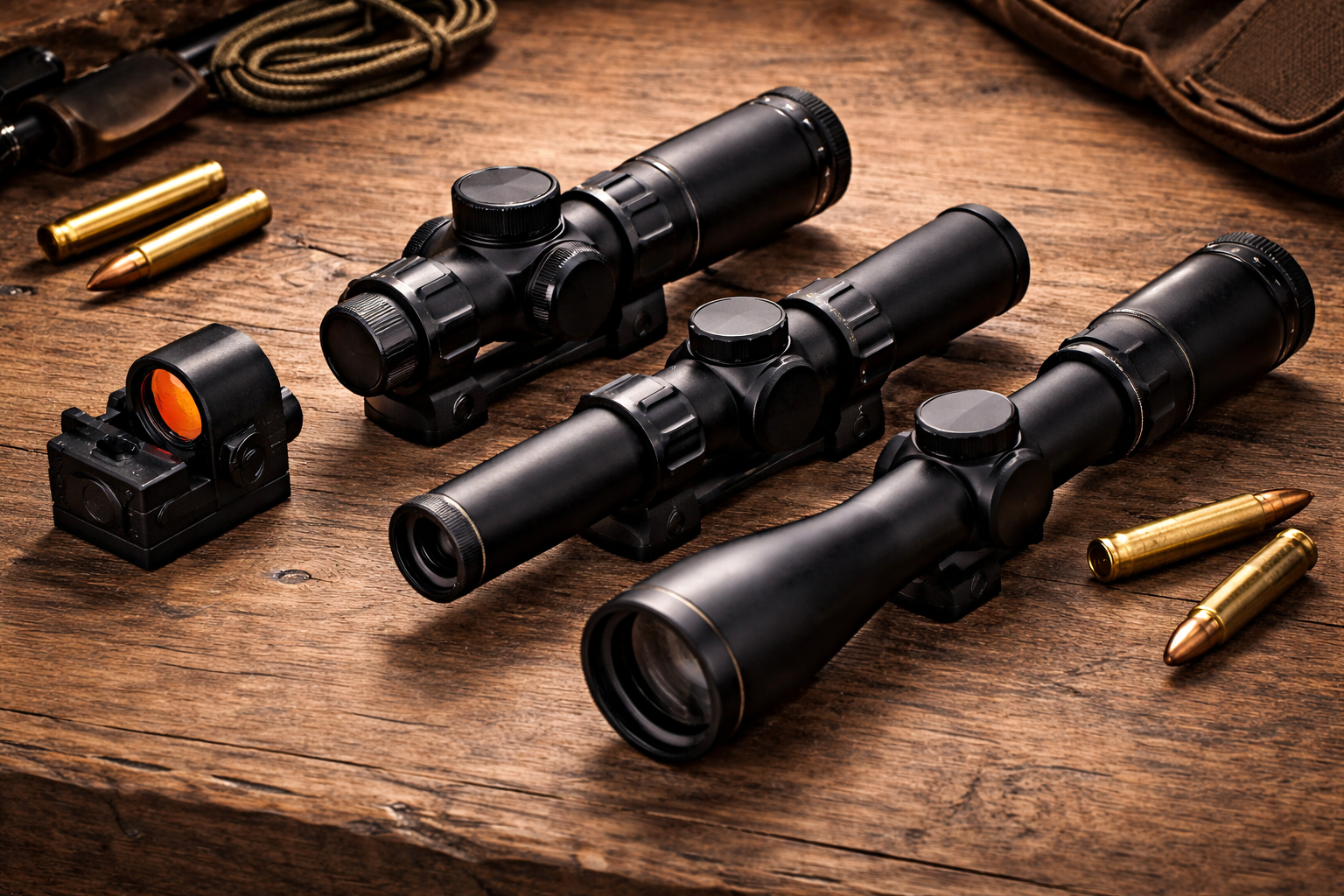
A big part of the shift is that modern rifles make optics mounting easy—and optics make hunters better.
Especially new hunters.
Option A: red dot (fast, forgiving, perfect for woods)
If your shots are mostly inside 125–150 yards and your priority is speed and simplicity,
a quality red dot can be an excellent choice.
Keep brightness appropriate, confirm zero, and learn what “dot wobble” looks like when you’re excited.
Option B: 1–4x or 1–6x LPVO (do-everything Midwest tool)
LPVOs shine for mixed woods and field edges:
1x for quick shots, a little magnification for a precise hold.
If you hunt with a straight-wall and you want one optic that does it all, this category is hard to argue against.
Option C: classic 2–7x or 3–9x hunting scope (still the king of “easy”)
For many hunters, a simple hunting scope is the easiest path to confidence.
Pick a reticle you can see at dawn, keep it lightweight, and don’t over-magnify your life.
That means your optic should prioritize speed and clarity, not long-range turret wizardry.
Shot placement with straight-walls: angles, vitals, and tracking reality
Straight-wall cartridges are great deer tools—inside the distances they were designed to live.
But they are still bullets, and deer are still animals.
That means shot placement and angle discipline matter more than the headstamp.
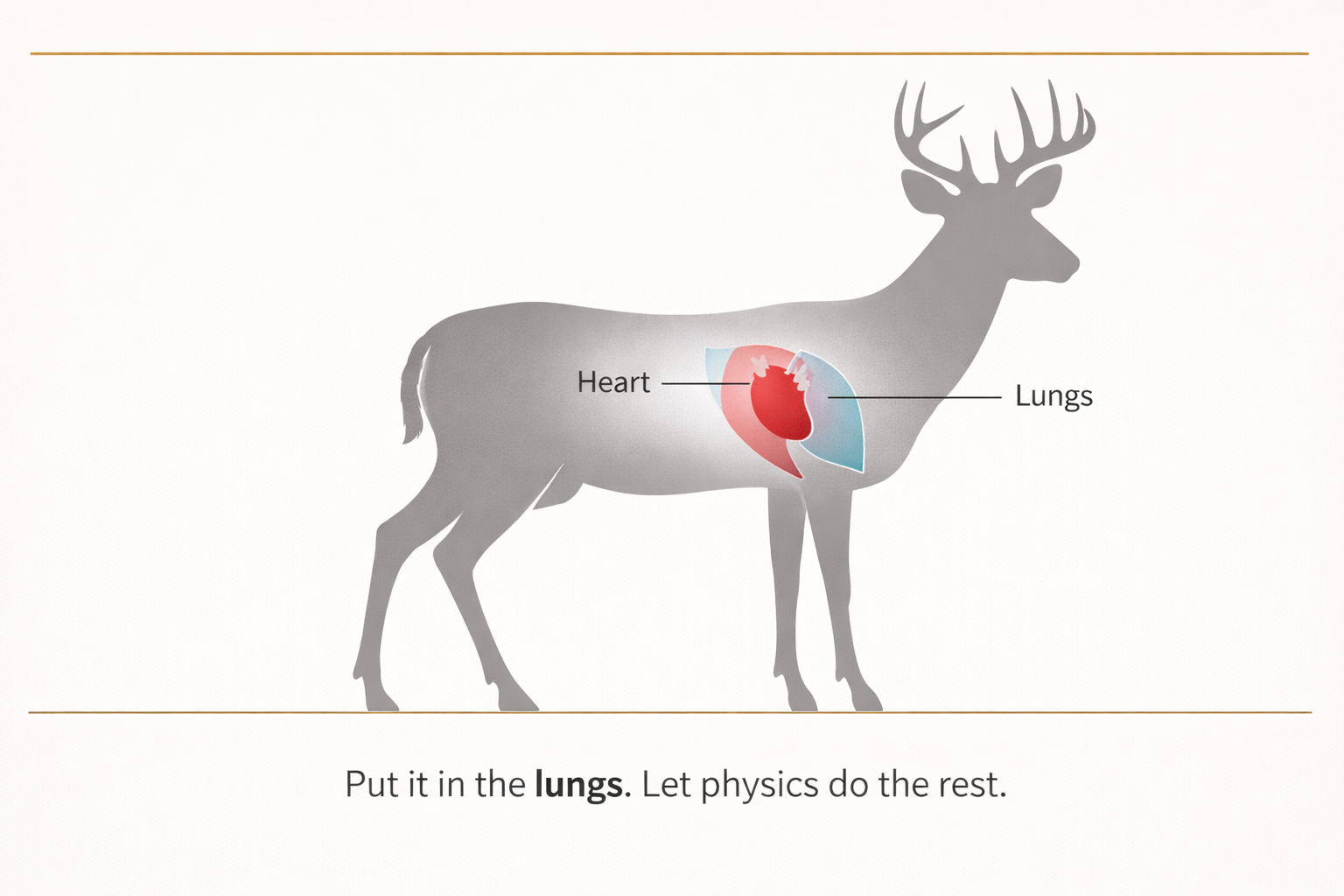
The “boring” shot that works: broadside heart/lung
If you’re new (or you’re honest), broadside heart/lung is the highest-percentage shot on a calm deer.
Aim for the center of the vital triangle behind the shoulder.
It’s boring. It’s effective. And it usually produces the best blood trails.
Quartering away: excellent with patience
Quartering away can be a great shot if you visualize the exit through the opposite shoulder.
The key is to wait until the angle is correct—don’t force it because you’re excited.
Quartering toward: higher risk
Quartering toward shots demand more precision and create a smaller margin.
If you’re still building confidence, pass and wait.
In 2026 deer camp, “passing” is a skill, not a failure.
note the last landmark, and give it the right amount of time before pushing.
A calm recovery is part of ethical hunting.
Setup tips: zero distance, confirmation, and field-proofing
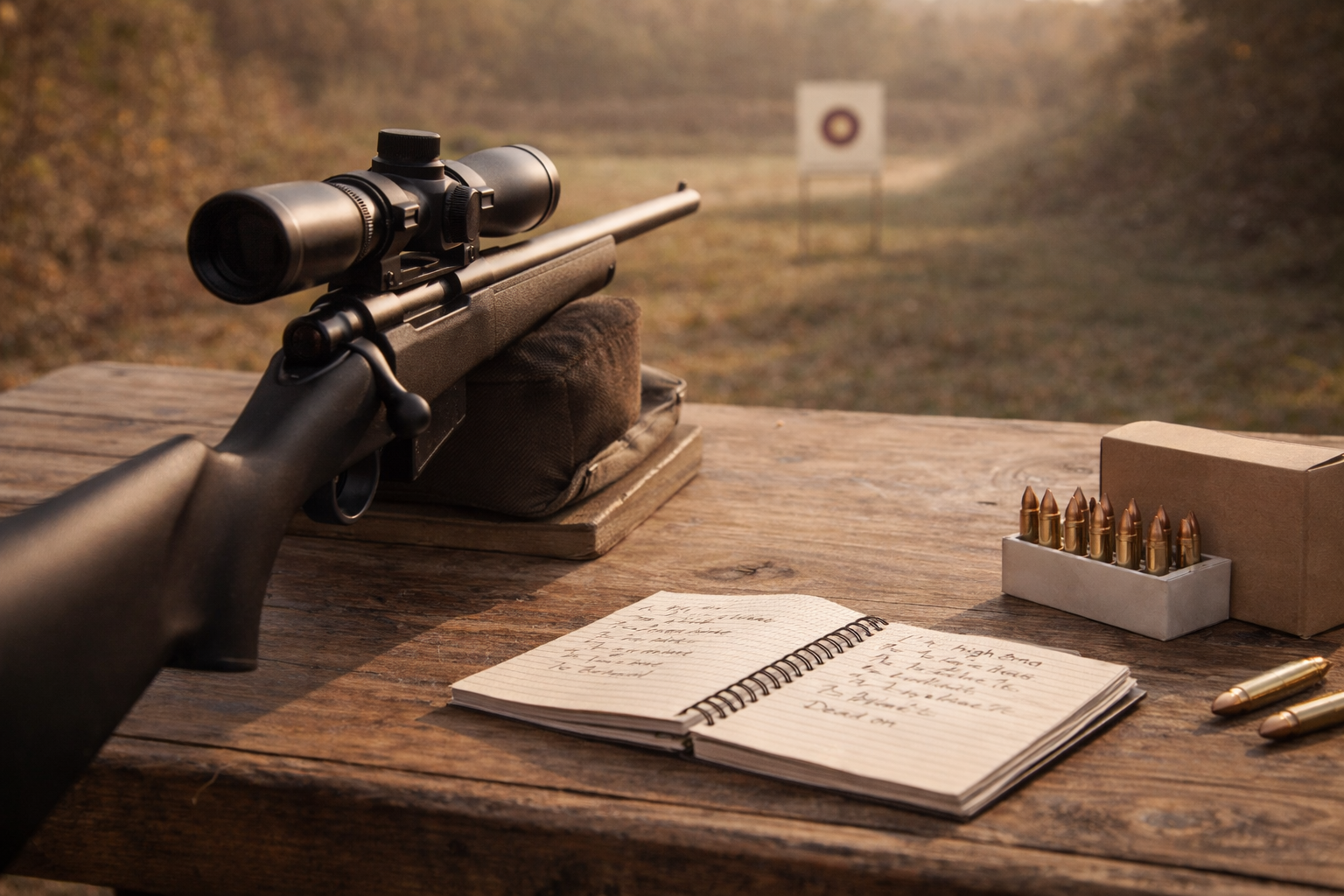
Straight-wall rifles reward simplicity. Here’s a setup approach that works for most hunters without turning your range day into a science fair:
Pick a zero that matches your real distances
- 100-yard zero: simplest for new shooters; you’ll hold a bit high/low beyond that.
- 150–200-yard zero: great for .350 Legend and .450 Bushmaster where tables show “0” around 200 in many examples; reduces mental math inside typical hunting ranges.
Confirm from field positions
Bench groups are for zeroing and confidence. Hunting hits are made from weird angles, bad chairs, and cold hands.
Confirm at least one group from:
sitting with sticks, kneeling on a pack, or leaning against a tree.
Make your holds stupid-simple
If you need a spreadsheet to take a 140-yard shot, your system is too complicated.
Consider:
- One zero distance
- One “max no-thinking distance” (e.g., 175–200 depending on you)
- One holdover reference for longer shots (e.g., “300 = hold top of back” — if you’ve proven it on steel/paper)
It’s whether you built a system you can run when your heart is trying to escape your chest.
Pick your cartridge: a simple decision tree
Choose .350 Legend, a simple 2–7x or LPVO, and shoot it a lot.
Decision Tree
- Are most of your shots inside 150–200 yards?
• Yes → go to #2
• No / sometimes longer → consider whether your state allows bottleneck cartridges; if not, choose the straight-wall with the flattest trajectory you can shoot well and keep your range disciplined. - Do you want mild recoil and high practice volume?
• Yes → .350 Legend
• No → go to #3 - Do you prefer lever-gun handling and woods hunting?
• Yes → .360 Buckhammer (where legal) or .45-70
• No → go to #4 - Do you want maximum “big-bore thump” inside 200?
• Yes → .450 Bushmaster or .45-70
• No → circle back to .350 Legend (because your shoulder just told you the truth).
You win by placing a good shot and recovering your deer quickly and cleanly.
Pros & cons: the straight-wall + lightweight rifle shift
✅ Pros
|
⚠️ Cons
|
FAQs
What is the best straight wall cartridge for deer hunting?
For most hunters—especially new or recoil-sensitive—.350 Legend is the best overall blend of shootability,
availability, and practical performance inside common deer distances. If you want bigger impact inside 200, look at .450 Bushmaster.
Are straight-wall rifles better than slug guns?
Not universally. Slugs still work and are required in some places. But many hunters shoot rifles more accurately and comfortably,
which can translate to better field outcomes and more practice.
How far can you ethically shoot with a straight-wall cartridge?
Ethically depends on your ability to hit a 6-inch vital zone from field positions every time, plus your bullet’s performance at distance.
For many hunters, straight-walls live best inside 200 yards, sometimes farther with proven practice and disciplined holds.
Do lightweight rifles hurt accuracy?
Lightweight rifles can be accurate, but they can also be harder to shoot steadily and can increase felt recoil.
The sweet spot is a rifle light enough to carry, but heavy enough to shoot comfortably.
Do I need a scope or is a red dot enough?
If you hunt woods and your shots are close, a red dot can be perfect. If you hunt edges and want more precision, a 2–7x or LPVO is a strong choice.
Pick the optic that matches your distances and lighting conditions.
Final verdict
The 2026 whitetail gear shift isn’t about chasing a trend. It’s about hunters choosing setups that help them shoot better.
Straight-wall cartridges plus lightweight rifles are taking over because they offer a smarter balance:
enough performance for real-world deer distances, less punishment than slug guns, and a platform that encourages practice.
If you want the cleanest “most people” answer, start with .350 Legend in a rifle that fits you,
add a simple optic, and build a zero/hold system you can run half asleep.
If you want more thump, step up to .450 Bushmaster or .45-70—but respect recoil and don’t let ego pick your range.
Pick the setup you’ll practice with. Zero it right. Keep your shots ethical. Recover your deer like you mean it.
That’s the whole game.
Sources
- Illinois IDNR: “Single-shot rifles and deer hunting in Illinois” (effective Jan. 1, 2023; straight-wall criteria).
- Indiana DNR: “Deer Hunting — Legal equipment” (rifles 5.56mm/.219″ and larger; public/private).
- Michigan DNR: 2025 Deer Regulations (Limited Firearm Zone: straight-walled .35+; case length 1.16″–1.80″).
- Ohio DNR: “Ohio Hunting and Trapping Regulations 2025–26” PDF (straight-wall rifles .357–.50; 3 shells total).
- Hornady: .350 Legend 150 gr InterLock Hornady BLACK (ballistics table).
- Hornady: .450 Bushmaster 250 gr FTX Hornady BLACK (ballistics table).
- Hornady: 2022 Standard Ballistics Chart PDF (shotgun slug ballistics tables).
- Federal: Power-Shok Rifle 360 Buckhammer 180 gr (muzzle velocity + specs).