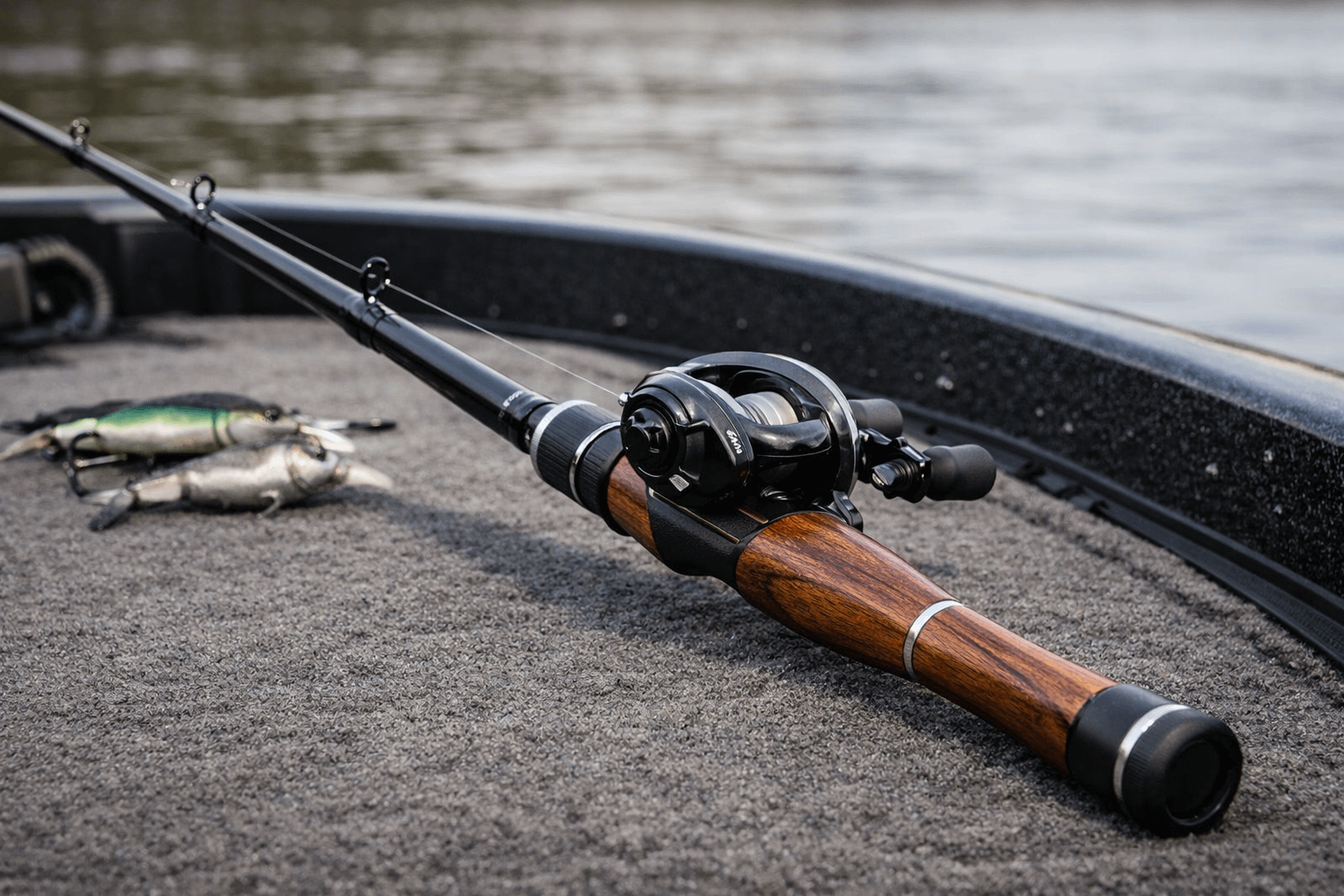
CarboniteX One-Piece Casting Rod Review (2026): 30T Sensitivity + Fuji MicroGuides for Total Control
The CarboniteX one-piece casting rod is built for anglers who want to feel everything, set hooks like they mean it, and steer fish out of bad decisions—without hauling a broomstick.
Quick heads-up: This review is written so a beginner can follow it, but it doesn’t talk down to you. If you’ve been fishing baitcasters for years, you’ll still get real value—especially in the “why it feels the way it feels” sections.
Quick Answer
The CarboniteX one-piece casting rod is a fast-action, one-piece baitcasting rod built around a 30T carbon blank, fitted with Fuji MicroGuides, and finished with a handcrafted wooden split grip. In plain English: it’s tuned for control—bottom contact, accurate casts, crisp hooksets, and enough backbone to move fish out of cover—especially in the 7’3″ Medium-Heavy Fast version. :contentReference[oaicite:0]{index=0}
If you want a rod that feels “connected” (like your lure is texting your hand in real time), CarboniteX is aimed directly at you. If you travel a lot, fish tiny guides with big leader knots, or want a moderate action for crankbaits, you’ll want to think twice (and we’ll break down exactly why).
Use coupon code: MICHELLEBAHR
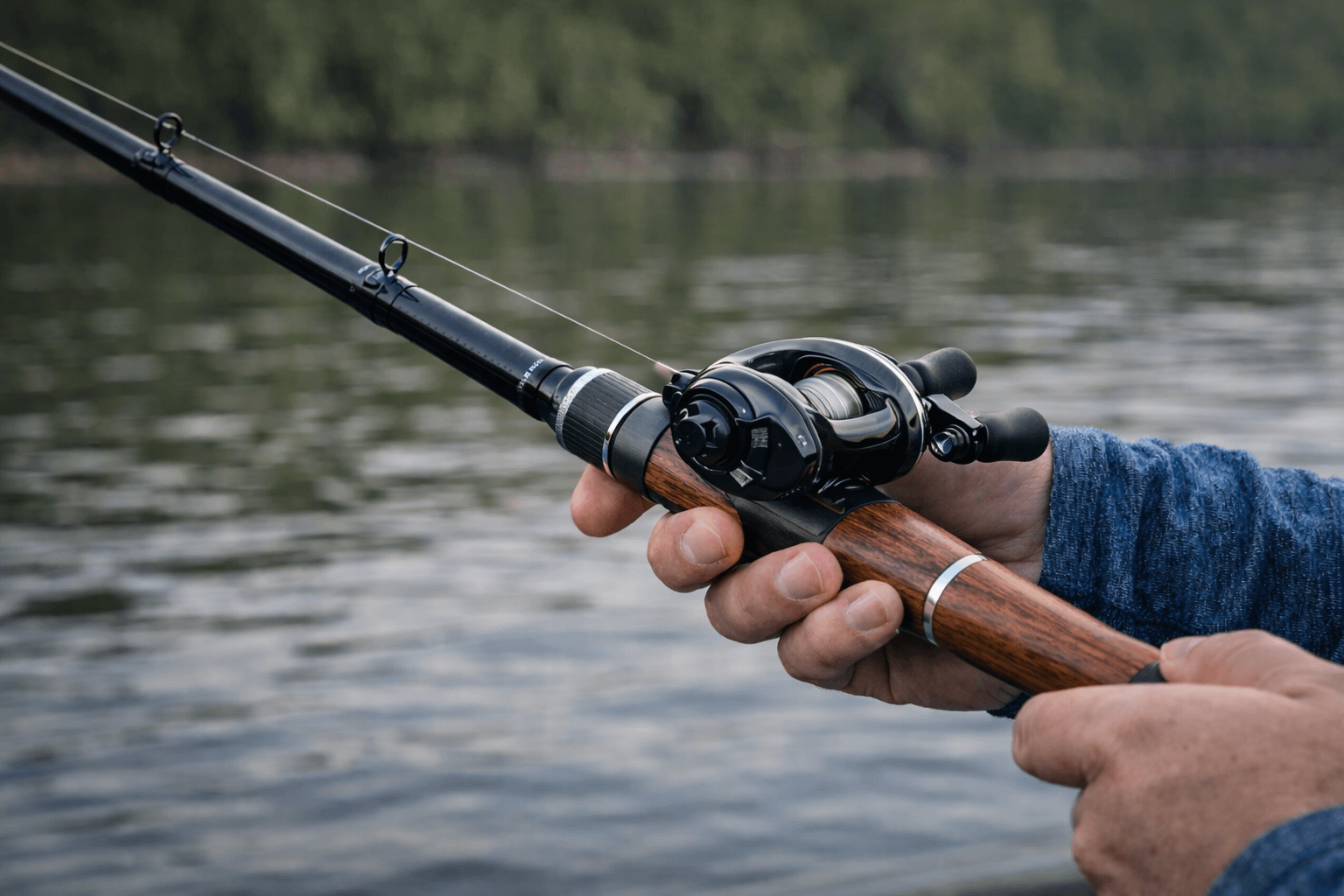
Quick View
- Rod type: Baitcasting (casting rod)
- Pieces: 1 (one-piece)
- Action: Fast
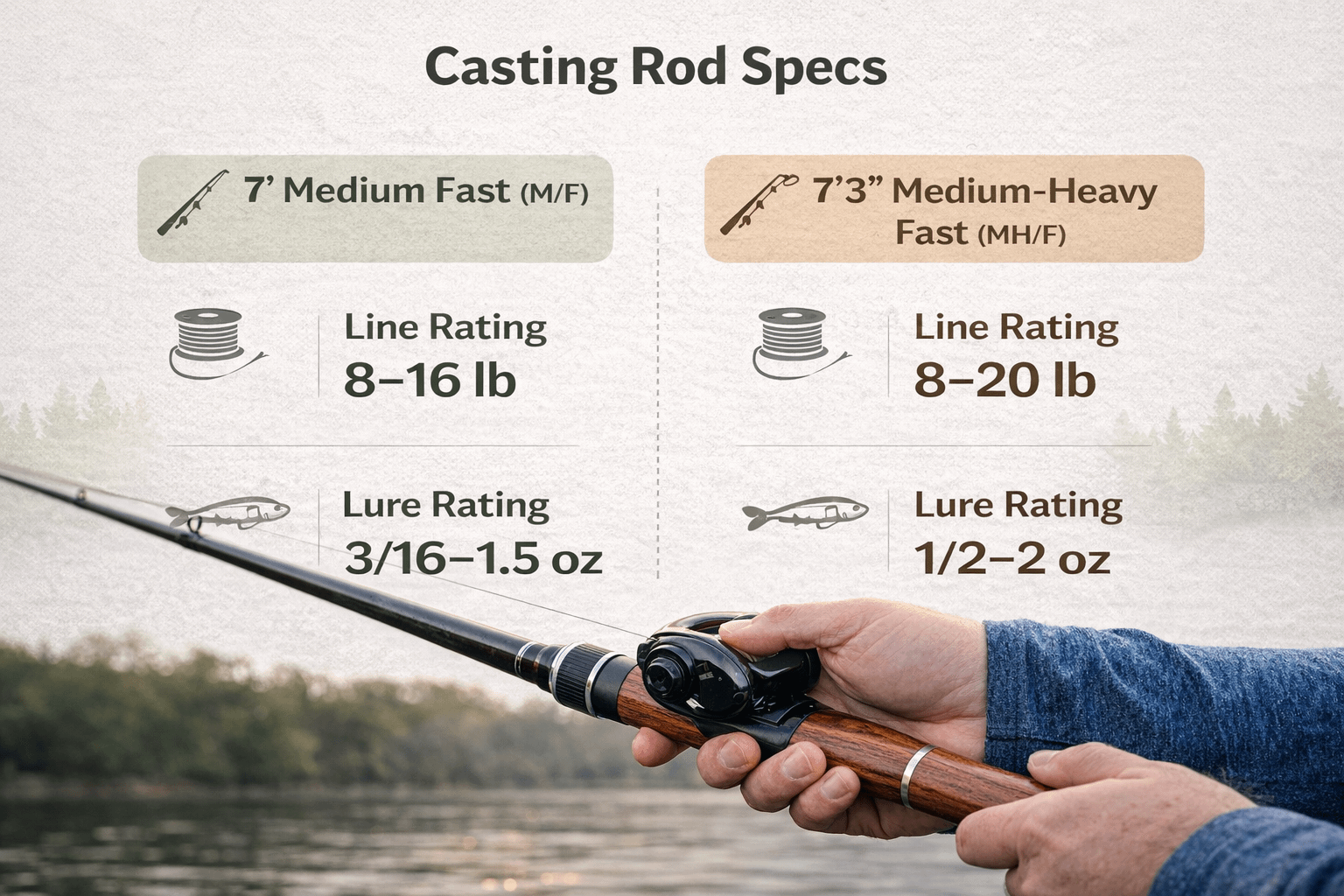
- Powers / variants: 7′ Medium Fast; 7’3″ Medium-Heavy Fast
- Line ratings: 8–16 lb (M), 8–20 lb (MH)
- Lure ratings: 3/16–1.5 oz (M), 1/2–2 oz (MH)
- Guides: 8 + 1
- Guides system: Fuji MicroGuides
- Price noted on listing: around the $189.99 range (varies with promos/stock)
These details are pulled from the product listing for the CarboniteX one-piece casting rod. :contentReference[oaicite:1]{index=1}
What You Actually Get
CarboniteX is offered (at least on the listing you provided details from) in two “do-it-all” bass-leaning builds:
- 7′ Medium / Fast — lighter lure range, more forgiving with smaller hooks, and easier to fish all day without feeling like you did wrist curls in the parking lot.
- 7’3″ Medium-Heavy / Fast — more backbone, more control in cover, better for heavier single-hook stuff, and generally the one most “bottom-contact” anglers gravitate toward.
Now, let’s talk about what those ratings really mean—because “Medium” and “Fast” can be annoyingly subjective across brands. Shimano says power is essentially how much force it takes to load the blank, while action is where/how the rod bends under load (and how quickly it returns). In other words: power = backbone, action = bend profile / recovery speed. :contentReference[oaicite:2]{index=2}
Also worth noting: the CarboniteX one-piece casting rod is pitched as a control-first build, and the listing explicitly leans into “total command” and jig-style performance. That’s consistent with a fast-action, micro-guide, one-piece setup—because that combo typically prioritizes signal transfer and response. :contentReference[oaicite:3]{index=3}
CarboniteX Specs Table
| Model | Length | Power | Action | Line Rating | Lure Rating | Guides | Pieces | Notes |
|---|---|---|---|---|---|---|---|---|
| CarboniteX Casting | 7’0″ | Medium | Fast | 8–16 lb | 3/16–1.5 oz | 8 + 1 | 1 | Control + sensitivity focused |
| CarboniteX Casting | 7’3″ | Medium-Heavy | Fast | 8–20 lb | 1/2–2 oz | 8 + 1 | 1 | More backbone for cover / heavier hooks |
Specs are based on the CarboniteX one-piece casting rod listing details. :contentReference[oaicite:4]{index=4}
Power & Action Explained
If you’ve ever bought a rod that looked perfect online and then felt like a pool cue (or a wet noodle) in person… yeah. That’s power and action confusion.
Power is backbone
Power is basically how much force it takes to load the blank. A heavier power can handle heavier lures, heavier hooks, thicker cover, and more direct pressure on fish. Shimano’s breakdown is clean: heavier power makes it easier to set bigger hooks and move fish away from cover; lighter power helps cast lighter baits and fish finesse presentations. :contentReference[oaicite:5]{index=5}
CarboniteX Medium (M) is your “do more with less fatigue” option. CarboniteX Medium-Heavy (MH) is your “I’m going in there after him” option.
Action is where the rod bends
Action describes where the rod flexes under load and how quickly it returns to straight. A fast action generally bends more toward the tip section and recovers quickly, which helps with single-hook techniques, bottom contact, and quick hooksets. Shimano specifically calls out fast rods for slack-line and bottom-contact techniques (like jig fishing) where control matters, and notes they often feel more sensitive because more of the blank is backbone. :contentReference[oaicite:6]{index=6}
Wired2Fish adds an important nuance: “fast” isn’t only about where it bends—it’s also about how quickly the blank returns to normal after load. That recovery speed influences casting crispness and lure control. :contentReference[oaicite:7]{index=7}
So when CarboniteX says “control,” the fast-action choice matches the mission.
30T Carbon Fiber: What That Means
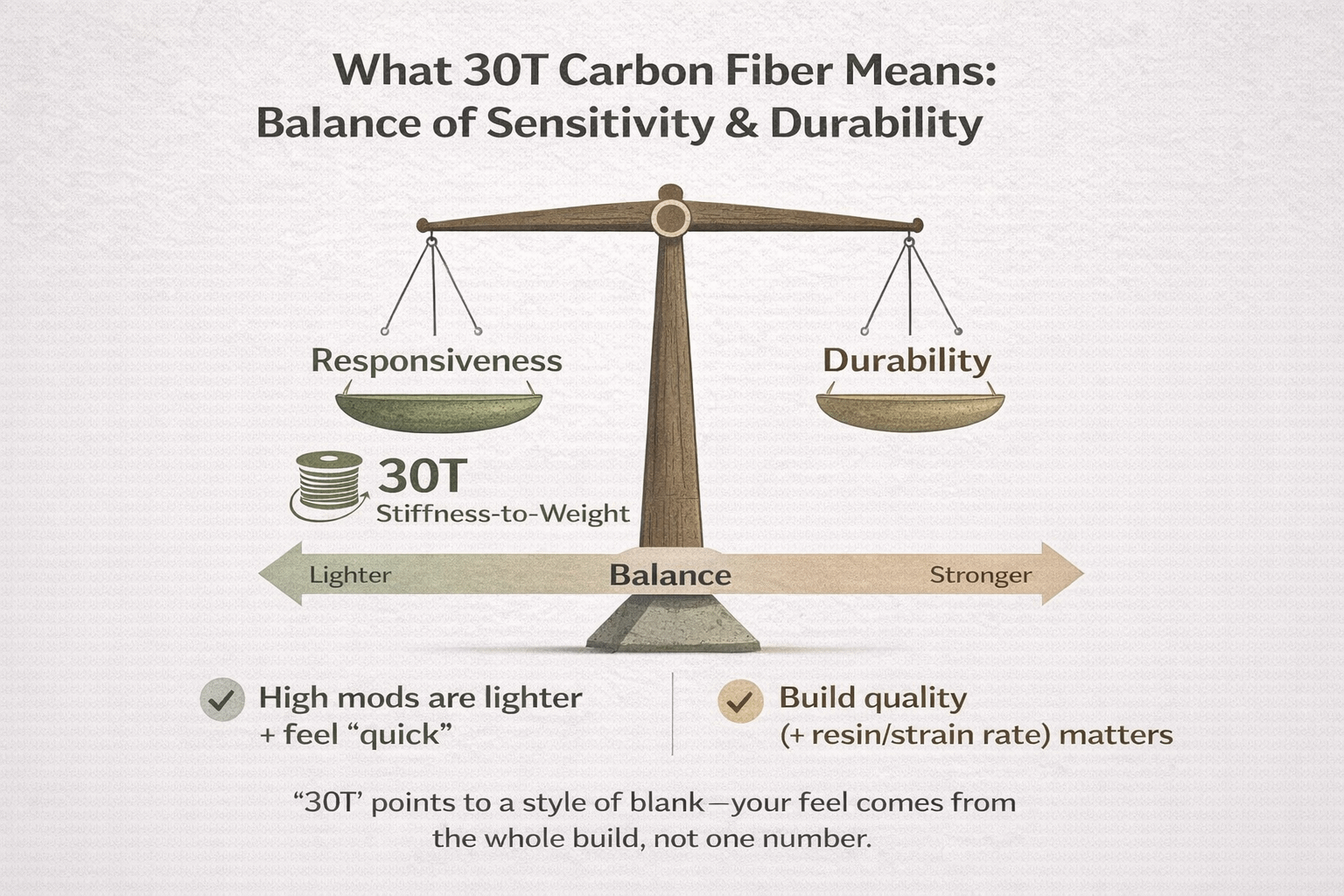
“30T” gets thrown around like it’s a universal yardstick. It isn’t. But it does point you toward the general neighborhood of stiffness-to-weight—and that matters.
Modulus in human terms
At the material level, carbon fibers are often characterized by properties like tensile modulus (stiffness) and tensile strength. Toray—one of the major carbon fiber producers—publishes technical data sheets that list modulus in units like Msi or GPa. For example, Toray’s T300 data sheet lists tensile modulus around the 230 GPa range for the fiber itself (with composite properties depending on layup and resin). :contentReference[oaicite:8]{index=8}
Rod marketing “ton” ratings are a messy shorthand that tries to communicate stiffness-to-weight without forcing everyone to read engineering docs. The problem is that the fishing industry doesn’t use a single standard conversion, so “30T” from one maker may not be identical to “30T” from another.
Why “modulus” alone is not the whole story
Gary Loomis (via a Kistler Rods post quoting him) makes the point that you can’t talk modulus without also considering strain rate—the measured strength of the material—and notes that higher modulus can mean faster, more consistent energy storage and release (casting distance and accuracy), but that strength matters too. :contentReference[oaicite:9]{index=9}
In other words: “higher modulus” can help you get a lighter, faster-feeling blank… but if the overall recipe (fiber + scrim + resin + build quality) isn’t there, you can end up with a rod that feels amazing right until it doesn’t.
What 30T usually signals for anglers
For most bass anglers, “30T” tends to land in a practical sweet spot: crisp enough to feel bottom contact and detect bites, but not so “hyper high modulus” that it becomes a pure drama queen about impacts and abuse. That’s not an absolute rule, but it’s the general intent behind a lot of 30T builds.
And CarboniteX is clearly positioned as a “power + feel + control” rod. The listing highlights high-modulus 30T carbon fiber and sensitivity/backbone benefits in exactly that direction. :contentReference[oaicite:10]{index=10}
One-Piece Blank: Sensitivity, Backbone, and the Travel Tax
A one-piece casting rod is the “no compromises” option for feel—because there’s no ferrule joint interrupting the blank. That uninterrupted structure often translates into:
- Cleaner vibration transfer (you feel taps, ticks, and bottom composition changes more clearly)
- More consistent bend under load (hookset and fight feel smoother)
- More direct power (especially when you lean into a fish and steer it)
CarboniteX leans hard into this: “seamless one-piece design,” “lightning-fast sensitivity,” and “rock-solid backbone.” That’s exactly what anglers chase in a dedicated bottom-contact or cover-capable stick. :contentReference[oaicite:11]{index=11}
The travel tax
Here’s the “tell it like it is” part: one-piece rods are a pain in the rear to transport. Not “impossible,” just annoying.
- If you have a truck bed, a rod locker, or garage storage: you’ll be fine.
- If you drive a smaller vehicle, fish after work, or travel: you’ll need a plan (rod sleeves, careful angles, and not slamming doors on rod tips—ask us how we know).
One-piece rods can also be more vulnerable to impact damage during transport because you can’t break them down into a protected case as easily.
Bottom line: the CarboniteX one-piece casting rod is a performance choice. Just don’t pretend it’s a travel-friendly choice.
Fuji MicroGuides: Why Smaller Guides Can Feel “Sharper”
The CarboniteX one-piece casting rod is built with Fuji MicroGuides. That’s not a cosmetic flex—micro guides can change the way a rod behaves.
At a high level, micro guides can:
- Reduce weight out toward the tip (which can improve balance and recovery)
- Help control the line path (less slap, cleaner tracking)
- Increase perceived sensitivity because the tip feels more “alive” when there’s less hardware weight hanging off it
Bassmaster has covered micro guide advantages in terms of weight reduction and performance benefits, and rod-building/component discussions often echo the same theme: less weight on the blank (especially toward the tip) generally improves responsiveness. :contentReference[oaicite:12]{index=12}
Also, Wired2Fish points out that guide choices affect efficiency and that more/appropriate guides can keep line off the blank under load and improve casting/retrieving performance. :contentReference[oaicite:13]{index=13}
Micro guide reality check
Micro guides are awesome—until you run a bulky leader knot through them 200 times a day.
If you’re a straight braid angler (or braid to a short leader with a slim knot), you’ll love this setup. If you fish long fluoro leaders with a big knot, you may feel friction, hear ticking, or lose a little casting smoothness.
This isn’t a CarboniteX problem. It’s a “physics is undefeated” problem.
Handcrafted Wooden Handle: Grip, Balance, and Maintenance
The handcrafted wooden handle is the thing you’ll notice before you even rig a reel. Wood handles feel different than cork or EVA:
- Firm in the hand (less “spongy” than EVA)
- Temperature feel (wood can feel cool in cold weather and warm in sun—more noticeable than foam)
- Tactile feedback (many anglers feel wood transmits vibration nicely because it’s rigid)
CarboniteX positions the handle as “refined and rugged,” and visually it’s clearly part of the rod’s identity—not an afterthought. :contentReference[oaicite:14]{index=14}
How to keep a wooden handle from looking like a regret
Wood is durable, but you should treat it like any quality finish:
- Wipe it down after trips (especially if sunscreen, fish slime, or lake funk gets on it).
- Don’t store it soaking wet in a sealed rod sleeve for days (that’s how you grow a biology experiment).
- If the finish dulls over time, a light wipe with a manufacturer-recommended protectant (or a minimal, non-greasy wood-safe conditioner) can restore feel—just don’t make it slippery.
Translation: use the rod hard, but don’t be a goblin about storage.
Best Techniques for CarboniteX
The CarboniteX one-piece casting rod is built around fast action + sensitivity, which screams “single hook” techniques. Shimano’s guidance aligns: fast rods excel when you need quick hooksets, line control, and bottom-contact feel. :contentReference[oaicite:15]{index=15}
Here’s where CarboniteX shines, broken down by variant.
7′ Medium Fast: best uses
- Weightless and light Texas rigs (think smaller plastics where you still want crisp contact)
- Finesse jigs (compact jigs, lighter heads)
- Spinnerbaits and smaller chatter-style baits (yes, fast can work—just watch your hookset aggression)
- Topwater with single hooks (buzzbait, toad-style baits)
- Light swimbaits (within rating, especially paddletails)
The medium version’s lure range (down to 3/16 oz) makes it friendlier for lighter presentations while still giving you fast recovery for accurate casting. :contentReference[oaicite:16]{index=16}
7’3″ Medium-Heavy Fast: best uses
- Jigs (the “home base” technique for a rod like this)
- Texas rigs with heavier hooks and weights
- Swimbaits in the 1/2–2 oz window (the rating hints it’s built to launch)
- Flipping and pitching around moderate-to-heavier cover
- Carolina rigs (especially if you like that crisp “tick” feel)
The MH version’s 1/2–2 oz rating is telling: it’s meant to control heavier baits and heavier hook hardware, and still respond instantly. :contentReference[oaicite:17]{index=17}
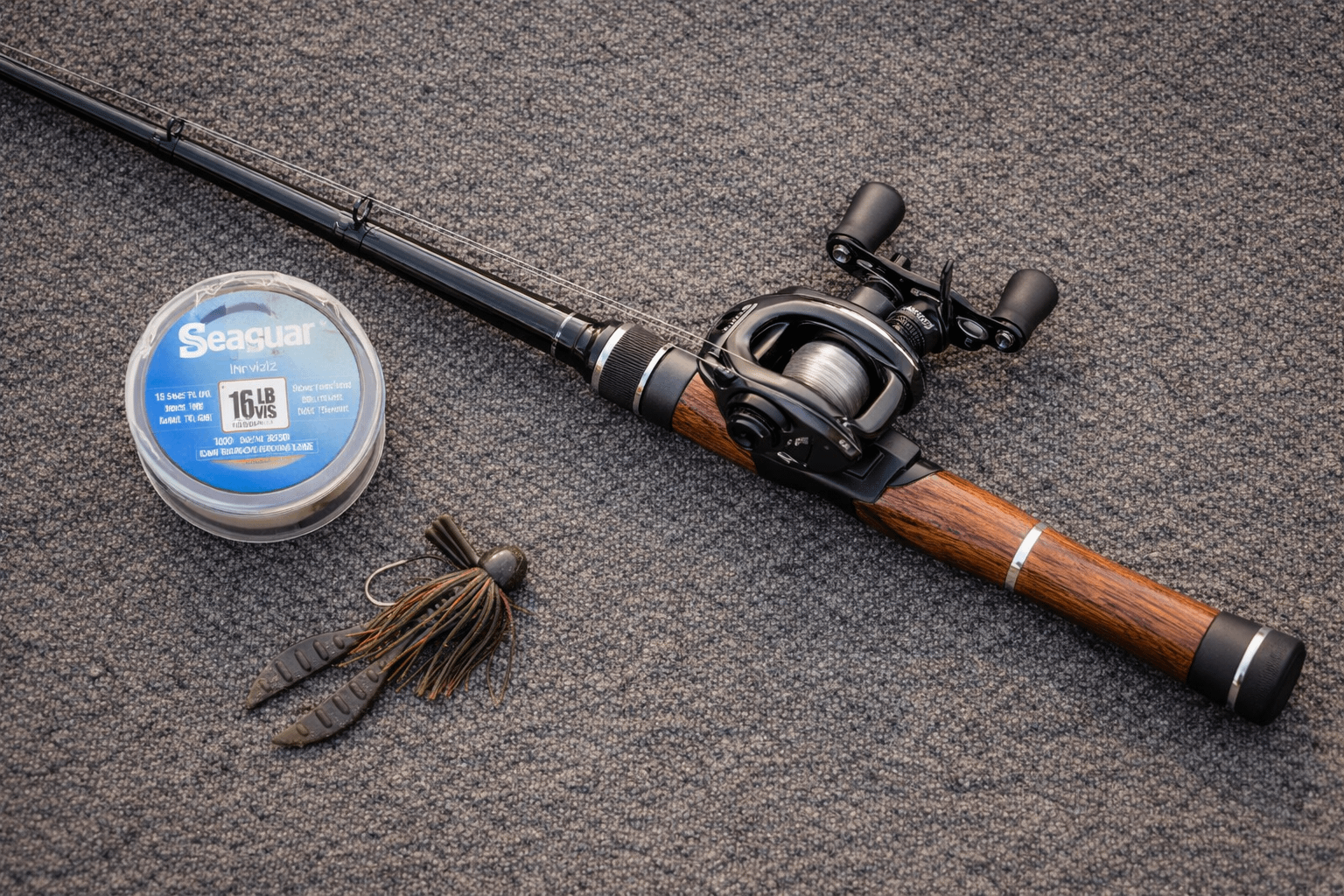
Setup Recipes: Reels, Line, Knots, Drag
Let’s rig this like you actually fish—not like a catalog photo where nobody ever gets wet and the hooks are suspiciously clean.
Reel pairing
For a 7′ to 7’3″ fast-action rod, you generally want a reel that helps you control start-up inertia and handle technique demands:
- Jigs / Texas rigs: 7.1:1 to 8.x:1 is popular for picking up slack fast.
- Swimbaits: 6.x:1 to 7.x:1 depending on retrieve preference.
- Spinnerbaits / chatter baits: 6.x:1 to 7.x:1 (keeps you from over-speeding the bait).
Balance tip: micro-guide rods can feel tip-light compared to heavier guide trains, so a slightly heavier reel can sometimes make the whole setup feel “locked in.” Not required, just often pleasant.
Line choices
Medium version (8–16 lb line rating):
- Fluoro: 10–15 lb for bottom contact and clear water.
- Braid: 20–30 lb braid to a leader if you want max feel and manageability.
Medium-Heavy version (8–20 lb line rating):
- Fluoro: 15–20 lb for jigs/rigs around cover.
- Braid: 30–50 lb (especially for vegetation or heavier single-hook baits).
These are “works for most people” starting points. Your local cover, fish size, and confidence matter more than internet arguing.
Leader knots + micro guides
If you’re running braid to fluoro, use a slim knot (FG is famous for a reason) so it passes micro guides cleanly. Big knots can click through micro guides and steal distance.
Drag settings
- Jigs / Texas rigs: tighter drag, but not locked—let the rod work, don’t break your line on a surprise boat-flip moment.
- Swimbaits / moving baits: slightly lighter drag can help keep fish pinned during surges.
Pro tip: set drag with the rod at a fishing angle (not straight up). You’re trying to match real load conditions, not win a tug-of-war with gravity.
Beginner Corner: How to Not Turn Your Spool into a Bird’s Nest
If you’re new to baitcasters, the CarboniteX one-piece casting rod can still be a great pick—because fast rods can make casting feel precise. But baitcasters punish sloppy setup. Here’s the “no tears” method.
Step-by-step baitcaster setup
- Start with a 3/8 oz to 1/2 oz lure. Lighter lures are harder to cast cleanly at first.
- Set spool tension so the lure drops slowly and stops when it hits the ground (classic baseline).
- Set brakes high (yes, high—your ego will survive).
- Make smooth casts—don’t “snap cast” like you’re trying to throw a baseball through time.
- Thumb the spool as the lure lands (you’re the final brake).
Common mistakes
- Trying to cast into the wind before you can cast at all.
- Dropping lure weight too soon.
- Cranking brakes down mid-backlash instead of stopping, clearing, and resetting.
Once you can cast cleanly with brakes high, back them off little by little. That’s how you learn fast, without wasting a Saturday picking line out like a raccoon working a trash can.
Real-World Use: What You’ll Feel and When It Matters
Here’s what “sensitivity” actually looks like on the water with a rod like the CarboniteX one-piece casting rod.
Bottom composition changes
On a crisp fast-action rod, you’ll feel the difference between:
- Hard bottom (sharp “tick tick” feel)
- Gravel (consistent crunchy vibration)
- Muck (dead, dampened feel—like dragging through pudding)
- Grass (that “loaded but springy” resistance)
This matters because fish position changes with bottom type and season. Feeling those transitions helps you stop blind-casting and start fishing with intent.
Bite detection
Not every bite is a “THUNK.” A lot of good fish bites are:
- a mushy heaviness,
- a tiny tick,
- or your lure simply stops doing what it should.
Fast + sensitive helps you detect those “something is different” signals sooner. And sooner usually means you set the hook before the fish spits it.
Fast action gives you quick power. Medium-Heavy gives you more power. Together (MH/Fast) they give you that “move the fish now” lever—especially for jigs and Texas rigs where you’re driving a single hook through plastic and into jaw.
This is exactly the kind of use-case Shimano points toward for fast rods with single hooks and cover-oriented presentations. :contentReference[oaicite:18]{index=18}
Durability & Care: Keeping It Crisp
Here’s the truth: most “rod durability issues” are actually “human behavior issues.” Doors, ceiling fans, tailgates, rod lockers, stepping on tips… fish are innocent compared to what we do in parking lots.
Micro guide checks
Wired2Fish notes that guides should be checked because damaged inserts can fray line and cause breakoffs. That’s not theoretical—one cracked insert can turn your expensive fluorocarbon into a donation. :contentReference[oaicite:19]{index=19}
Simple habit: run a Q-tip through the guides. If it snags, you found a problem before it found your line.
Blank care
- Use a rod sleeve.
- Don’t store heavy stuff on top of it.
- Don’t “high stick” fish (rod straight up) when you can lift with your arms and keep a safer rod angle.
Warranty / returns notes
The listing indicates a warranty/returns structure (including a stated warranty period and return window on the shop’s policy presentation). Always confirm current terms at purchase time because policies can change. :contentReference[oaicite:20]{index=20}
Pros & Cons
✅ Pros
|
⛔ Cons
|
Comparison Table: CarboniteX vs Popular Alternatives
This isn’t here to trash other rods. It’s here so you can see what you’re buying relative to what’s common on the market.
| Rod | Length | Power / Action | Line Rating | Lure Rating | Pieces | Notable Component Notes | Typical Price Tier |
|---|---|---|---|---|---|---|---|
| CarboniteX Casting (MH/F option) | 7’3″ | MH / Fast | 8–20 lb | 1/2–2 oz | 1 | Fuji MicroGuides, wooden split grip | Mid |
| Shimano SLX Casting (example model) | 7’2″ | Heavy / Fast | 15–30 lb | 1/2–1 1/2 oz | 1 | Titanium Oxide guides, EVA split grip (model dependent) | Budget |
| St. Croix Mojo Bass Trigon (example model) | 7’1″ | MH / Fast | 12–20 lb | 3/8–3/4 oz | 1 | SCIII carbon fiber, aluminum-oxide rings (example listing) | Mid |
| Dobyns Fury FR 734C (popular all-around) | 7’3″ | Heavy / Fast | 10–20 lb | 1/4–1 oz | 1 | Commonly noted as light/sensitive for price | Mid |
| Daiwa Tatula XT (series) | Varies | Varies | Varies | Varies | Varies | Series notes include Fuji aluminum oxide rings and HVF blank tech | Budget |
Comparison specs are pulled from example retailer/manufacturer listings for the referenced rods/series. :contentReference[oaicite:22]{index=22}
What this table tells you: CarboniteX (especially the 7’3″ MH/F) is unusually “heavy on lure rating” versus a lot of mainstream MH fast rods, which often top out around 3/4–1 oz. That suggests CarboniteX is intentionally built to handle heavier presentations—swimbaits and heavier bottom-contact baits—without folding up. :contentReference[oaicite:23]{index=23}
FAQs
Which CarboniteX one-piece casting rod should I buy: 7′ M/F or 7’3″ MH/F?
Buy the 7′ M/F if you fish lighter baits more often, prefer a slightly more forgiving backbone, or want a rod that’s easier to cast all day. Buy the 7’3″ MH/F if you fish jigs/rigs in cover, throw heavier baits, or want more hook-setting authority. :contentReference[oaicite:24]{index=24}
Are micro guides “better”?
They can be. They often reduce tip weight and sharpen response. But if you throw long leaders with bulky knots, micro guides can become annoying. Bassmaster’s micro-guide coverage focuses on performance/weight benefits, and practical use adds the knot caveat. :contentReference[oaicite:25]{index=25}
Is a fast-action rod bad for beginners?
No. It’s just less forgiving if you’re constantly ripping hooksets on treble hooks or fighting fish with too much tension. For single-hook techniques, fast action is extremely common and often helpful. Shimano explicitly highlights fast rods for single-hook and bottom-contact control. :contentReference[oaicite:26]{index=26}
Does 30T guarantee a certain “level” of graphite?
It points in a direction (stiffer, lighter feel), but it’s not a universal standard. Real material performance depends on more than a single number—resin, scrim, layup, and build quality matter. Loomis’ modulus + strain-rate explanation is a good reality check. :contentReference[oaicite:27]{index=27}
What’s the deal with ICAST mentions?
ICAST is a major trade show for the sportfishing industry, produced by the American Sportfishing Association (ASA), and described by ASA as the world’s largest sportfishing trade show. :contentReference[oaicite:28]{index=28}
Final Verdict
If your fishing leans toward bottom contact, single-hook power, and precision casting, the CarboniteX one-piece casting rod is aimed straight at your wheelhouse. The design choices—fast action, one-piece blank, and Fuji MicroGuides—stack the deck in favor of “feel” and “control.” :contentReference[oaicite:29]{index=29}
But don’t buy it because “one-piece sounds cool.” Buy it because you want the performance tradeoffs and you’re willing to deal with the transport reality. One-piece rods are like owning a full-size smoker: the results are amazing, but you’re not casually moving it to your buddy’s apartment.
Best pick for most bass anglers: the 7’3″ MH/F if you fish cover, jigs, Texas rigs, and heavier baits.
Best pick for versatility and comfort: the 7′ M/F if you want lighter lure flexibility and less fatigue.
Use coupon code: MICHELLEBAHR