Cranberry D-Mannose Urinary Tract Support for Dogs & Cats: A Blunt, Practical Guide (Plus: Soft Chews vs Max Granules)
If you’ve ever watched your dog squat six times to produce three tragic drops… or your cat sprint to the litter box like the floor is lava… you already know urinary issues don’t just “pass.” They ruin sleep, wreck carpets, and can turn a perfectly sweet pet into a grumpy little gremlin.
This post is a hands-on, beginner-friendly breakdown of Cranberry D-Mannose Urinary Tract Support—what it is, what it can realistically help with, what it cannot do, and how to use it without fooling yourself or delaying the vet when it actually matters.
Quick Answer
Cranberry D-Mannose Urinary Tract Support is best used as a support / prevention tool for pets who are prone to urinary tract irritation or recurring lower urinary issues—especially when your vet has already ruled out serious stuff (stones, obstruction, kidney issues) and you’re trying to reduce repeats.
The core idea is simple: cranberry compounds + D-mannose may reduce bacterial “stickiness” in the bladder/urinary tract. That can help some pets experience fewer flare-ups—but evidence in dogs/cats is mixed, and it’s not a magic eraser for infection. In cats, urinary signs are often not bacterial UTIs at all, which is why you don’t want to self-diagnose.
Quick View
- Best for: Dogs with recurring cystitis history; older females with occasional leaks; cats needing urinary support after a vet workup; picky pets (granules can be mixed, chews are treat-like).
- Main actives: D-Mannose + Cranberry + Vitamin C (both forms). The Max Granules also include nettle leaf + echinacea.
- Reality check: Helps support urinary health; does not replace antibiotics or diagnostics.
- Most common “wins”: Fewer repeats, less irritation, better routine consistency (especially with food-mixed granules).
- Biggest “gotchas”: Male cat emergencies, bladder stones, dehydration, and assuming “UTI” without a urine culture.
What This Product Is
Think of Cranberry D-Mannose as a daily support supplement meant to keep the urinary tract environment less friendly to problems. It’s commonly used in two situations:
- After the vet visit (diagnosed and treated) — to help reduce the odds of repeat episodes.
- For “prone” pets — seniors, pets with past urinary episodes, or pets where your vet has said, “Yep, they’re one of those.”
The product line comes in multiple forms (soft chews, tablets, granules/powder). The EntirelyPets listing for Max Granules (90 doses) includes a detailed active ingredient panel and dosing chart.
What you’re really buying isn’t magic. It’s consistency:
a measured dose you can actually give every day, plus ingredients with a plausible mechanism that may reduce bacterial adhesion in the urinary tract in some cases.
Soft Chews vs Max Granules (90 doses)
You gave me the Max Granules product link, and you also provided images of the 120 Soft Chews. So here’s the clean way to think about it:
| Version | What it feels like day-to-day | Active ingredients | Best for | Potential downside |
|---|---|---|---|---|
| Max Granules (90 doses) | “Sprinkles” you mix into food; easier for picky treat-refusers; easy to split/adjust dose. | D-mannose, cranberry powder, vitamin C, nettle leaf, echinacea (per 2.5g scoop). | Pets who already eat meals reliably; cats/dogs that won’t take chews. | Some pets notice smell/texture; you must mix well (wet food helps). |
| Soft Chews (120 ct) | Treat-like chew; easiest “compliance” if your pet loves snacks (most do). | D-mannose, cranberry extract, vitamin C (per soft chew) (from product label images provided). | Dogs who take chews happily; households that want zero food mixing. | Picky pets can refuse; some cats won’t chew them (cats are gonna cat). |
Note: Ingredient amounts shown in the granules section are pulled directly from the EntirelyPets Max Granules listing.
How Cranberry + D-Mannose Work
The problem: bacteria that “stick”
A common cause of bacterial UTIs is E. coli. Some strains have little “grippy hands” (fimbriae) that help them latch onto the lining of the urinary tract. Once they stick, they multiply, inflame tissue, and you get the classic signs: frequent urination, accidents, discomfort, blood in urine, and that “I’m trying but nothing’s happening” squat.
D-mannose: the decoy sugar
D-mannose is a simple sugar that can act like a decoy binding target. The concept: bacteria bind to the D-mannose instead of binding to the bladder wall, then get flushed out during urination. That’s the theory and it’s why D-mannose is discussed as a complementary approach—especially for recurrent issues.
Important honesty: veterinary evidence is still limited and not slam-dunk for dogs/cats across the board. In cats and dogs, literature reviews note that while the mechanism is plausible, clinical evidence can be inconsistent or lacking.
Cranberry: “don’t stick to the wall” chemistry
Cranberries contain compounds (often discussed as proanthocyanidins) that may reduce the ability of certain bacteria to adhere to urinary tract tissue. That mechanism is why cranberry extract is studied for urinary health. But again: results can vary by species, dose, formulation, and the actual cause of urinary signs.
So… why use it at all?
Because in the real world, pet owners aren’t asking for a perfect journal article. They’re asking:
- “How do I reduce repeats?”
- “How do I support my pet between vet visits?”
- “How do I stop playing urinary roulette every two months?”
If your vet has ruled out the big scary stuff and you’re dealing with recurring lower urinary issues, these ingredients can be a reasonable part of a bigger plan—hydration, hygiene, diet, and proper diagnostics.
What It Can Help With
Best-case uses
- Recurring bacterial cystitis support (dogs): after treatment, trying to reduce recurrence risk alongside vet guidance.
- Urinary “irritation” prone pets: those that get mild episodes and your vet says it’s safe to support preventatively.
- Bladder health routines: pets where hydration/diet tweaks plus a supplement keep things calmer.
What it won’t do
- It won’t “cure” an active UTI the way targeted antibiotics can. Diagnostic testing matters.
- It won’t remove bladder stones (and stones can mimic UTI signs).
- It won’t fix a blocked male cat (life-threatening emergency).
- It won’t solve dehydration (which is a huge driver of urinary issues).
Symptoms: “Monitor” vs “Vet Now”
If you only read one section, read this one. This is the part that saves wallets and saves lives.
| What you see | What it might mean | What to do |
|---|---|---|
| More frequent urination, mild accidents, otherwise acting normal | Could be irritation, mild cystitis, early infection, or behavioral | Call vet for guidance and a urine plan (especially if it persists > 24 hours) |
| Blood in urine, painful urination, straining | Infection, stones, inflammation—needs evaluation | Vet appointment ASAP; urinalysis/culture often recommended. |
| Vomiting, lethargy, fever, back pain | Possible kidney involvement or systemic illness | Urgent vet care |
| Male cat straining with little/no urine, crying, hiding, belly tense | Possible urinary obstruction (emergency) | Emergency vet NOW (do not “wait and see”) |
Merck Veterinary Manual lists common bladder infection signs like frequent urination, painful/difficult urination, inappropriate urination, and blood in urine—plus notes diagnosis requires urine testing and treatment is typically antibiotics (duration depends on situation).
Dosing & Administration
Max Granules (90 doses) dosing (per EntirelyPets)
According to the Max Granules listing, the active ingredients are listed per 2.5g scoop, and dosing is based on weight.
| Pet Weight | Daily Feeding (Granules) | Simple notes |
|---|---|---|
| 1–25 lbs | 1 scoop daily | Easy to split into half AM / half PM if sensitive stomach. |
| 28–50 lbs | 2 scoops daily | Mix into wet food or add a splash of warm water to kibble to “lock it in.” |
| 51 lbs and over | 3 scoops daily | Large dogs do best when it’s blended well (otherwise they’ll dust the bowl and walk away). |
Max Granules active ingredients
| Active ingredient | Amount per scoop | Why it’s included (plain English) |
|---|---|---|
| D-Mannose | 150 mg | May act as a “decoy” to reduce bacterial adhesion and help flush bacteria out. |
| Cranberry powder | 100 mg | Contains compounds studied for reducing bacterial stickiness; evidence mixed but promising in some contexts. |
| Vitamin C (ascorbic acid) | 35 mg | Antioxidant support; sometimes used in urinary support formulas. |
| Nettle leaf | 40 mg | Traditional botanical used in some urinary support blends (supportive role, not a “cure”). |
| Echinacea powder | 50 mg | Often included for immune support in supplement blends (evidence varies by use case). |
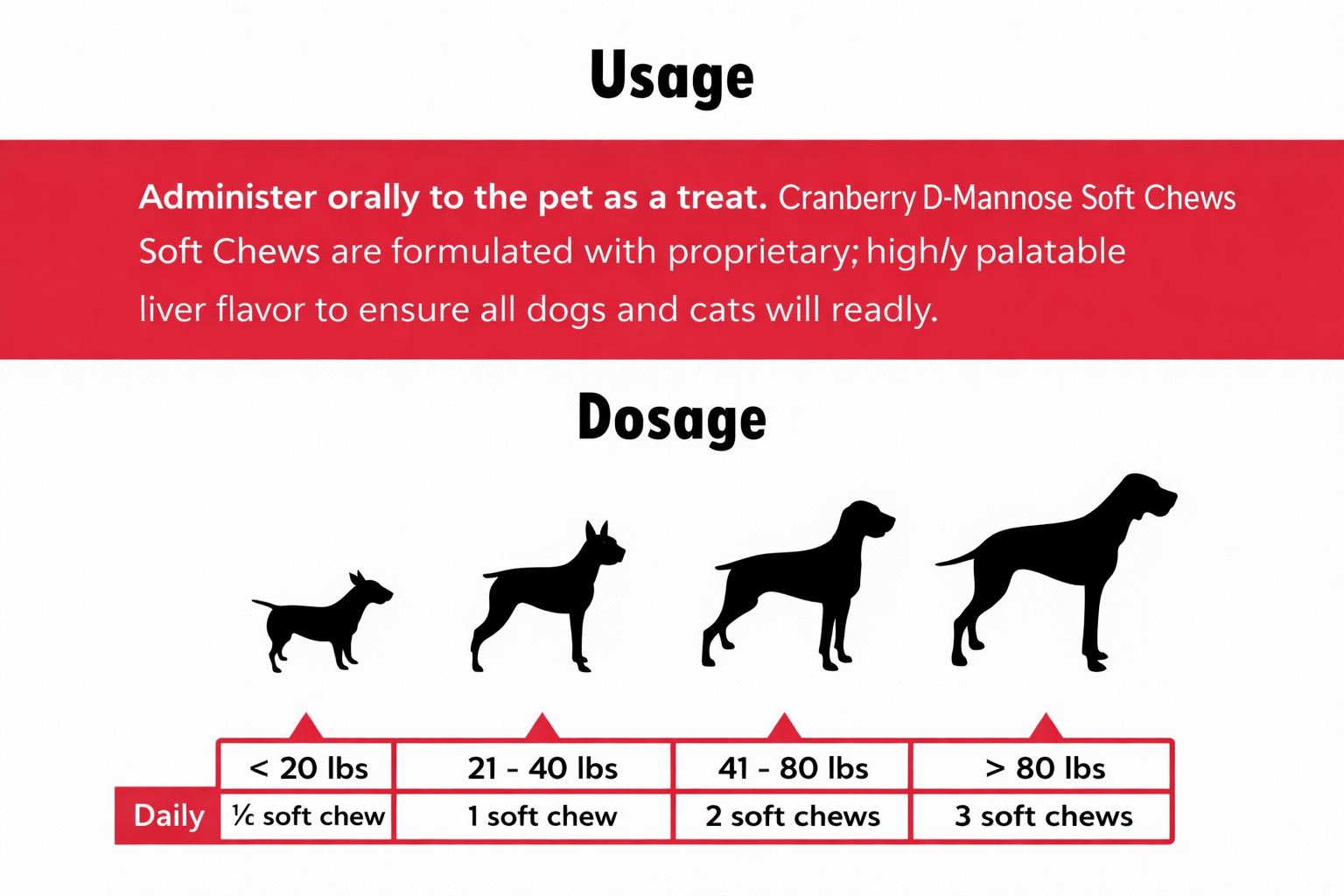
Soft Chews dosing (from the product label images you provided)
The soft chew version includes a weight-based daily chew count (½ chew up to 3 chews, depending on size). Use the label directions and—if your pet has medical conditions—confirm with your vet.
Setup Tips
Supplements fail for three reasons:
- You can’t get the pet to take it.
- You don’t give it consistently.
- The real problem is something else (stones, obstruction, dehydration, non-bacterial inflammation).
1) Introduce it slowly
Cats can boycott food like it’s a labor strike. If you’re using granules, start with a smaller amount for a couple days, then ramp up. If your cat is medically fragile or has diet restrictions, ask your vet first.
2) Wet food is your cheat code
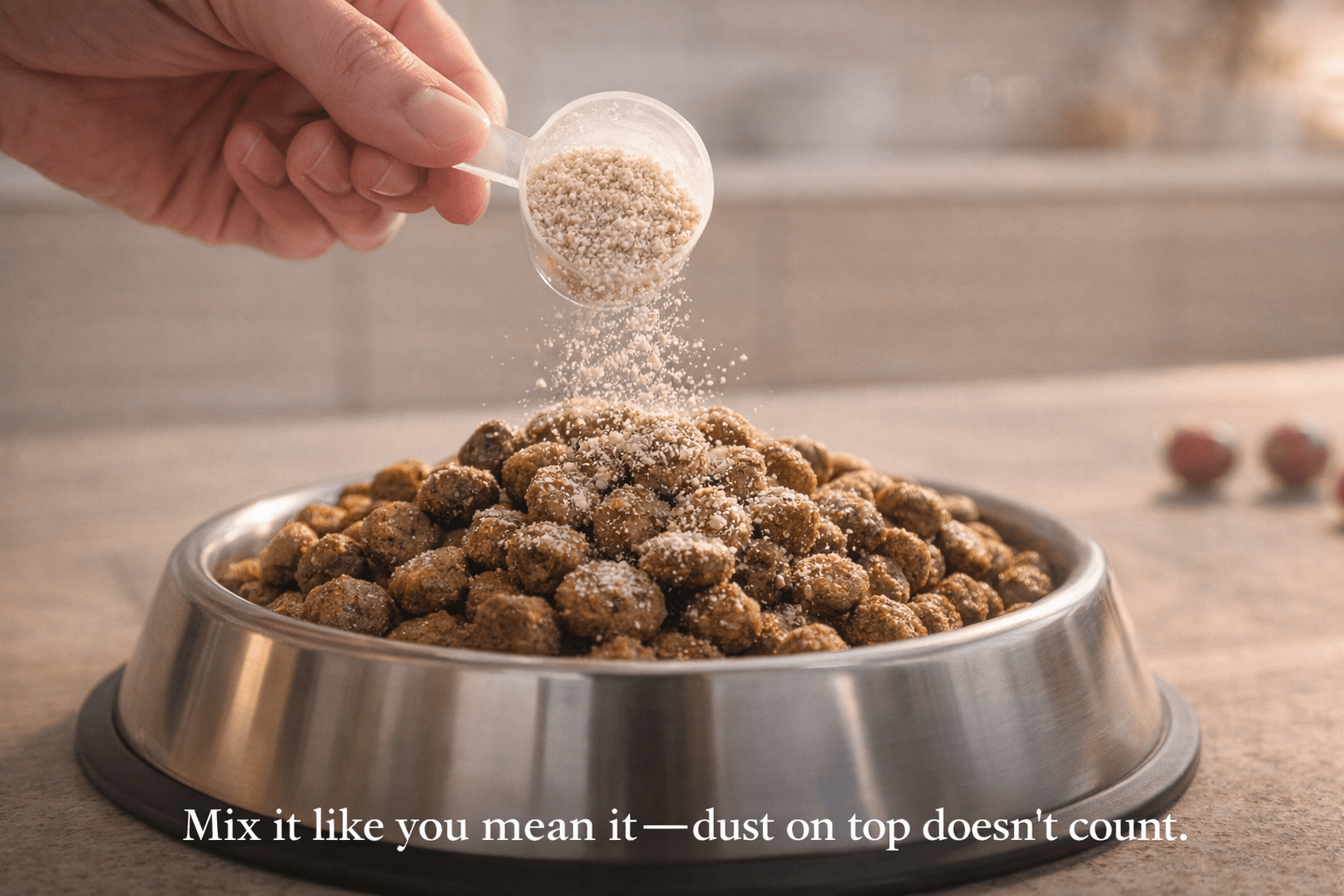
Granules stick better to wet food than dry kibble. If you only feed kibble, add a spoon of plain wet food or a splash of warm water, mix thoroughly, then add the granules so they bind instead of turning into “bowl dust.”
3) Hydration matters more than people want to admit
A huge part of urinary health is simply dilution + flow. Concentrated urine is irritating. Encourage water:
- Multiple bowls, multiple locations
- Pet fountains (many cats drink more)
- More wet food (especially for cats)
- Flavor water lightly (vet-approved options) if needed
Even WebMD’s pet guidance emphasizes increasing water intake as part of managing lower urinary tract problems.
4) Don’t skip the urine test if symptoms are real
Merck Veterinary Manual is blunt: a urine sample (urinalysis, often culture) is needed to diagnose bacterial cystitis, and antibiotics are used when appropriate. Supplements are not a substitute for that step. {index=31}
5) Clean matters
- Clean litter boxes more frequently (cats will “hold it” if the box is gross)
- Let dogs out on a consistent schedule (holding urine too long isn’t helpful)
- Clean accidents properly (enzymatic cleaner) to prevent repeat marking
Real-World Use Notes
Granules: smell + texture
On the Max Granules page, customer reviews mention a fishy odor despite fish not being listed, and that pets still ate it fine when mixed into food. That’s not “proof” of anything medically—but it’s useful for expectations.
Compliance is king
If your pet refuses chews, granules win. If your pet refuses “sprinkles,” chews win. The “best” product is the one you can give consistently without turning breakfast into a wrestling match.
Pros & Cons
Specs Table
| Spec | Max Granules (EntirelyPets listing) | Soft Chews (from your provided label images) |
|---|---|---|
| Primary use | Urinary tract support supplement (dogs/cats) | Urinary tract support supplement (dogs/cats) |
| Form | Granules / powder (90 doses) | Soft chews (120 count bucket) |
| Actives | D-mannose, cranberry powder, vitamin C, nettle leaf, echinacea | D-mannose, cranberry extract, vitamin C (per label image) |
| Dosing | 1–25 lb: 1 scoop • 28–50 lb: 2 scoops • 51+ lb: 3 scoops | Weight-based chew count (½ to 3 chews daily) (per label image) |
| Storage | 59°–86°F; avoid excessive heat | See container label (follow manufacturer guidance) |
Comparison Table
Urinary support isn’t one product category—it’s a whole ecosystem. Here’s how this stack compares to other common approaches.
| Approach | What it’s trying to do | Best fit | Limitations |
|---|---|---|---|
| Cranberry + D-mannose | Reduce bacterial adhesion risk; support bladder environment | Recurrence support after vet workup; mild prone pets | Not a cure; evidence mixed in dogs/cats; depends on cause. |
| Prescription urinary diets | Modify urine chemistry; manage crystals/stones; support lower urinary tract | Stone/crystal-prone pets; vet-directed management | Requires diet compliance; not “optional” once medically needed |
| Antibiotics (vet prescribed) | Treat bacterial infection | Confirmed infection cases | Needs correct drug/duration; stewardship matters. |
| Hydration strategy | Dilute urine; increase flow; reduce irritation | Almost everyone, especially cats | Owners underestimate how much it matters. |
FAQs
How fast does cranberry + D-mannose work?
If your pet is currently symptomatic, don’t use a supplement as a stopwatch test. Symptoms need evaluation. For prevention/support routines, think in weeks, not hours. The goal is fewer repeats over time, not instant relief.
Can I use this with antibiotics?
Often yes, but your vet should confirm based on your pet and what they’re treating. The key point: antibiotics treat infection; supplements support the environment and may help reduce future episodes.
Are most cat “UTIs” actually UTIs?
Not always. Reviews discussing feline urinary issues note that bacterial infection is not the only (or even the most common) cause of lower urinary signs in cats, and evidence for cranberry/D-mannose clinical effects in dogs/cats can be inconsistent. Translation: symptoms ≠ diagnosis.
When should I NOT use this without vet input?
- Male cats with straining or minimal urine
- Pets with kidney disease, complex medical histories, or on multiple medications
- Pets with repeated urinary episodes without a urine culture plan
Final Verdict
If you want a clean, honest summary:
- This product line makes sense as a daily urinary support routine—especially the form your pet will actually take.
- Max Granules are great for picky pets and easy dose adjustment, with a published active panel and weight-based dosing.
- Soft Chews are “compliance gold” for treat-motivated dogs.
- But no supplement replaces diagnostics, and urinary issues can turn serious fast—especially in cats.