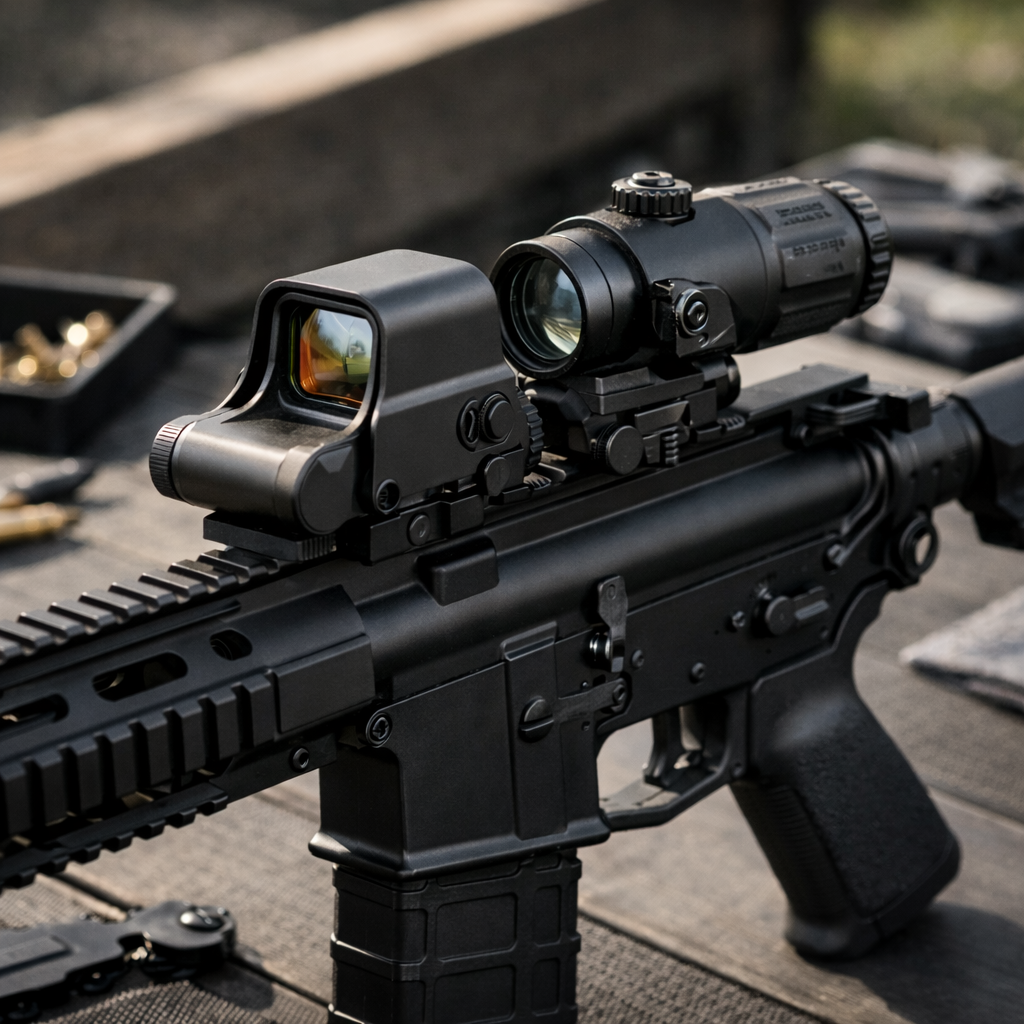
EOTECH HHS Green Review: A Premium Hybrid Holographic Setup That Still Hits Hard
The EOTECH HHS Green is one of those optics setups that makes immediate sense the second you shoulder the rifle: fast at 1x, sharp enough with magnification, and rugged enough that it does not feel like range-toy jewelry pretending to be duty gear.
Some optics look fantastic in a product photo and start falling apart the minute you ask them to do anything harder than sit on a bench next to a latte and a loaded magazine. This is not that kind of optic. The EOTECH HHS Green is the kind of setup that exists because shooters keep asking the same question: how do I keep true close-range speed without giving up the ability to stretch a shot or identify a target better at distance?
The answer, at least in the EOTECH world, has been the hybrid package for a long time. Put a holographic sight up front. Put a magnifier behind it on a switch-to-side mount. Keep the rifle fast when the shot is close. Flip magnification into place when things open up. No drama. No giant LPVO hanging off the rifle like a boat anchor. No trying to pretend a tiny micro dot is the perfect answer for every single job under the sun.
That is what makes the HHS Green interesting in 2026. It is not trying to be cheap. It is not trying to be minimalist. It is not trying to win the internet spec-sheet Olympics with absurd battery life and a dozen buzzwords no one remembers five minutes after checkout. It is trying to be a serious all-in-one fighting, training, and practical-use optic package for shooters who actually understand why 1x speed and magnified precision both matter.
And yes, there is a wrinkle here. Listings for this exact package are messier than they should be. Depending on where you look, you will see mixed descriptions involving EXPS2 variations, one-dot wording, two-dot wording, and even night vision claims that do not line up. That matters, because when you are spending real money on a premium optic, the phrase “close enough” should not be part of the checkout process. So this review is going to tell it like it is: the HHS Green is a hell of a concept and a strong package, but buyers need to verify the exact reticle and feature set shown by the seller before they click buy.
That does not kill the review. It actually makes the review more useful. Because most people shopping this setup are not looking for fluffy copy. They want to know what the HHS Green feels like on a rifle, what it does well, where it is heavy, whether the green reticle is genuinely helpful, whether the G33 still holds up, and whether this package makes more sense than a Vortex holographic setup, an Aimpoint plus magnifier, a Holosun enclosed dot combo, or just buying an LPVO and calling it a day.
So that is what we are doing here. We are breaking down the EOTECH HHS Green the Bark & Brass way: blunt, practical, beginner-friendly, and honest enough to save somebody from buying the wrong optic for the wrong rifle. Because spending premium money on a setup that does not match your actual use case is a great way to turn your excitement into a very expensive lesson.
Quick Answer: Is the EOTECH HHS Green worth it?
If you want the short version, here it is: yes, the EOTECH HHS Green is worth serious money for the right shooter. It gives you fast holographic performance at 1x, a crisp magnified view through the G33 when you need more detail, side controls that play nicely with a magnifier, and the kind of rugged feel that reminds you this thing was built for hard use instead of polite conversation.
The catch is simple. It is not light, it is not cheap, and the current listing ecosystem around the exact green reticle configuration is sloppier than it should be. So this is a strong buy for someone who wants premium hybrid performance and does not mind premium weight and premium price. It is a bad buy for somebody who really needs night vision compatibility, featherweight rifle balance, or Aimpoint-style battery life that seems to outlive civilizations.
Quick View: EOTECH HHS Green
- Best For: AR-15 carbines, home-defense rifles, training rifles, tactical use, ranch/property rifles, 2-gun style setups
- Optic Type: Holographic sight + 3x magnifier hybrid package
- Biggest Win: True 1x speed with fast transition to magnified target ID and better precision
- Biggest Drawback: Heavy compared to many red dot + magnifier combos and nowhere near modern LED battery life
- Reticle Note: Seller descriptions are inconsistent; verify the exact green reticle shown in the product photos before checkout
- Night Vision: Treat this package as non-night-vision unless the exact seller listing and product photos clearly prove otherwise
- Who Should Skip It: Ultralight rifle builders, budget buyers, and anyone who specifically needs EXPS3-level NV compatibility
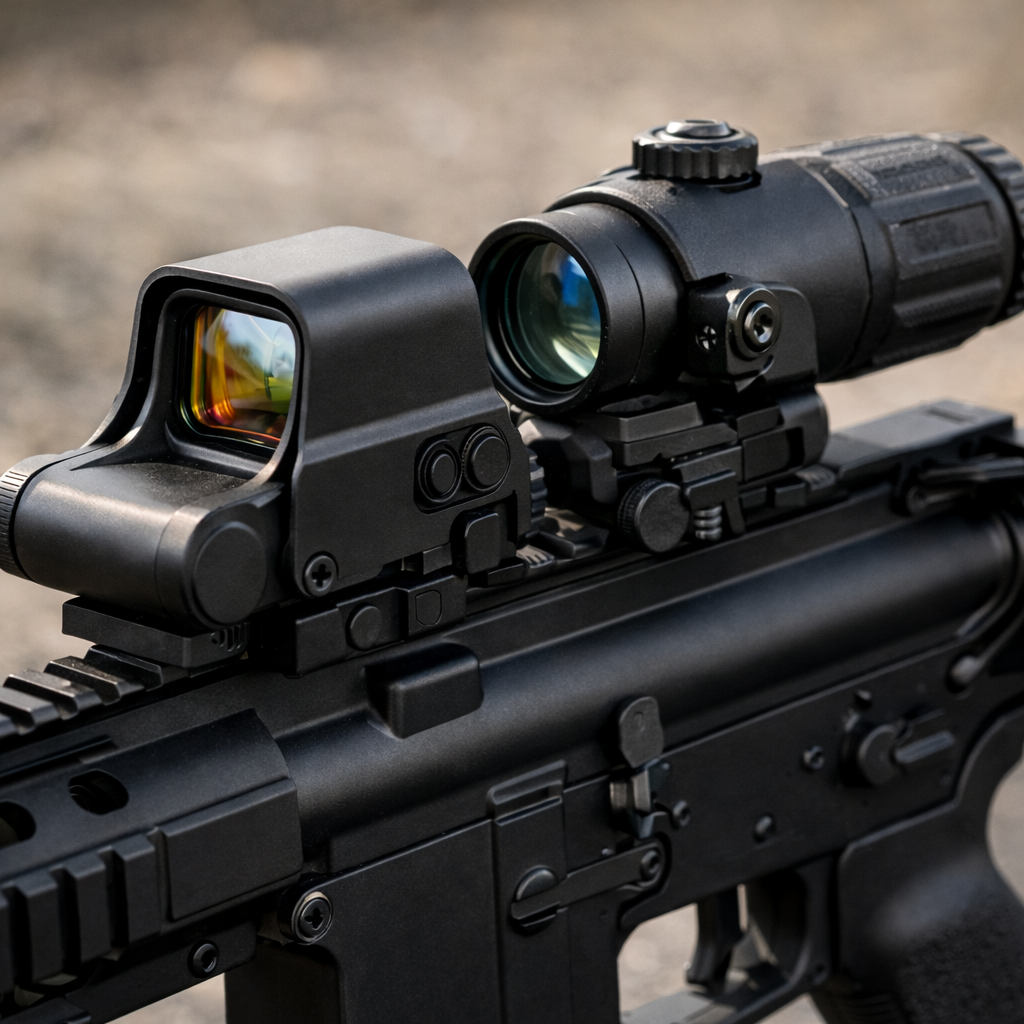
What the EOTECH HHS Green actually is — and why the exact package matters
The HHS in the name stands for Holographic Hybrid Sight, and that matters more than a lot of people realize. This is not just a boxed bundle made for marketing. It is a deliberate concept. You are getting a full-size holographic weapon sight paired with a magnifier on a flip mount so you can go from pure speed to added reach without changing your basic sight picture or learning a whole new optic system.
That is the first thing that makes the HHS Green different from a lot of cheaper optic bundles. This is not a random red dot thrown together with a generic magnifier and a shrug. EOTECH built this whole package around how the EXPS-style holographic sight and G33 magnifier work together. The side buttons on the EXPS pattern matter. The mount height matters. The sight window shape matters. The way the reticle behaves under magnification matters. The switch-to-side mount matters. It is a complete concept, not just a convenience combo.
Now here is where buyers need to pay attention. The current HHS Green listing ecosystem is a little drunk. Some listings describe it one way. Others describe it another. The official EOTECH page itself mixes signals. That is not ideal. The safe takeaway is this: you are buying a green-reticle EXPS2-family holographic sight paired with a G33 3x magnifier on a switch-to-side mount. That much is consistent enough to build around. But the exact reticle wording on some listings does not line up cleanly, so smart buyers should verify what the seller shows in product images and product details before money changes hands.
That might sound nitpicky, but it really is not. A 1-dot center setup and a 2-dot setup do not feel exactly the same in use. A clean single center dot tends to feel a little less busy. A multi-dot arrangement can give you more hold references for distance work. Neither is automatically “better” for every shooter, but pretending they are interchangeable would be lazy. And Bark & Brass is not here to hand you lazy.
Beyond the reticle weirdness, the rest of the package concept is pretty straightforward. The holographic sight gives you the famous EOTECH-style ring-and-center aiming picture that a lot of shooters love for speed. The G33 gives you 3x magnification when the target is farther, smaller, partially obscured, or simply harder to identify. Flip it out of the way and you are right back to wide-open 1x performance.
This is why the HHS Green still has a real place in a market crowded with enclosed dots, prisms, LPVOs, and every tactical alphabet soup combo under the sun. It does one specific thing extremely well: it lets a rifle stay quick up close without turning the whole setup into a pure close-range-only gun.
That makes the HHS Green attractive on carbines that live in the real world. Home-defense carbines. Property rifles. Training rifles. Defensive “general purpose” ARs. Patrol-style setups. Even some competition guns where the balance of speed and target ID matters more than shaving every ounce off the rifle like you are prepping it for a mountain hunt on Mars.
So the correct way to look at this package is not “Is this the newest optic idea ever?” It is not. The correct question is: does this package still solve a practical rifle problem better than a lot of other options? For the right shooter, the answer is absolutely yes.
EOTECH HHS Green specs table
| Feature | Details |
|---|---|
| Product | EOTECH HHS Green / HHSGRN hybrid package |
| Core Setup | EXPS2-family holographic sight + G33 3x magnifier + Switch-to-Side mount |
| Magnification | 1x primary sight / 3x with magnifier engaged |
| Eye Relief | Unlimited at the holographic sight; magnifier eye relief is limited by the G33 behind it |
| Dot / Reticle | Green EOTECH speed-ring style reticle; verify whether your seller shows the exact 1-dot or 2-dot configuration before checkout |
| Adjustment | 0.5 MOA per click |
| Brightness | 20 daylight settings |
| Night Vision | Official HHS Green / EXPS2-family description points to non-NV use |
| Battery | 1× CR123 |
| Battery Life | Approx. 1,000 hours at nominal setting for standard EXPS2 use; about 600 hours for the green reticle version |
| Mount Interface | 1″ Weaver or MIL-STD-1913 Picatinny rail |
| Total Length | About 7.9″ |
| Total Weight | About 22.4 oz for the full hybrid package |
| Water Resistance | 10 ft (3 m) for the HHS Green package; the G33 magnifier itself is more water resistant than the combined HHS rating |
| Country of Origin | HWS made in the USA, magnifier assembled in the USA |
| Warranty | 10-year warranty |
Why the hybrid holographic concept still makes sense
There is a reason people keep coming back to EOTECH-style holographic setups even in a market drowning in tiny enclosed red dots and LPVOs with names that sound like military toaster ovens. The concept flat-out works.
At 1x, the holographic sight is fast. Not “fast once you get used to it.” Not “fast if you keep it on the right brightness and stand under the correct moon phase.” Just fast. Big window. Open feel. Both-eyes-open shooting. Natural target focus. That is why so many people still love the format. When a rifle needs to be quick at room distance, hallway distance, or across-the-yard distance, a good holographic sight feels less like looking through a tiny tube and more like simply placing the reticle where the shot needs to go.
Then the magnifier changes the conversation. Suddenly that same rifle gets better at seeing details, reading partial targets, confirming what you are actually looking at, and tightening up shots beyond the kind of ranges where raw 1x speed is the whole story. You are not turning the carbine into a sniper rifle, and nobody should pretend otherwise. But you are making it much more useful in the real middle ground where practical rifles actually live.
That middle ground matters. A lot. People love internet extremes. Either the rifle is for 10-yard speed work or it is for 600-yard precision. Real carbines are usually not living in those extremes. Real carbines are doing mixed work. A little speed. A little distance. A little movement. A little unknown target size. A little bad light. A little “I need to see better, not just shoot faster.” That is the exact lane where an HHS setup earns its keep.
And the holographic part is not just hype. It changes how the reticle behaves. One of the long-time selling points of EOTECH holographic sights is that the reticle stays crisp under magnification in a way that many traditional LED red dots do not. That matters when you add a magnifier, because the whole point of adding magnification is to gain actual practical precision, not just make your target look bigger while your aiming point turns into a glowing meatball.
It also helps explain why people with astigmatism or mild reticle distortion issues sometimes do better with holographic sights than with certain LED dots. That is not a universal promise, because eyeballs are weird and personal. But it is a real enough trend that a lot of shooters bring it up for a reason. Some people see an LED dot like a starburst, comma, jellybean, or cosmic accident. A holographic reticle can look more usable to them. Not always. Often enough to matter.
The other part of the hybrid concept that gets overlooked is speed of transition. A switch-to-side mount sounds simple because it is simple. That is the whole point. Under no magnification, the rifle stays quick. When you need more detail, you swing the magnifier into place. When you do not, it goes back out of the way. There is no magnification ring to crank. No eye box drama like an LPVO at higher power. No need to change optic height or rethink the whole presentation. The rifle still handles like a red-dot gun until you decide otherwise.
Now, does that mean the hybrid holographic concept is perfect? Nope. Not even close. It costs more. It weighs more than many LED dot combos. It burns battery faster. It takes up more rail space than a tiny micro dot. And some shooters simply prefer an LPVO because they want more than 3x and are willing to accept the tradeoffs that come with it.
But that does not kill the concept. It just defines it. The hybrid holographic setup is for the shooter who values immediate 1x performance first, then wants magnified utility second. It is not for the guy building a rifle around maximum battery life. It is not for the minimalist trying to make the front of his rifle weigh less than a sandwich. It is for the shooter who wants a serious carbine optic system that is brutally good at being a carbine optic system.
That is the lane the HHS Green lives in. And in that lane, it still makes a ton of sense.
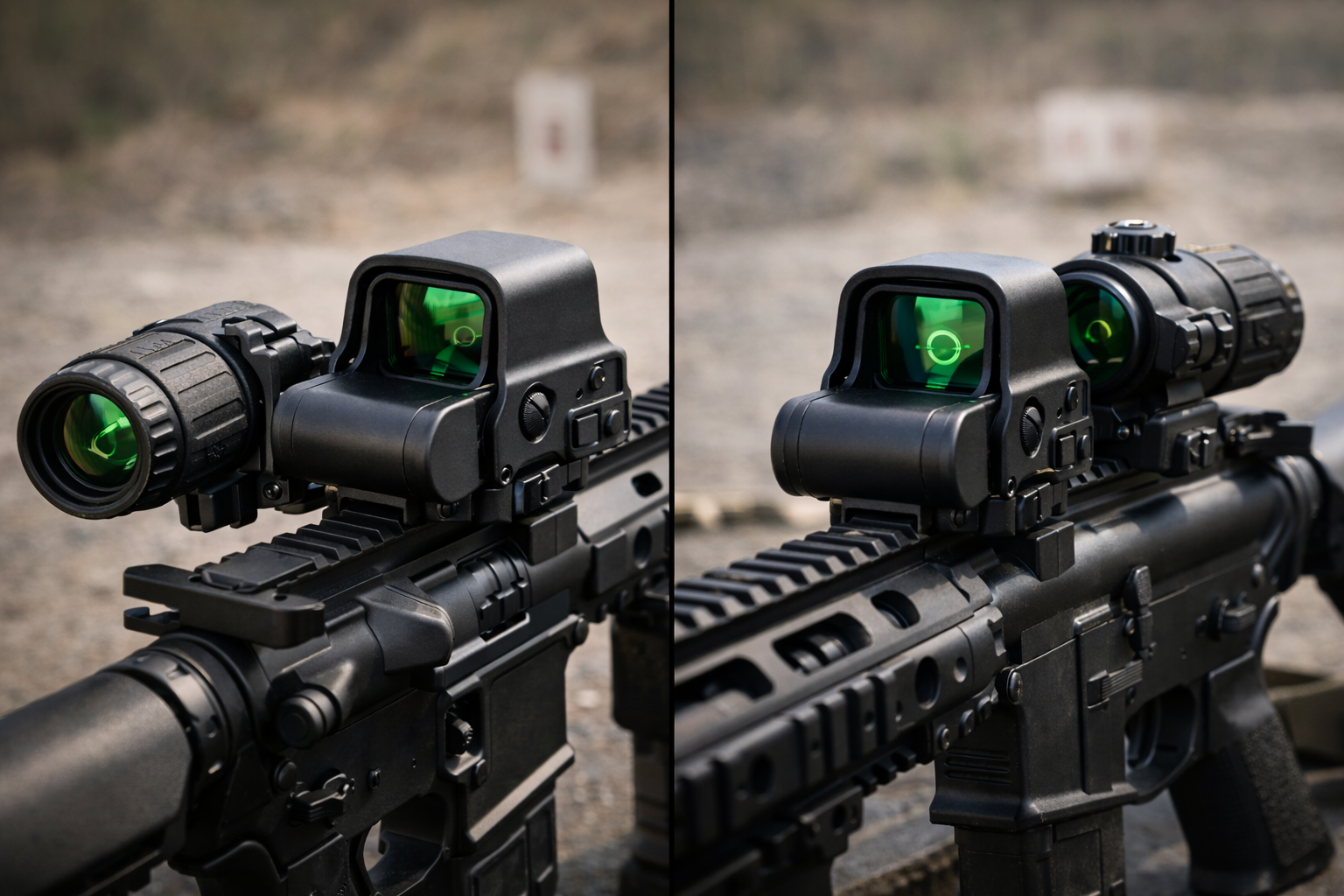
Real-world use: where the EOTECH HHS Green shines, and where it does not
1) Home-defense and defensive carbine use
For a defensive carbine, the HHS Green makes a lot of sense as long as you understand the job. Up close, you are using it like a holographic sight, not like a magnified optic. That means fast presentation, wide situational awareness, and a reticle that is easy to grab in a hurry. In practical terms, that is what people are paying for with EOTECH in the first place.
The green reticle can be genuinely useful in bright daylight and certain backgrounds where red can get a little less distinct to some eyes. Outdoors, in harsh light, green often punches through in a way that people notice immediately. Indoors, the benefit is more personal. Some shooters love it. Some do not care. Some actually prefer red. The point is not that green is magic. The point is that for the shooter whose eyes pick up green faster, it can be a real advantage rather than just a catalog bullet point.
The magnifier in a home-defense context is mostly a “parked to the side unless needed” tool. Inside a house, 3x is rarely what you want. That is not the point. The point is that the same rifle might also live in a patrol truck, ride on rural property, cover a barn, back door, long driveway, or field edge, or serve as a general-purpose defensive rifle rather than a pure indoor-only gun. That is where the HHS setup starts separating itself from a simple dot.
The downside is weight. On a defensive rifle that already has a light, sling, loaded magazine, maybe a suppressor, and maybe backup irons, another 22-ish ounces of optic system is not nothing. This setup feels substantial on the rifle. Some shooters will call that confidence. Others will call it front-end bloat. Both are telling the truth from different chairs.
2) Training rifles and range carbines
This is one of the strongest homes for the HHS Green. A training rifle benefits a lot from having both 1x speed and 3x utility. You can run close drills, transitions, movement work, barricades, and speed standards without feeling handicapped. Then, on the same rifle, you can swing into more deliberate target work, smaller steel, partials, or longer holds without wishing you had brought a different upper or a different optic.
That kind of flexibility matters because it makes you more likely to train with one rifle the way you actually use it. That is a big deal. A lot of people buy one optic for the square range and another optic for “serious use,” then never get the same reps on the setup they supposedly trust most. That is backwards. A hybrid package like the HHS Green reduces that divide. You can build your reps on the same basic system you actually plan to keep on the rifle.
The G33 still earns respect here. It is not the newest magnifier on the planet, but it remains a solid, practical 3x option. The image is crisp enough for the job, the form factor works, and the mount system does what it is supposed to do without getting cute. Sometimes “it does the damn job” is the highest compliment a piece of gear deserves.
This is also where the holographic reticle behavior under magnification becomes more than marketing. When you are trying to clean up shots on smaller targets, you notice whether the reticle helps or fights you. A fine aiming point that stays usable under magnification is part of why EOTECH-style setups remain relevant.
3) Property rifles, ranch rifles, and general-purpose AR builds
This might be the sweet spot. A general-purpose AR does not need to be perfect at one thing. It needs to be good at a lot of things. Fast on coyotes that pop out at ugly distances. Useful when a target is partially hidden. Capable when a shot is inside 25 yards one minute and over 100 the next. Comfortable in mixed light. Easy to use when you are wearing gloves, in a jacket, standing weird, or shooting from a less-than-perfect position.
The HHS Green plays really well in that lane. At 1x, it feels like a serious close-range optic. With the magnifier in place, it helps you identify and place shots better without turning the rifle into a scope-first setup. That is a huge difference. A lot of general-purpose rifles get built into one compromise too far. Either they are so stripped down that they start feeling under-equipped, or they are so “do everything” that they turn into heavy science projects. The HHS Green walks that line well, provided the shooter is okay with the weight.
For someone on land, around outbuildings, around equipment, or around open lanes where you might have to see more than you can with naked 1x, the hybrid concept just flat-out works. It is a better fit than a tiny pistol-style optic pretending to be a rifle answer. It is faster up close than most LPVOs for most average shooters. And it gives you more real utility at distance than a plain unmagnified dot.
4) Competition and action shooting
The HHS Green can absolutely work in practical competition, but this is where the tradeoffs start getting more personal. For some shooters, the EOTECH window and reticle feel fantastic for speed, and the magnifier helps on stages where more detail matters. For others, the extra weight and the slightly bulkier setup compared to a lighter dot or a purpose-picked LPVO starts to feel less attractive.
This is one of those areas where nobody should pretend there is one universal answer. If the stage design heavily rewards fast 1x speed and occasional magnified help, the HHS concept can be excellent. If the competition format pushes more heavily into sustained midrange work, then an LPVO starts making more sense. That is not a criticism of the EOTECH. It is just the reality of matching the optic to the game.
Still, for a shooter who wants one rifle to cover training, practical matches, and defensive use without swapping optics like socks, the HHS Green remains very viable.
5) Where it does not make sense
Let’s cut the nonsense and save some people money. The HHS Green is not the right answer for everyone.
It is not the best pick for ultralight rifle builds. It is not the best pick for the buyer who measures battery life in presidential terms and hates changing batteries. It is not the best pick for somebody whose entire use case is dedicated night vision work. It is not the best pick for someone who really needs 5x, 6x, or 8x more often than they need raw 1x speed. And it is definitely not the best pick for someone trying to stay in a mid-tier budget.
That does not make it bad. It makes it specific. Good gear gets more useful the minute you stop demanding that it be all things for all people. The HHS Green is a premium hybrid optic system with premium strengths and premium tradeoffs. That is the honest answer.
Comparison table: EOTECH HHS Green vs other serious optic paths
| Optic Setup | Type | Approx. Weight | Battery Life | Night Vision | Biggest Advantage | Biggest Tradeoff |
|---|---|---|---|---|---|---|
| EOTECH HHS Green | Holographic + G33 3x magnifier | 22.4 oz | Approx. 600 hours for green reticle | No | Fast 1x feel with holographic reticle behavior under magnification | Heavy and battery life is short compared to LED dots |
| EOTECH HHS II | Holographic + G33 3x magnifier | 22.4 oz | Approx. 1,000 hours | No | Same hybrid concept without paying the green-reticle premium | Still heavy, still not Aimpoint battery life |
| Vortex AMG UH-1 Gen II + Micro3X | Holographic + 3x magnifier | About 21.2 oz | Approx. 1,500 hours | Yes | Strong holographic alternative with NV and solid support | Still chunky, and many shooters simply prefer the EOTECH window/feel |
| Aimpoint Duty RDS + 3XMag-1 | LED red dot + 3x magnifier | About 17.9 oz | 30,000 hours | Yes | Huge battery-life edge with lighter overall package | Does not give you the holographic sight picture people love from EOTECH |
| Holosun AEMS + HM3X | Enclosed LED dot + 3x magnifier | About 13.7 oz | Up to 50,000 hours | Available on relevant variants | Very light for a combo and hard to ignore for value buyers | Still not the same premium holographic experience or pedigree |
How the EOTECH HHS Green stacks up against those alternatives
The cleanest comparison is with the EOTECH HHS II. That is basically the sibling decision. Same hybrid family. Same general role. Same weight class. Same G33 logic. The real question there is whether you specifically want the green reticle enough to justify choosing the green package and dealing with the listing confusion around it. For some shooters, yes. For others, the plain HHS II is the easier, cleaner buy.
Against the Vortex AMG UH-1 Gen II plus Micro3X, the HHS Green is fighting a serious alternative. The Vortex combo keeps the holographic idea alive while giving you NV support and a bit more battery life. Some shooters love the UH-1. Others still prefer the EOTECH sight picture, reticle familiarity, and overall brand history in this space. This is one of those comparisons where brand preference and eye preference matter a lot. On paper, Vortex makes a compelling case. On the rifle, many shooters still end up in the EOTECH camp because the feel is what they wanted all along.
The Aimpoint Duty RDS plus 3XMag-1 is the adult, sensible, practical alternative. It is lighter than the HHS Green. It absolutely crushes it in battery life. It gives you NV compatibility. It is rugged. It is proven. If your priorities are weight, battery life, and pure LED-dot practicality, Aimpoint starts looking very hard to argue against. But the reason EOTECH still has a seat at the table is that the experience is different. Plenty of shooters still prefer the holographic window, reticle feel, and target acquisition rhythm. This comes down to whether you value the EOTECH experience enough to carry the EOTECH tradeoffs.
The Holosun AEMS plus HM3X is the value hammer. It is dramatically lighter. It offers absurd battery life by comparison. It gives you a modern enclosed-dot approach and a solid magnifier without clubbing your rifle to death with weight. For a lot of shooters, that is going to be the rational choice. But again, rational and preferred are not always the same thing. If what you specifically want is the EOTECH-style holographic performance, buying something else because the spreadsheet looks prettier is like buying a practical pickup when what you actually wanted was the old V8 that makes you grin every time you fire it up. Logic matters. So does what you actually shoot well.
That is really the story of the HHS Green in one paragraph: it survives comparison not because it wins every category, but because it still offers a specific performance feel that many shooters genuinely prefer. That matters more than internet arguments like to admit.
Check Price at Ammunition Depot
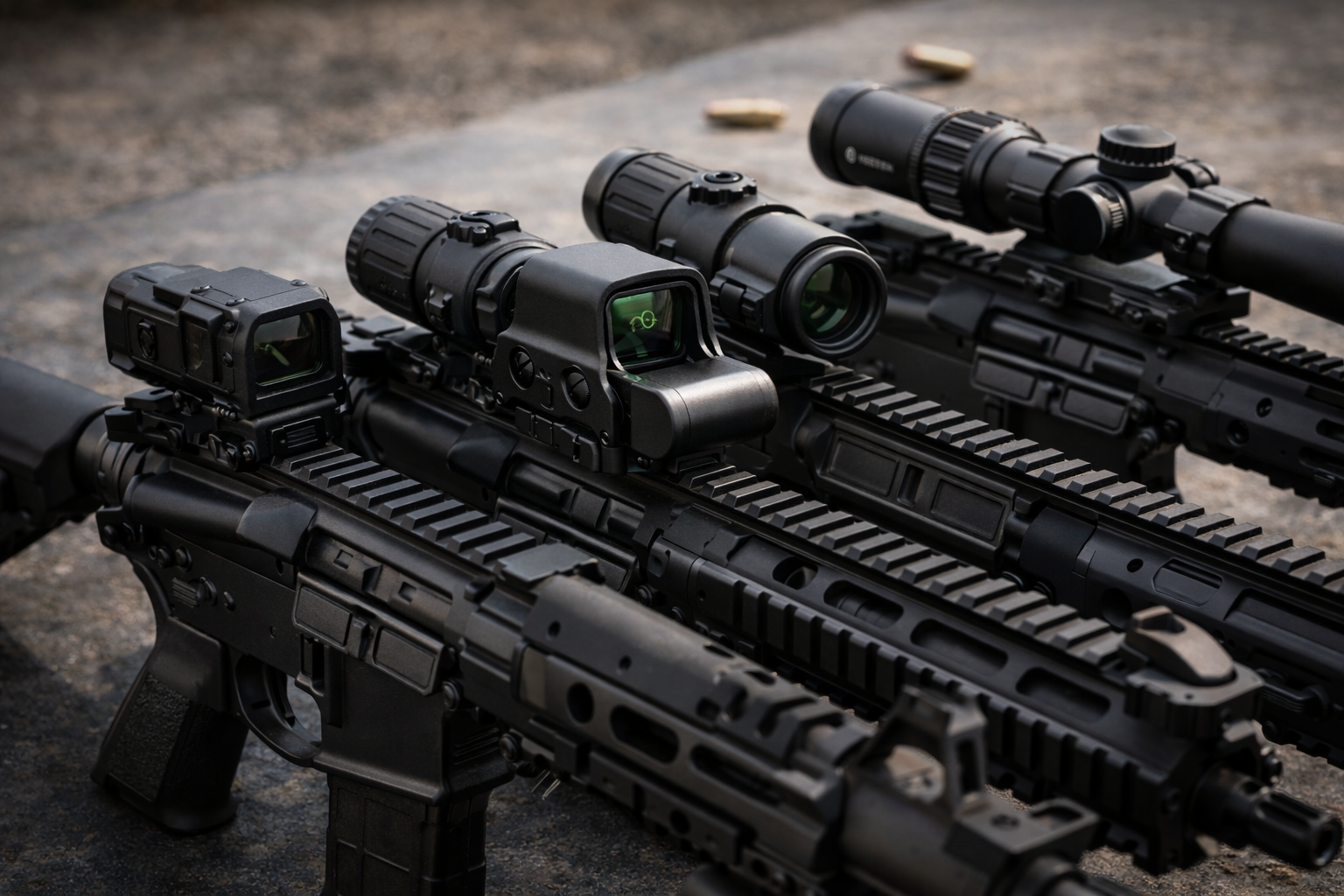
Pros and cons of the EOTECH HHS Green
✅ Pros
|
❌ Cons
|
The biggest thing you notice when you pick up a rifle wearing the HHS Green is that it feels substantial. Not cheap. Not flimsy. Not toy-like. It feels like a serious optic system. That is a compliment, but it also hints at the main drawback. You are carrying the whole system, not just the good feelings. The weight is real. The bulk is real. The battery-life tradeoff is real.
Still, those drawbacks buy you something. They buy you a very specific kind of performance. A lot of optics are technically competent. Fewer of them make you feel immediately connected to the rifle. That is where EOTECH keeps hanging around in premium conversations. People do not just buy the numbers. They buy the experience. The window. The reticle. The rhythm. The way the system moves from up-close speed to magnified detail without ever feeling like it forgot it was a carbine optic.
That is the real pros-and-cons answer. This setup is not “worth it” because it beats everything on paper. It is worth it because for the right shooter, it feels right where it counts.
Setup tips: how to mount, zero, and use the EOTECH HHS Green without doing dumb stuff
Start with the rifle’s real job
Before the optic ever touches the rail, decide what the rifle actually is. Defensive AR? General-purpose ranch rifle? Training gun? Match rifle that moonlights as a practical-use gun? That matters, because optic placement, backup iron-sight decisions, and even whether you leave the magnifier on all the time should be based on real use, not internet cosplay.
Mount the holographic sight first
Get the main holographic sight placed where it gives you a comfortable presentation without crowding the charging handle or turning your upper receiver into a traffic jam. On most AR-15 builds, the EXPS-style sight ends up living on the receiver with a little breathing room behind it for the magnifier. Do not shove everything together like you are trying to win a rail-space Tetris championship.
The point is consistency. When you shoulder the rifle, the window should land naturally in front of your eye. No hunting. No chin gymnastics. No weird turtle-neck position. If your presentation feels off, the rifle will tell you fast.
Then set the G33 for eye relief that works for you
The magnifier is where a lot of people get sloppy. They slap it behind the sight, declare victory, and then wonder why the image feels cramped or annoying. Take the extra few minutes and actually set it where your eye relief works in your normal stance. Not your “standing perfectly square on a flat range with zero gear on” stance. Your real stance. With the stock where you run it. With the clothing you might actually wear. With the rifle shouldered like an adult.
The good news is the G33 is not some fragile diva. It is pretty straightforward. Once you get it in the right place and aligned, it does what it is supposed to do. But those first setup inches matter more than people admit.
Use a sane zero
For most civilian AR-15 carbines, a 50-yard zero is still one of the most practical all-around choices. It is easy to confirm, easy to live with, and works well across the mixed distances where a hybrid setup like the EOTECH HHS Green actually shines.
If you want to speak in military terms, here is the honest version: the Army has long used a 25-meter zero target as a way to get a rifle close to a 300-meter battlesight zero, but 25 meters is not literally the same as 300 meters. Current Army marksmanship guidance is clear that a 25-meter zero does not guarantee a center hit at 300 meters, and a true 300-meter zero has to be confirmed at distance whenever possible.
So the practical answer is simple. Pick the zero that fits the rifle’s job. For many civilian carbines, that is 50 yards. For military-style training, a 25-meter near zero can be a useful starting point for a 300-meter battlesight concept, but it still needs real confirmation downrange. And no, the magnifier does not create a new zero. It just helps you see the target and reticle better. Zero the sight. Align the magnifier. Confirm the setup. Done.
Do not run the reticle brighter than necessary
This is one of the fastest ways to make any illuminated optic look worse than it is. Crank the brightness too high and the reticle blooms, glows harder than necessary, and starts making precision worse instead of better. The correct brightness is not “as bright as possible.” The correct brightness is bright enough to be fast, but no brighter.
This matters even more with a premium optic because people tend to assume expensive means you should be able to abuse the brightness settings and still get perfection. That is not how eyeballs work. Set it for the environment you are in. Adjust as conditions change. That is not a flaw. That is just using the gear correctly.
Flip the magnifier out of the way unless you actually need it
One of the dumbest mistakes people make with hybrid setups is acting like the magnifier must stay in line all the time because “I paid for it.” No, you paid for the option. Use the option. If the work is close, fast, and open, keep the rifle in its quickest form. If the work needs more detail, flip the magnifier in. That is literally why the system exists.
Trying to force 3x into situations where 1x would be faster is like wearing insulated bibs in July because you spent good money on them. Congratulations. You still made the day worse.
Witness-mark your setup
If this is a serious-use rifle, mark your mounts and fasteners so you can spot movement. A tiny witness mark can tell you fast whether something has shifted after hard use, transport, or a lot of rounds. This is not sexy advice. It is adult advice. Adult advice saves money and headaches.
Train transitions on purpose
Do not just own a hybrid optic. Use it like a hybrid optic. Practice with the magnifier out. Practice with it in. Practice moving it without looking at it. Practice recognizing when more detail actually helps and when it just slows you down. A magnifier is not magic. It is a tool. Tools earn their place when the user stops treating them like decoration.
Who should buy the EOTECH HHS Green — and who should skip it
Buy the EOTECH HHS Green if…
You want a real general-purpose carbine optic system. Not a cheapest-possible setup. Not a minimalist gram-counting setup. Not a “maybe someday I will use magnification” setup. A real one. You want premium 1x speed, practical magnified help, strong build quality, and a sight picture people still deliberately choose in a market packed with alternatives.
Buy it if your rifle needs to be fast up close but still useful at distance. Buy it if you genuinely prefer the EOTECH holographic experience to standard LED dots. Buy it if your eyes pick up green well and you already know that matters for you. Buy it if your rifle is meant to do serious work, hard training, or broad practical use and you are fine paying for a premium hybrid optic to support that role.
It is also a strong buy for the shooter who has tried the lighter, cheaper, “good enough” options and keeps circling back to the EOTECH feel anyway. At some point, buying the thing you actually prefer is not irrational. It is just honest.
Skip the EOTECH HHS Green if…
You are building an ultralight rifle. Skip it. This package is not for ounce-counting builds.
You need night vision compatibility as a hard requirement. Skip it and move into the correct EXPS3/HHS family instead of trying to wish NV features into a non-NV package.
You want years of battery life and the least maintenance possible. Skip it and look hard at Aimpoint or at least an enclosed LED dot with much longer runtime.
You are on a tighter budget and mainly want a capable close-to-midrange setup without paying premium EOTECH money. Skip it and look at strong value alternatives like a Holosun-based combo or a simpler dot-and-magnifier solution.
You mostly shoot inside 50 yards and have no real reason to care about a magnifier. Skip it. A plain high-quality optic will probably serve you better and keep the rifle handier.
And finally, skip it if product-listing inconsistency makes you nervous and you are not willing to verify the exact reticle configuration before ordering. On a premium optic, hesitation like that is fair. Better to be careful than end up with buyer’s remorse and a credit-card bill that feels like a kick in the teeth.
Check Price at Ammunition Depot

Final Verdict: EOTECH HHS Green review conclusion
The EOTECH HHS Green is a premium, purpose-built hybrid optic package that still absolutely makes sense. It is fast where a carbine should be fast, helpful where magnification actually matters, and rugged enough to feel like real gear instead of a fragile accessory with delusions of grandeur.
Its weaknesses are not hidden. It is heavy. It is expensive. It does not touch LED red-dot battery life. And the exact listing language around this green package needs more buyer attention than it should.
But when you judge it for the job it is actually meant to do, the HHS Green still hits hard. For shooters who want true 1x speed, practical 3x flexibility, and the specific EOTECH holographic feel that cheaper alternatives do not fully duplicate, this package remains a serious contender and a very legitimate buy.
Bark & Brass verdict: buy it for a serious general-purpose AR if you want the EOTECH experience and you are willing to pay for it. Skip it if weight, battery life, or hard NV requirements sit higher on your priority list.
FAQs: EOTECH HHS Green review
Is the EOTECH HHS Green worth the money?
For the right shooter, yes. The HHS Green earns its price by combining fast 1x holographic performance with a proven 3x magnifier in one serious-use package. It is not a bargain optic, and it is not trying to be. The real question is whether you specifically value the EOTECH hybrid experience enough to live with the weight and battery tradeoffs. Many shooters do. Plenty do not. That is why this is a use-case decision, not a universal answer.
Is the green reticle actually better than red?
For some eyes, absolutely. For others, not really. Green can stand out more in bright daylight and against certain backgrounds, and some shooters find it easier to acquire quickly. But “green is better” is too broad to be honest. The real answer is that green is better for some people, neutral for others, and sometimes less preferred indoors or in certain lighting. If you already know your eyes like green, that is a real point in favor of this package.
Is the EOTECH HHS Green night vision compatible?
Treat this package as non-night-vision unless the exact product listing and photos clearly prove otherwise. That is one of the messiest parts of the current listing ecosystem. Some retailer copy says things that conflict with EOTECH’s official HHS Green and EXPS2-family descriptions. For a premium optic, do not gamble. Verify before you buy.
Does the G33 magnifier change the zero?
No. The magnifier does not create a new zero. It enlarges the sight picture and helps you see the target and reticle more clearly. The primary sight gets zeroed. The magnifier gets aligned. That is the workflow. If your point of impact is wandering, something else is wrong.
Is the EOTECH HHS Green good for astigmatism?
It can be a very good option for some shooters with astigmatism, but nobody should promise miracles. Many people do report that holographic reticles look more usable to them than some LED dots. Others still see distortion. Eyes are personal, messy, and occasionally rude. The only perfect answer is real trigger time behind the optic. But yes, holographic sights remain one of the more common “this works better for my eyes” solutions.
Is the HHS Green too heavy for an AR-15?
Too heavy? Not automatically. Heavy enough that you will notice it? Absolutely. On a serious-use carbine, that weight may be worth it. On a lighter, handier rifle meant for all-day carry or minimalist handling, it can start to feel like more optic than you want. This is one of the biggest real-world buying questions, and it deserves a straight answer: the package is not light.
What is the difference between the HHS Green and HHS II?
The short answer is color and configuration. The green package gives you the green-reticle version of the hybrid concept, while the HHS II is the more standard red setup in this family. The broader user experience is similar. The buying decision usually comes down to whether you specifically prefer green enough to choose it, and whether the exact reticle configuration shown by the seller matches what you want.
Is the EOTECH HHS Green better than an LPVO?
Not better across the board. Better for certain priorities. If your rifle’s job revolves around being fast at 1x and only occasionally needing more detail, the HHS Green can be a better fit than an LPVO. If you regularly want more than 3x or spend more time on deliberate midrange and long-range work, an LPVO may serve you better. This is not an either/or religion. It is just matching tools to tasks.
What is the best zero for the EOTECH HHS Green on an AR-15?
A 50-yard zero remains one of the most practical all-around answers for a 5.56 AR. It keeps things straightforward, useful, and easy to confirm. Other zeros can work. But for a hybrid carbine optic meant to cover a lot of ground, 50 is still the cleanest general recommendation.
Should I leave the magnifier flipped in or flipped out?
Leave it where the job says it belongs. For close work, out. For more detail, in. That sounds simple because it is simple. The whole point of the system is flexibility. Use the flexibility.
Why this review matters at Bark & Brass
At Bark & Brass, we care about gear that actually earns space on a real rifle. Not fantasy safe queens. Not internet flex pieces. Not “operator” junk sold with more attitude than performance. The HHS Green is interesting because it sits in a lane a lot of shooters still genuinely need: one rifle, one optic system, close-range speed, better midrange utility, and no pretending that every shooter’s needs stop at room distance or start at 600 yards.
That is why this review tells the truth about the good and the bad. The HHS Green is a strong premium setup. It is also not light, not cheap, and not something buyers should order blindly without checking the exact listing details. Honest gear writing should save readers money when gear is wrong for them and give them confidence when gear is right. That is the whole point.