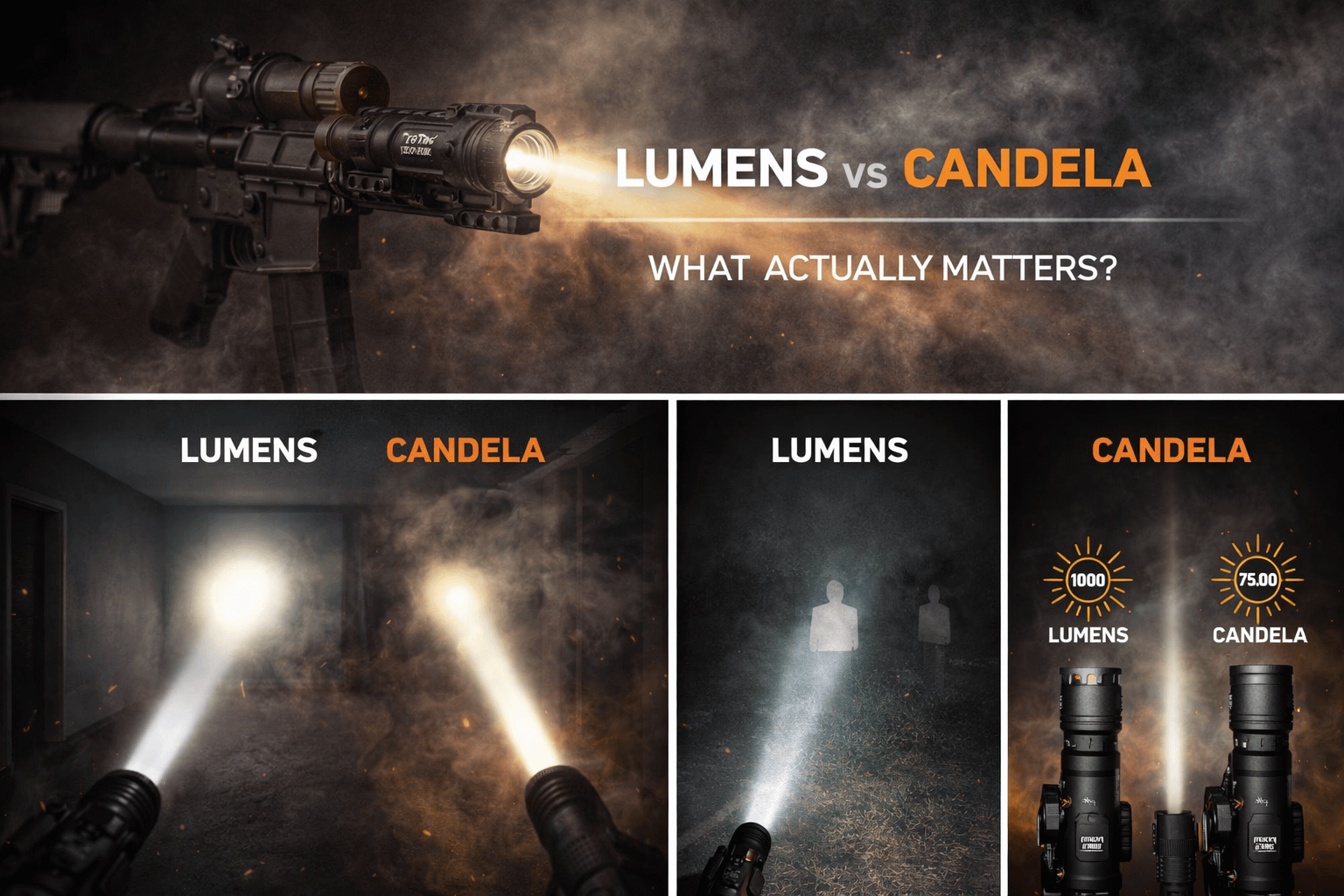
“AR-15 weapon light beam comparison showing lumens vs candela”
A no-hype, real-world breakdown of lumens vs candela—what the numbers actually mean, how they affect AR-15 performance, and how to choose the right beam for home defense, training, and outdoor use.
Why Lumens vs Candela Confuses So Many Shooters
If you’ve ever shopped for an AR-15 flashlight, you’ve seen it: massive lumen numbers splashed across packaging, ads promising daylight at midnight, and spec sheets that feel more like marketing than information.
Most new shooters assume more lumens automatically means a better weapon light. That assumption is understandable—and wrong.
Lumens and candela measure two completely different things, and misunderstanding that difference is one of the biggest mistakes people make when setting up a defensive rifle.
This confusion doesn’t come from shooters—it comes from how lights are marketed.
What Lumens Actually Measure (Plain English)
Lumens measure total light output.
Think of lumens as how much light exists, not how it’s used.
A light with:
-
1,000 lumens produces more total light than a 500-lumen light
-
But that light can be spread out or tightly focused
Lumens tell you nothing about:
-
Distance
-
Intensity at a specific point
-
How well light cuts through darkness
This is why two lights with the same lumen rating can feel wildly different on an AR-15.
What Candela Actually Measures (The Missing Piece)
Candela measures light intensity at a specific point.
In real terms:
-
Candela determines how far a beam reaches
-
Higher candela = tighter, more focused beam
-
Candela controls how well a light punches through:
-
Darkness
-
Smoke
-
Streetlights
-
Headlights
-
Candela is what lets you identify something at distance—not just light it up.
Why Lumens Alone Don’t Tell the Full Story
Here’s the simplest way to understand it:
-
Lumens = volume of light
-
Candela = pressure of light
A high-lumen, low-candela light:
-
Floods rooms
-
Lights up walls and corners
-
Loses effectiveness quickly outdoors
A lower-lumen, high-candela light:
-
Reaches farther
-
Cuts through ambient light
-
Can feel “less bright” up close but dominates at distance
This is why lumens alone are a poor decision-making tool.
Indoor AR-15 Use: Lumens vs Candela
Inside a home, most defensive encounters occur within 7 yards or less. At that distance:
-
Excessive candela can cause harsh splashback
-
Wide spill helps with situational awareness
-
Beam forgiveness matters more than distance
This is why many home-defense-friendly lights use moderate lumens with balanced candela.
Outdoor & Distance Use: Lumens vs Candela
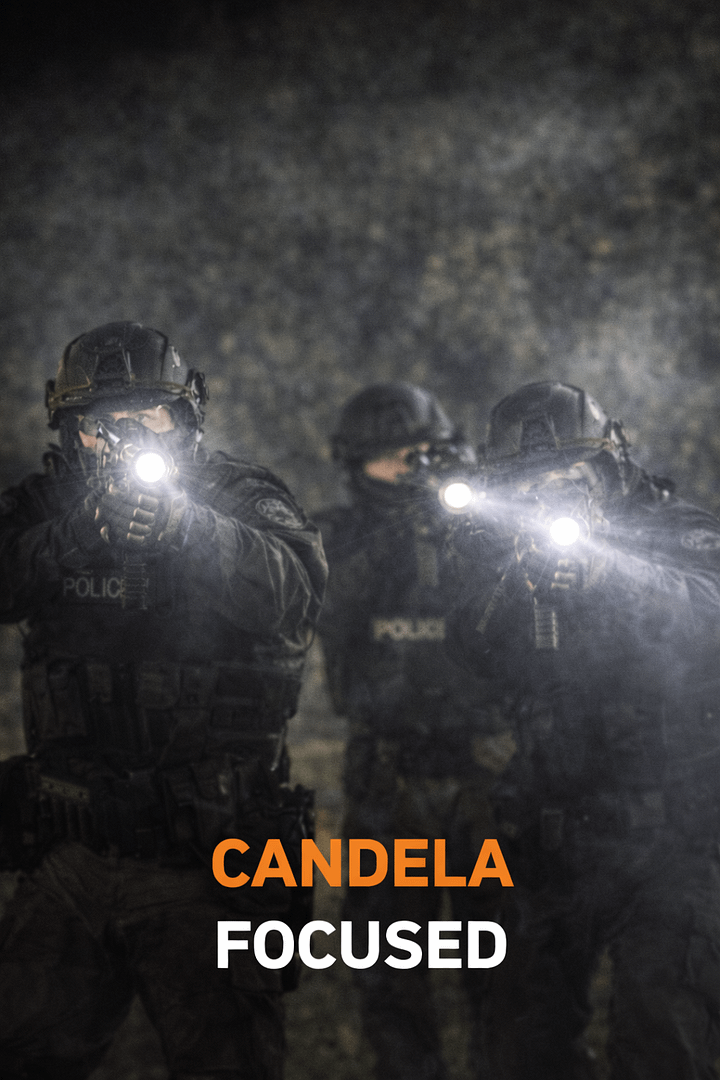
Step outside, and everything flips.
Ambient light, shadows, and distance demand:
-
Higher candela
-
Tighter beam
-
Less spill
This is where Turbo-style lights dominate.
“high candela AR-15 weapon light for outdoor distance identification”
Pros & Cons: High-Lumen Focused Lights
| Pros | Cons |
|---|---|
| Excellent room-filling illumination indoors | Limited effectiveness at longer distances |
| More forgiving for new shooters | Can wash out targets outdoors |
Pros & Cons: High-Candela Focused Lights
| Pros | Cons |
|---|---|
| Superior distance identification | Less forgiving indoors |
| Performs better against ambient light | Requires more training to use effectively |
How Law Enforcement Thinks About Light Output
Law enforcement agencies increasingly prioritize candela, especially for patrol rifles. According to discussions and reporting from GunTalk and AmmoLand, officers need to identify threats around vehicles, alleyways, and street lighting—situations where lumens alone fail.
Beam Pattern Explained (Hot Spot, Spill, and Throw)
Once you understand lumens and candela, the next piece that clicks everything into place is beam pattern. This is where numbers stop being abstract and start becoming something you can actually feel when you press the switch.
Every weapon light beam is made up of three parts:
Hot Spot
The hot spot is the brightest, most concentrated part of the beam.
This is where candela lives.
-
Tight hot spot = higher candela
-
Wide hot spot = lower candela
-
Determines how far the light reaches
For outdoor AR-15 use, this is the part of the beam that lets you identify shapes, movement, and details past typical indoor distances.
Spill
Spill is the softer light that surrounds the hot spot.
-
Helps with situational awareness
-
Lights peripheral areas
-
Reduces tunnel vision
For home defense, spill is often more important than throw. You want to see hands, doorways, and corners—not just what’s directly in front of the muzzle.
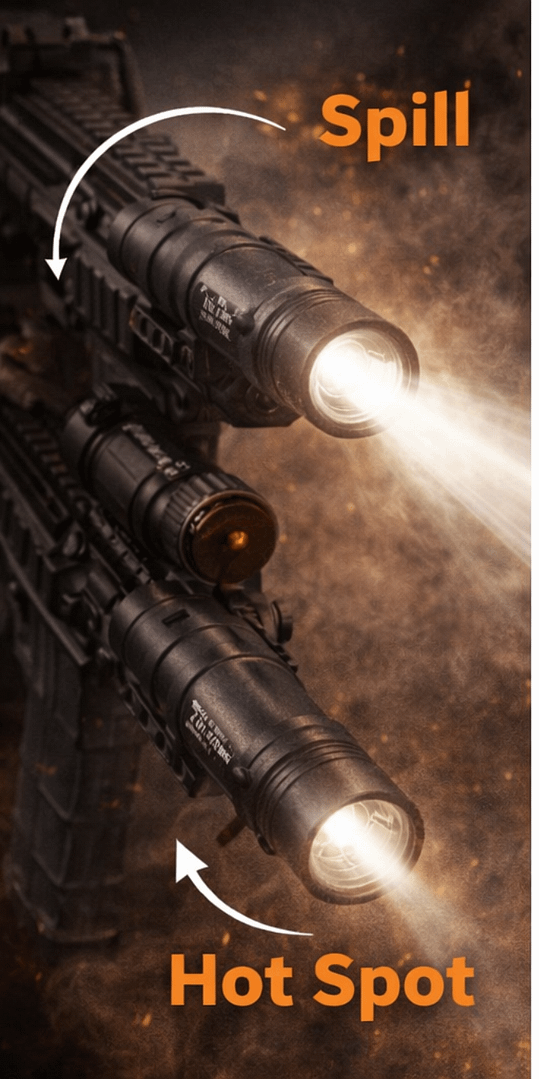
AR-15 flashlight beam pattern hot spot and spill explained”
Throw
Throw is the combination of hot spot intensity and beam focus.
-
High candela = longer throw
-
Low candela = shorter throw
Throw matters outdoors. Indoors, it can actually work against you if it’s too aggressive.
Why Marketing Overemphasizes Lumens
Lumens are easy to sell.
A bigger number looks better on a package, and most buyers don’t have a reference point for what those numbers actually mean in a hallway or backyard. This leads to three common marketing problems:
-
Lumens without context
-
No candela disclosure
-
No beam pattern explanation
This is why two “1,000-lumen” lights can feel completely different on an AR-15. One floods a room comfortably. The other punches a hole in the dark and leaves everything else shadowed.
Neither is wrong—they’re just built for different jobs.
How Lumens and Candela Affect Training
Training with your rifle light reveals things specs never will.
High-Lumen, Low-Candela Lights in Training
-
Easier to control indoors
-
Less self-blinding from walls
-
Faster target transitions
-
More forgiving under stress
These lights are excellent for:
-
New shooters
-
Family members
-
Dry-fire and low-light drills inside structures
High-Candela Lights in Training
-
Require deliberate activation
-
Demand better muzzle discipline
-
Highlight bad habits quickly
These lights excel when:
-
Training outdoors
-
Working around vehicles
-
Identifying targets at distance
Neither option replaces training. They simply emphasize different skills.
Common Beginner Mistakes (And Why They Happen)
Understanding lumens vs candela helps avoid some very common—and very frustrating—mistakes.
Mistake #1: Buying the Brightest Light Available
More brightness isn’t always better. Indoors, excessive candela can create glare and back-splash that actually reduces visibility.
Mistake #2: Ignoring Beam Pattern
Specs don’t show how a beam behaves in a hallway. Beam pattern matters more than numbers.
Mistake #3: Not Matching the Light to the Environment
Apartment, suburban home, rural property—each environment favors a different balance.
Choosing the Right Balance for Home Defense
For most home-defense AR-15s, the ideal setup is:
-
Moderate lumens
-
Moderate candela
-
Balanced beam pattern
This gives you:
-
Enough brightness to dominate darkness
-
Enough spill to maintain awareness
-
Enough control to avoid self-blinding
This is why many proven home-defense lights don’t chase extreme candela figures.
Choosing the Right Balance for Outdoor & Rural Use
If your rifle is used outdoors—property defense, training land, perimeter awareness—the equation changes.
You want:
-
Higher candela
-
Tighter hot spot
-
Less emphasis on spill
Here, distance identification matters more than room illumination.
Pros & Cons Summary: Lumens vs Candela
High-Lumen Bias (Flood-Focused)
| Pros | Cons |
|---|---|
| Excellent indoor visibility and situational awareness | Limited effective range outdoors |
| Forgiving for beginners under stress | Struggles against ambient outdoor light |
High-Candela Bias (Throw-Focused)
| Pros | Cons |
|---|---|
| Superior long-range identification | Can cause splashback indoors |
| Performs well around vehicles and streetlights | Requires more disciplined use |
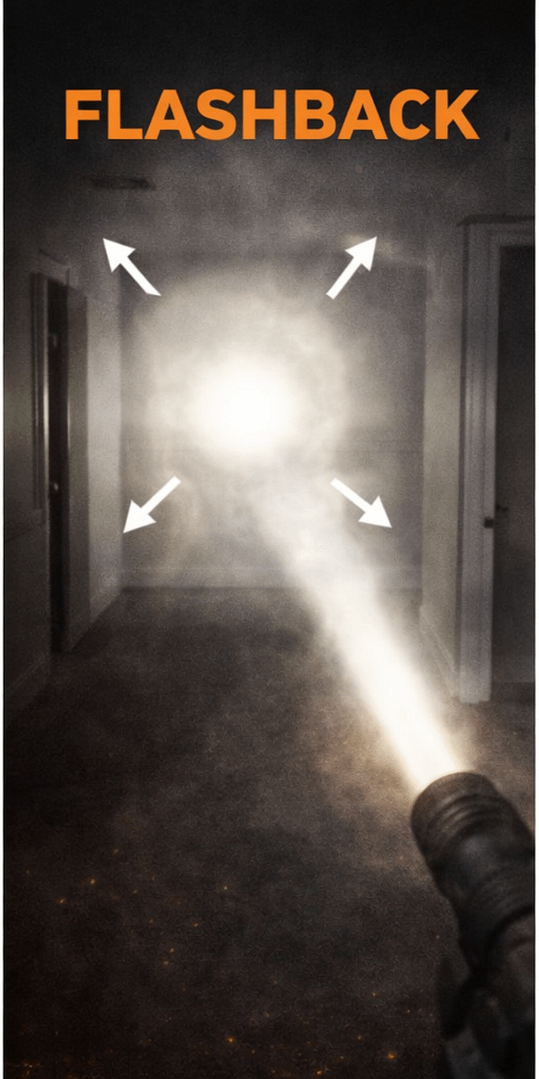
AR-15 weapon light indoor flashback from high candela beam”
Frequently Asked Questions (FAQs)
Is candela more important than lumens?
Neither is universally “more important.” Candela matters for distance. Lumens matter for area illumination.
How many lumens do I need for a home-defense AR-15?
Typically 500–1,000 lumens with a balanced beam pattern works very well indoors.
Can a light be too bright indoors?
Yes. Excessive candela can reflect off walls and reduce usable visibility.
Do police prioritize lumens or candela?
Modern patrol rifle setups increasingly prioritize candela for outdoor and vehicle-based encounters.
Why don’t all manufacturers list candela?
Because lumens are easier to market and easier for consumers to understand.
Should beginners avoid high-candela lights?
Not necessarily—but they benefit from training and understanding beam behavior.
Final Thoughts: What Actually Matters
The lumens vs candela debate only matters when it’s misunderstood.
Lumens tell you how much light exists.
Candela tells you how that light behaves.
Once you stop chasing numbers and start matching beam characteristics to your environment, everything gets simpler. The “best” AR-15 flashlight isn’t the brightest—it’s the one that lets you see clearly, identify correctly, and act decisively in the conditions you’re most likely to face.
That’s the difference between buying specs and buying capability.
Blog Links
Streamlight ProTac Rail Mount 2
Streamlight ProTac HL-X Rifle Light Review
Best AR-15 Flash Lights for Home Defense