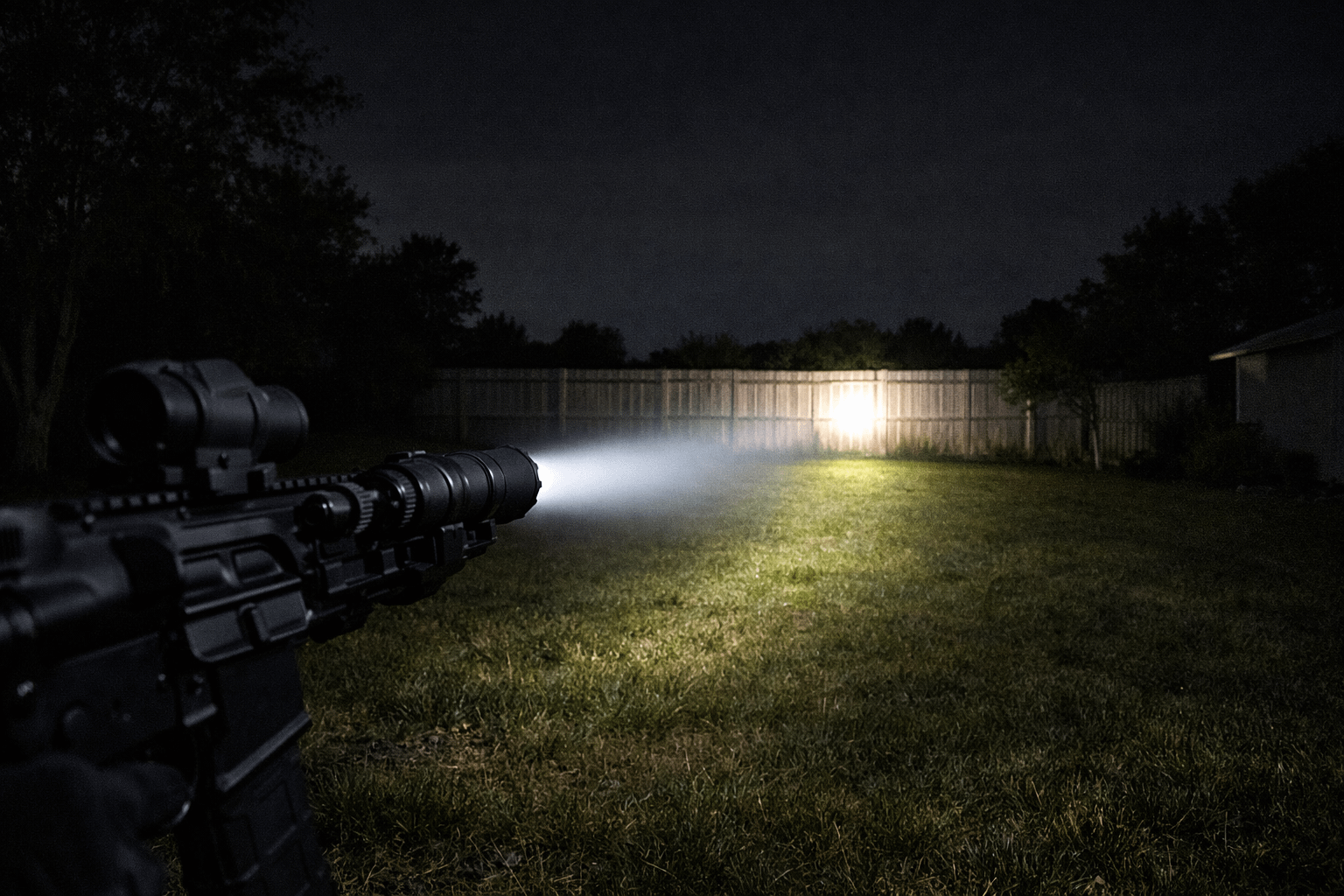
If you want a compact Scout-style light that throws instead of just glowing, this M340DFT Turbo review breaks down what “Turbo” really means on a rifle. More importantly, it translates the specs into real hallway, driveway, and yard performance—so you can set it up once and stop tinkering.
Internal Links
- Best AR-15 Flash Lights in 2026
- Lumens vs Candela for AR-15 Flash Lights (What Actually Matters?)
- Where to Mount a Flashlight on an AR-15
- Streamlight ProTac HL-X Review
- SureFire M640U Review
- SureFire Mini Scout Light Pro Review
1) What This M340DFT Turbo Review Covers
This M340DFT Turbo review focuses on how the light behaves where people actually use it: hallways, doorways, stairs, driveways, and yards. Additionally, this M340DFT Turbo review covers mounting placement, power options, and a quick audit you can run in minutes. Finally, this M340DFT Turbo review includes a comparison table so your readers can pick the right light in the series without guessing.
2) What the M340DFT Turbo Is (and why “Turbo” matters)
The SureFire Scout Light Pro line has a reputation for a mature mount ecosystem and dependable hardware. However, the M340DFT Turbo changes the beam strategy: it leans into high candela in a compact body. In practice, this means the hotspot is tighter and reaches farther, especially when ambient light is fighting you.
Here’s the simple translation this M340DFT Turbo review sticks to:
-
Regular “bright” lights fill rooms well.
-
Turbo-style high-candela lights push a tight hotspot farther, which is useful outdoors and in bigger spaces.
-
Therefore, the M340DFT Turbo isn’t chasing “flood.” Instead, it’s chasing reach.
If you want the deeper “why,” link internally right here:
Read next: Lumens vs Candela for AR-15 Flash Lights (What Actually Matters?)
3) M340DFT Turbo Review Specs That Actually Matter
SureFire-style Turbo lights typically publish two performance lanes depending on battery type. That matters because buyers often read the best-case spec once and then get confused later.
M340DFT Turbo review quick spec table
| Power Source | Output Lane | What it means |
|---|---|---|
| SF18350 rechargeable | Higher candela + full Turbo feel | Best “reach” performance |
| CR123A (single) | Reduced output lane | Still strong, but less bite |
Beginner translation:
Even when lumens aren’t huge, candela is doing the heavy lifting. As a result, the beam “cuts” rather than “glows.”
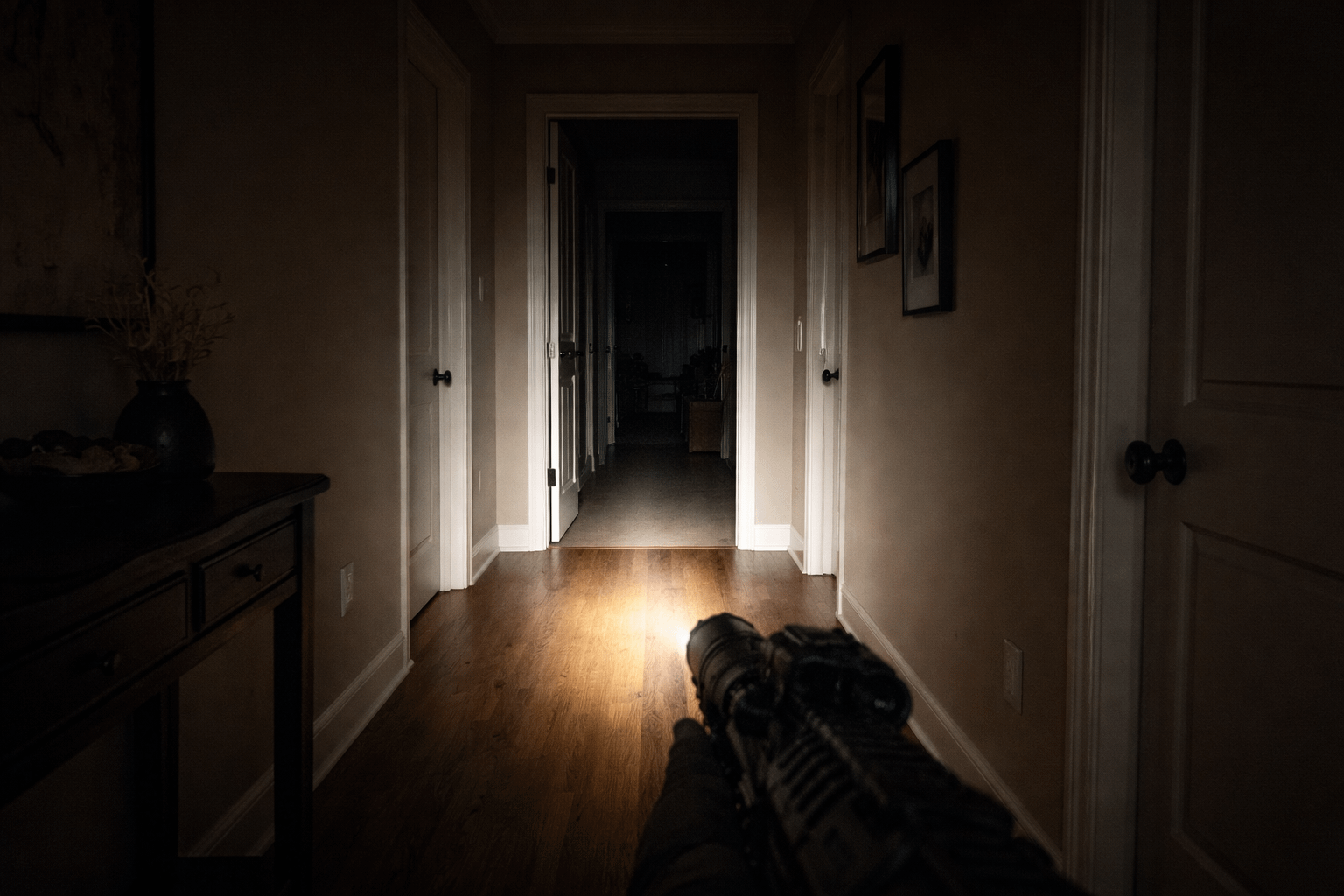
4) M340DFT Turbo Review Beam Indoors (How to Avoid Splashback)
Turbo indoors can feel spicy, not because the light is “bad,” but because white walls reflect hard. Still, with better habits, the beam becomes controllable fast.
Indoor habits that make this M340DFT Turbo review honest
-
Use momentary bursts more than constant-on
-
Aim low first (floor + doorway edges), then lift only for detail
-
Treat the hotspot like a pointer—quick info, quick off
5) M340DFT Turbo Review Beam Outdoors (Where Turbo Wins)
Outdoors is where Turbo lights earn their reputation. In other words, this is the part of the M340DFT Turbo review that makes people grin—because the hotspot stays defined farther out.
Outdoor benefits that show up fast
-
Better reach across a driveway or yard
-
Better resistance to porch lights and streetlights
-
More readable detail at practical property distances

6) Power Plan in This M340DFT Turbo Review: SF18350 vs CR123A
This M340DFT Turbo review keeps the battery advice boring on purpose—because boring is reliable.
Run CR123A when…
-
the rifle sits staged most of the time
-
you want simple storage planning
-
you’d rather avoid charging routines
Run SF18350 when…
-
you train often
-
you want full Turbo performance
-
you can keep a consistent charge routine
Either way, pick one plan and stick to it. Otherwise, you’ll constantly wonder whether the light is truly ready.
7) Switching and Controls in This M340DFT Turbo Review
Most shooters should start tailcap-first. Then, if speed matters later, add a remote switch only after your placement is proven.
Tailcap-first (recommended for beginners)
-
fewer failure points
-
easier troubleshooting
-
less snag risk
Remote switch later (only after your setup is clean)
-
faster momentary use
-
more consistent activation
-
but more routing responsibility

8) Where to Mount the Light (M340DFT Turbo Review Mounting Guidance)
Mounting isn’t cosmetic—it’s control. Because of that, you want a position where your support hand can run the light naturally.
Best starting points for most shooters:
-
11 o’clock / 1 o’clock (high-offset): great thumb access, reduced snag risk
-
12 o’clock: clean ambi feel, but rail space can get crowded
Link internally in the section where it matters:
Mounting guide: Where to Mount a Flashlight on an AR-15
Rail-type note (so beginners don’t get stuck)
-
If you have a Pic rail: placement experiments are easy
-
If you have M-LOK: you’re deciding where the rail section lives
-
If you have a short handguard: offset often stays cleaner than stacking gear up top
9) Turbo vs Balanced Beams (Key Tradeoffs Explained)
This part of the M340DFT Turbo review is simple: Turbo is a reach tool. Balanced beams are usually easier indoors.
Turbo gives you
-
distance confidence
-
better ambient light resistance
-
a tighter hotspot for detail
Turbo demands
-
better indoor technique
-
more intentional aiming
-
momentary habits in tight spaces
Beginner takeaway:
Turbo works indoors, but it rewards discipline. Meanwhile, outdoors it rewards you instantly.
10) Real-Home Walkthrough (Hallway, Doorway, Stairs)
This M340DFT Turbo review needs to feel real, so here are three mini-scenes that match how normal homes behave.
Hallway (white-wall bounce test)
Aim chest-high at a wall two feet away and you’ll hate life. Aim low at the floor and doorway edges and your eyes stay happier. As a result, you get information without washing yourself out.
Doorway (edge reveal test)
Hotspot into the room, spill on the edge. That balance keeps doorframe edges readable instead of disappearing into darkness.
Stairs (shadow factory)
Stairs move your muzzle angle constantly. Therefore, aim at landings or mid-steps, and stay momentary.
11) Troubleshooting + Maintenance
Turbo lights are tools. Tools need simple upkeep.
Troubleshooting table
| Problem | Likely cause | Quick fix |
|---|---|---|
| Flicker | tailcap not seated / battery contact | tighten tailcap, re-seat battery |
| “Feels weak” | battery low / lens dirty | swap battery, wipe lens |
| Indoor splashback | aim too high / constant-on | aim lower, go momentary |
| Sling snags | placement fights sling path | move to 11/1, re-route sling |
Maintenance (boring reliability routine)
-
monthly: activate momentary + constant-on, check mount tension
-
after range day: confirm tightness again
-
lens care: microfiber wipe, don’t scrape
12) The 7-Minute Setup Audit (M340DFT Turbo Review Checklist)
Minute 1 — Thumb test: activate 10 times without looking. If you miss twice, move it.
Minute 2 — Sling test: walk past a doorway edge slowly. If it catches, fix routing.
Minute 3 — Hallway bounce: momentary bursts, aim low.
Minute 4 — Doorway edge: hotspot into room, spill on edge.
Minutes 5–6 — Outdoor distance: test your real driveway/yard distance.
Minute 7 — Re-check tightness: confirm mount tension now and after range day.
13) M340DFT Turbo Review vs Every Light in the Series
| Light | Best for | Why it wins |
|---|---|---|
| M340DFT Turbo | Compact throw | high-candela reach in a small body |
| Streamlight HL-X | Value power | output-per-dollar (bigger body) |
| Streamlight RM2 | Simple budget | compact and straightforward |
| SureFire M640U | Balanced premium | general-purpose beam + ecosystem |
| SureFire Mini Scout | Compact premium | small footprint |
| InForce WML Gen 3 | Simplest control | integrated switch, no pad needed |
| Nextorch WL50IR | White + IR | dual-spectrum capability |
14) Pros & Cons
|
|
15) FAQ (ONE Section Only)
1) Is this M340DFT Turbo review saying it’s too intense for indoors?
Not at all. However, Turbo beams demand better habits indoors. Therefore, use momentary bursts and aim low first.
2) Why does candela matter so much in this M340DFT Turbo review?
Candela is intensity. As a result, it drives reach and keeps the hotspot readable in ambient light.
3) Should I run SF18350 or CR123A?
For frequent training, SF18350 is convenient. For staged rifles, CR123A stays simple.
4) Where should I mount it?
Start at 11/1 offset or 12 o’clock if your rail is clean. Then run the 7-minute audit.
5) Do I need a remote switch right away?
No. Tailcap-first is easier to trust. Later, you can add a remote if your routing stays clean.
16) Final Thoughts (Bark & Brass Style)
This M340DFT Turbo review comes down to one honest idea: Turbo is a reach tool. It doesn’t try to flood the world like a lantern. Instead, it throws a tight hotspot that stays sharp at distance, keeps its bite through ambient light, and turns a driveway or fence line from “maybe” into “clear.”
Indoors, better technique makes all the difference. On the other hand, outdoors is where the Turbo personality really clicks. Because of that, this M340DFT Turbo review recommends the light most strongly for mixed indoor/outdoor rifles, property checks, and anyone who wants compact throw without front-end clutter.
If you set it up clean, run the audit, and keep it boring, the M340DFT Turbo becomes the best kind of gear: the kind you stop thinking about.
(And yes—this M340DFT Turbo review is still a “buy once, cry once” lane. Still, the performance is the reason people keep coming back.)
Outbound Links