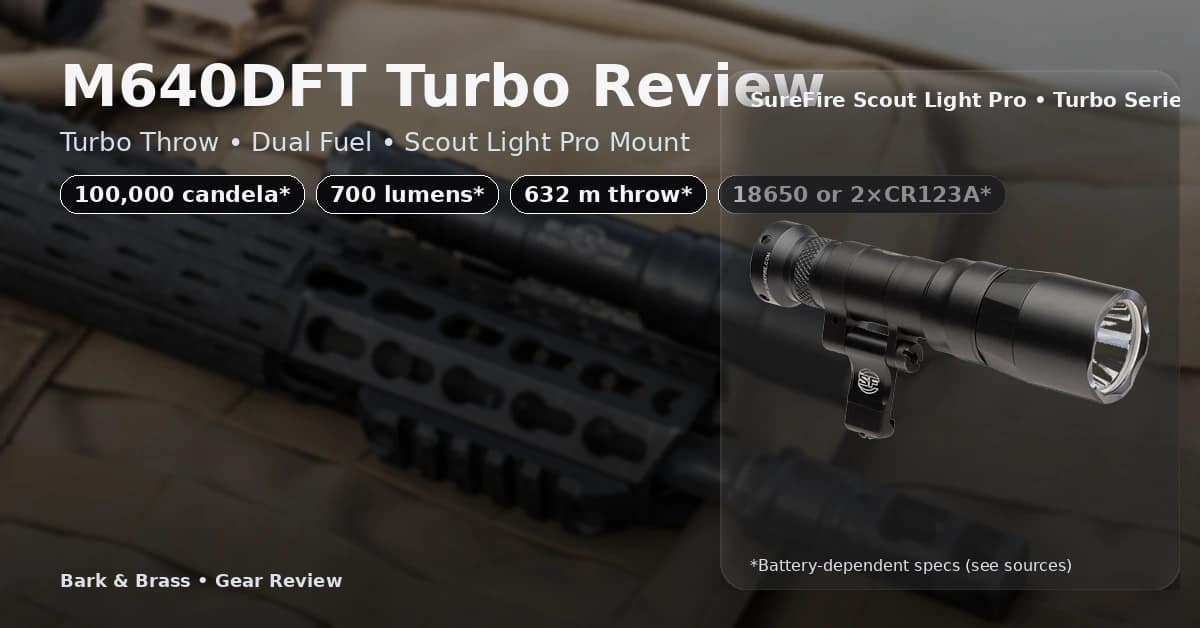
Deck: The M640DFT Turbo is built for shooters who want a tight, distance-friendly beam and a durable mount—without giving up battery flexibility.
Quick Verdict — Who the M640DFT Turbo Is For
If you want a beam that “reaches out” instead of washing everything in wide spill, the M640DFT Turbo is aimed at your lane. Even so, it’s not a perfect match for every home or every shooter.
Perfect for you if…
- You want long throw and a tighter hotspot for distance-friendly identification.
- You like having two battery options (rechargeable pack or CR123A backup).
- Your rifle is crowded and you need a mount that helps keep things tidy and snag-free.
You may want a different light if…
- You’re primarily indoors and want more spill for room-to-room awareness.
- You need the lowest-cost option—SureFire is premium gear, and it’s priced that way.
- You prefer a softer beam for close-up tasks and reflective interiors.
Why a Rifle Light Matters
A rifle light isn’t about looking “tactical.” Instead, it’s about seeing clearly so you can make better, safer decisions. In other words, a light helps you confirm what you’re looking at before you act.
For context, the Bureau of Justice Statistics reported that a household member was present in roughly 1 million burglaries per year (2003–2007 average), and some incidents involved violence when residents were home. That’s not here to scare anybody; rather, it’s a reminder that low-light uncertainty can happen fast.
Because of that, your rifle light should be reliable, simple to run, and easy to maintain. Consequently, the best setup is the one you can operate under stress without thinking too hard.
Candela vs Lumens
People argue lumens and candela like it’s a rivalry. However, they measure different things, and you need both concepts to pick the right tool.
- Lumens = total light output (how much light leaves the flashlight)
- Candela = beam intensity in a specific direction (how “focused” the beam is)
GunMagWarehouse explains candela as the unit of luminous intensity and notes it measures how intense the light is “in a particular direction.” That’s why higher-candela lights often feel like they “reach” farther.
So, here’s the easiest mental picture: lumens are how much water you have, while candela is whether you spray it through a wide fan or a tight hose. A Turbo-style beam is the tight hose.
What “Turbo” Means in Real Life
The Turbo idea is simple: concentrate the beam so the hotspot stays useful at distance. As a result, a Turbo light often feels more “laser-like” compared to a floodier beam.
SureFire’s M640DFT-PRO Turbo Scout Light Pro listing highlights a tightly focused beam and includes a note that the SF18650B battery is required to hit the top-end performance numbers.
Practically speaking, Turbo beams are popular for:
- Long driveways and property checks
- Outdoor scanning where distance matters
- Large structures and long hallways
- Training days where targets aren’t always close
Meanwhile, if most of your use is inside small rooms with light-colored walls, more spill can feel friendlier.
M640DFT Turbo Specs
Here are the key specs commonly listed for the M640DFT Turbo (battery-dependent):
- Output: 700 lumens (with SF18650B) / 600 lumens (with 2× CR123A)
- Peak intensity: 100,000 candela (SF18650B) / 90,000 candela (2× CR123A)
- Beam distance: 632 m (SF18650B) / 600 m (2× CR123A)
- Runtime: 2.75 hr (SF18650B) / 1.75 hr (2× CR123A)
- Length: 5.9 in
- Weight (w/ batteries): 5.5 oz
- Bezel diameter: 1.258 in
- Waterproof: IPX7 (1 meter for 30 minutes)
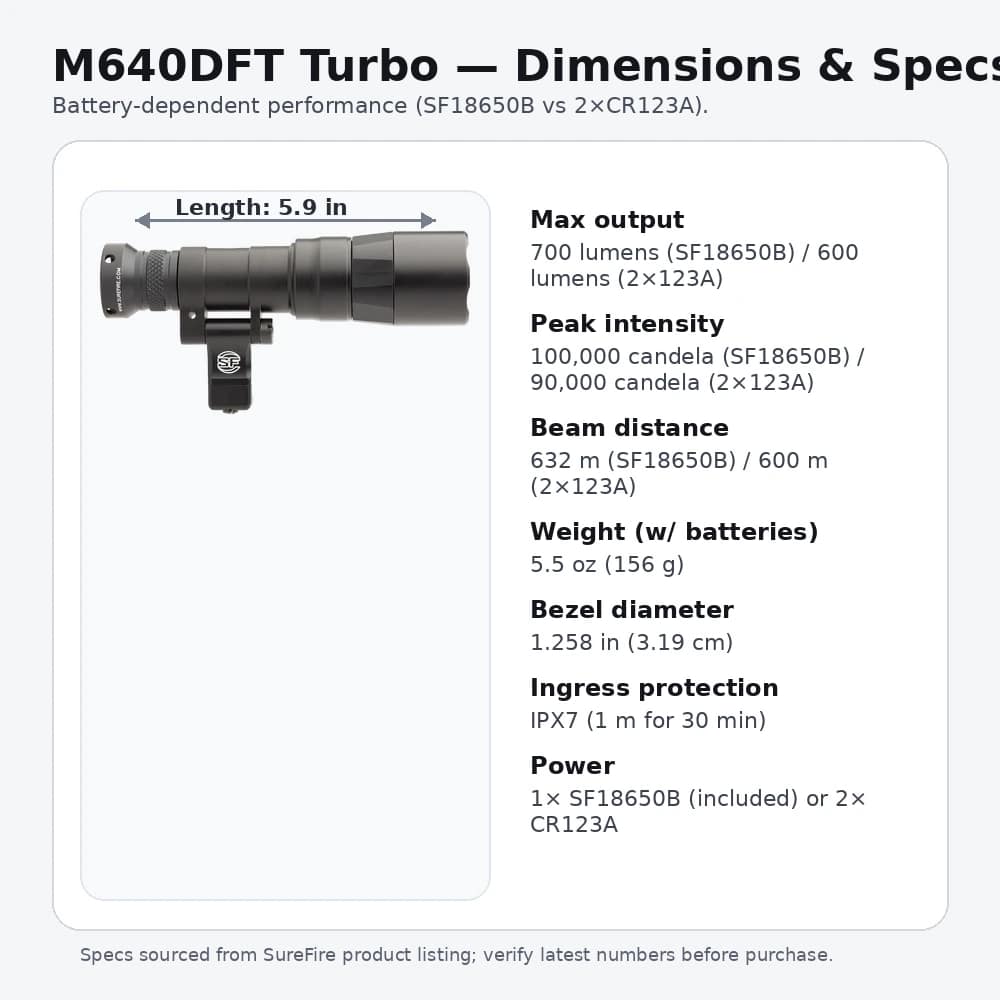
Important note: Performance depends on battery choice. Therefore, if you want the top-end numbers, confirm you’re using the correct power source and the latest manufacturer guidance.
Hands-On Feel: What It’s Like Mounted
When you pick up a rifle with a well-mounted light, the whole system feels cleaner. With the M640DFT Turbo, the first thing you notice is that it doesn’t feel like a fragile add-on. Instead, it feels like a compact metal tool that’s meant to live on a working gun.
The SureFire listing calls out a Mil-Spec hard-anodized aluminum body and a tempered window, which lines up with that “built to ride” impression.
Now for the real-world detail people care about: the beam personality. A throw-focused beam pulls your eyes straight into the hotspot. Consequently, it feels decisive—like it’s telling you exactly where to look.
Beam Pattern: Where the M640DFT Turbo Shines
Outdoors, Turbo-style beams tend to feel “cleaner” because you get more usable intensity downrange. On the other hand, indoors that tight hotspot can bounce hard off pale walls at close distances.
What you’ll love
- Distance-friendly hotspot: easier to keep detail at range
- Less wasted spill outdoors: helpful in brushy or cluttered environments
What you should understand
- Close reflective surfaces: may feel intense in small rooms
- Less room-filling light: compared to a more spill-heavy beam
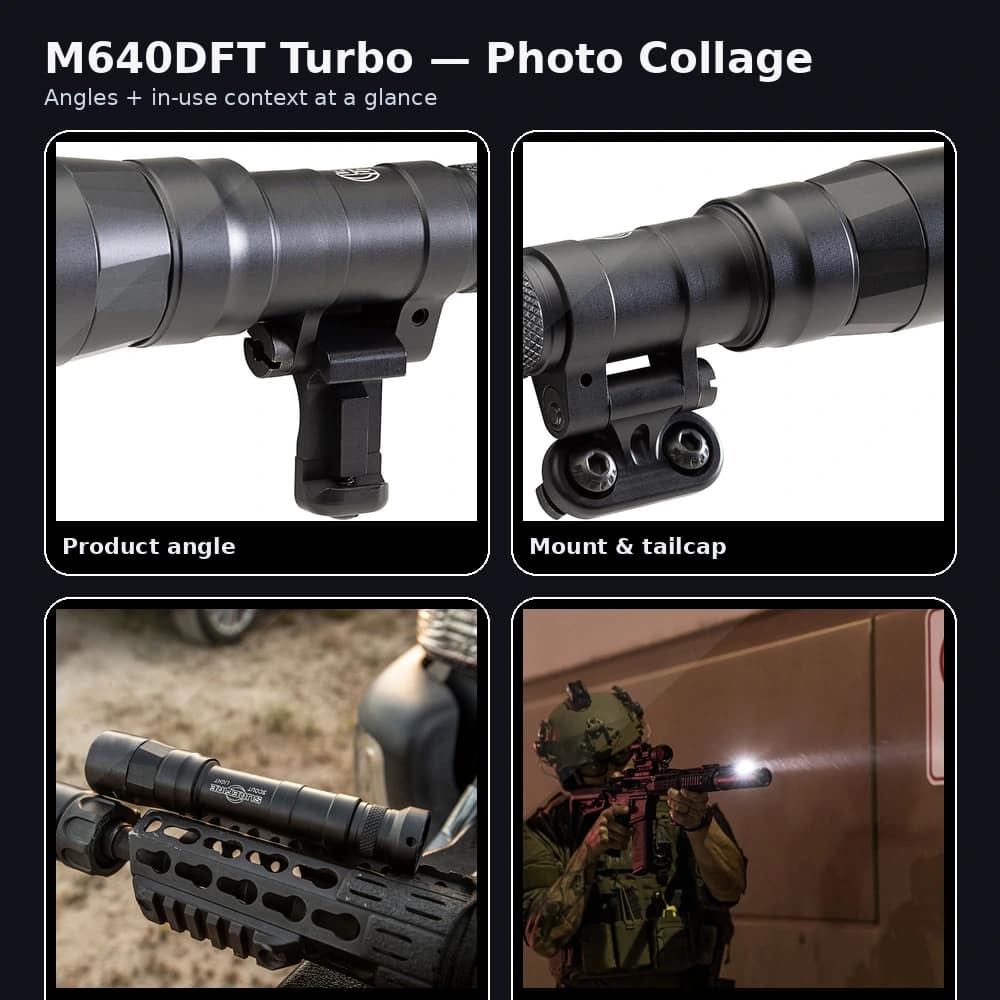
Mounting the M640DFT Turbo
Mounting sounds boring until your rifle gets crowded. Thankfully, the SureFire listing notes the Low-Profile Mount (LPM) is designed to optimize placement and includes mounting for MIL-STD-1913 and M-LOK rails.
The Comfort Test
- Shoulder the rifle normally.
- Place your support hand where it naturally lands.
- Try to activate the tailcap without shifting your grip.
- If you’re hunting for the button, move the light.
That’s the goal: repeatable activation. Moreover, a good mount position reduces snag points and keeps your setup feeling balanced.
Controls & Switching
The SureFire listing mentions instant activation and compatibility with accessory remote switches.
Still, beginners usually do best with a simple plan:
- Start with the tailcap so you learn what’s natural.
- Upgrade later if your grip or rail layout truly demands it.
In addition, practice “short bursts” rather than leaving the beam on continuously. That habit reduces splash, preserves night vision, and keeps you in control.
Dual Fuel for the M640DFT Turbo: SF18650B vs CR123A
Dual Fuel matters because it gives you options. According to the manufacturer listing and major retailers, you can run the rechargeable battery for top-end performance or swap to CR123A for convenience and storage planning.
Rechargeable (top performance)
- Pros: strongest listed output and intensity
- Tradeoff: you need a charging routine
CR123A (simple storage option)
- Pros: easy to stage as a backup
- Tradeoff: lower listed output and intensity
So, here’s the practical recommendation: train on the rechargeable option, then keep CR123A as a realistic backup plan if you want. That way, you’re covered either way.
Runtime Reality
Runtime specs are useful, but they’re often misunderstood. In real life, most defensive or “check that noise” light use happens in short bursts. Therefore, your routine matters more than the raw runtime number.
For reference, published runtime numbers are commonly listed around 2.75 hours on the rechargeable setup and 1.75 hours on CR123A, depending on source and configuration.
Consequently, a simple battery routine wins:
- Monthly function check
- Verify tightness and mount hardware
- Recharge or rotate batteries on a schedule
IPX7, Weather, and Durability
SureFire states the light meets the IPX7 waterproof test standard at 1 meter for 30 minutes.
That doesn’t mean you should treat it like a dive light. Instead, it means rain, splashes, and wet gear are unlikely to be deal-breakers. Even so, wipe things down after hard weather days and inspect your setup like any other serious tool.
Real-World Use Cases for the M640DFT Turbo
1) Home layouts with longer sight lines
If your home includes longer hallways or outdoor-facing windows, the tighter hotspot can be handy. However, in small white rooms, the beam can feel intense—so short bursts help.
2) Rural property checks
This is where a throw-focused beam feels “made for the job.” You can scan distance without flooding the entire world with spill.
3) Training nights
Turbo beams reward technique. For example, angles matter a lot near barricades. With practice, you’ll get the benefit without blinding yourself from splash.
Setup Recipes
Recipe A: Mostly indoors
- Mount for easiest thumb activation
- Use momentary bursts more often
- Avoid blasting close white walls when possible
Recipe B: Mixed home + property
- Use rechargeable for training; keep backup batteries staged
- Practice going from indoor corners to outdoor distance
Recipe C: Rural/distance priority
- Prioritize snag-free mount placement
- Practice scanning without leaving the beam on constantly
M640DFT Turbo Comparisons: Turbo Throw vs Spill/Hybrid Options
Comparison shopping is smart. In general, the decision comes down to beam style:
- Throw-focused: tighter hotspot, better distance performance
- Spill/heavier hybrid: more room-filling light for awareness
If your primary use is indoors, a more spill-heavy light may feel easier. On the other hand, if your environment includes distance, the M640DFT Turbo is built for that job.
Pros and Cons
| ✅ Pros | ⚠️ Cons |
|---|---|
|
|
Common Mistakes
- Mounting too far forward: can feel awkward and increase snag risk.
- Picking a beam for the internet: choose for your home and property instead.
- Never testing at home: reflective walls change everything.
- Ignoring battery routine: a dead light is just a tube on your rail.
Troubleshooting
“It’s too bright indoors.”
Use momentary bursts, adjust angles, and avoid blasting close reflective surfaces when possible.
“Activation feels awkward.”
Redo the Comfort Test and move the light until your thumb lands naturally.
“Beam looks weaker than expected.”
Check battery type/charge, clean the lens, and verify everything is snug.
FAQs
Is the M640DFT Turbo designed for distance?
Yes. The manufacturer listing highlights a tightly focused beam and high peak intensity, which aligns with distance-friendly use.
Does it mount to M-LOK and Picatinny?
Yes—mounting for MIL-STD-1913 and M-LOK is listed as included.
What’s the real difference between throw and spill?
Throw concentrates light for distance, while spill spreads light for broader awareness.
What batteries can I use?
Sources commonly list operation with a rechargeable battery for top performance and CR123A as an alternate option.
Is it waterproof?
It’s listed as IPX7 tested at 1 meter for 30 minutes.
Is this a good choice for beginners?
Yes, especially if you keep the setup simple and practice short, controlled activations.
Conclusion
The M640DFT Turbo is a premium, distance-first rifle light that rewards smart setup. If you need a beam that reaches out while staying compact and durable, it’s a strong fit. Meanwhile, if your world is mostly tight indoor rooms, you may prefer a beam with more spill.
Either way, the win is straightforward: mount it well, test it in your real environment, and keep your power routine consistent. Do that, and your light becomes a tool you can trust—not just something that looks good in photos.
Internal Linking
- Lumens vs Candela for AR-15 Flash Lights
- Best AR-15 Flash Lights for Home Defense
- SureFire M640U Review
- SureFire Mini Scout Light Pro
- Streamlight ProTac HL-X Rifle Light Review
- Streamlight ProTac Rail Mount 2
- InForce WML Gen 3 Review