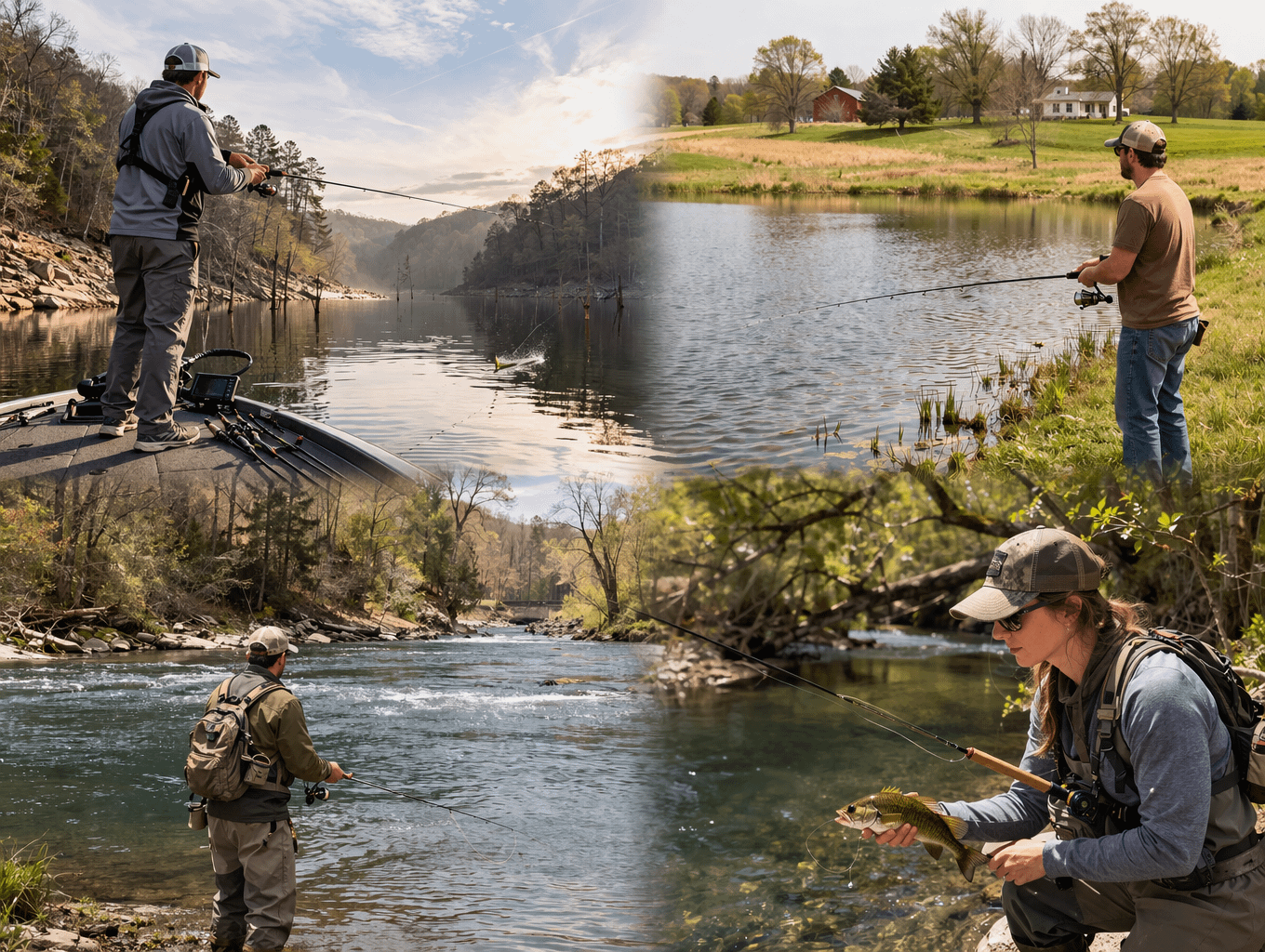
Spring Bass Fishing: The Big Lake, Pond, River, and Creek Guide for Catching More Bass
Spring bass fishing is one of the best times of year to catch quality bass, and spring bass fishing is also one of the easiest times to get fooled into doing the wrong thing with a ton of confidence. One cove can feel alive, the next bank can still fish like winter, and a river seam can outproduce a “perfect” shallow flat for reasons that only make sense once you understand the phase. Because of that, this guide covers spring bass fishing the way real people actually fish it: lakes, ponds, rivers, and creeks, with different gear, different presentations, and different expectations depending on what the water is doing.
Instead of pretending one lure, one rod, and one bank solves everything, this article breaks the season down into prespawn, spawn, and postspawn, then shows how those phases change across different waters. Moreover, it lines the gear up with the suppliers we actually want to use. Amazon gives us broad bass staples, Paradise Tackle covers useful bass lures and terminal tackle, DreamCatcher handles conventional rods, reels, and line, and DRAGONtail gives us a legitimate small-water tenkara angle for creeks, streams, and pond edges where that method truly fits. In other words, this is a full Bark & Brass pillar post, not a lazy listicle wearing a fake mustache.
Quick Answer
Spring bass fishing gets easier the minute you stop treating spring like one bite. In cold early prespawn water, bass usually stage between wintering areas and spawning cover, so jerkbaits, lipless crankbaits, jigs, underspins, finesse worms, and slower swimbaits often shine. As the water warms into the low-to-mid 50s, fish usually move shallower and get more aggressive, so spinnerbaits, chatterbaits, squarebills, swim jigs, Texas rigs, floating worms, and stick baits move up the list. During the spawn, slower targeted soft plastics around beds, pockets, cover, and protected areas usually matter more. After the spawn, topwaters, recovery cover, shade, docks, first breaks, and roaming baitfish edges become increasingly important.
As for gear, baitcasting usually wins for power fishing lakes, larger ponds, rivers, and heavier cover. Meanwhile, spinning gear usually wins for finesse, bank fishing, pressured fish, and all-around versatility. Tenkara or fly-style warmwater gear fits streams, creeks, some small rivers, and some pond-edge situations where precise short-range presentations with poppers, bugs, streamers, or nymph-style flies make more sense than bombing a reaction bait into the next zip code.
Quick View
- Best early spring tools: suspending jerkbaits, lipless crankbaits, jigs, underspins, swimbaits, finesse worms.
- Best warming-water tools: spinnerbaits, chatterbaits, squarebills, swim jigs, Texas rigs, trick worms, stick baits.
- Best spawn tools: stick worms, creature baits, tubes, Neko rigs, Texas rigs, targeted soft plastics.
- Best postspawn tools: poppers, walking baits, buzzbaits, frogs, swim jigs, dock worms, first-break crankbaits.
- Lakes and reservoirs: focus on migration routes, staging points, creek channels, warming pockets, and shallow flats near depth.
- Ponds: they warm faster, fish move shallower sooner, and compact presentations often beat oversized tackle.
- Rivers: current decides the map, so seams, eddies, gravel, wood, and slower spawning pockets matter most.
- Streams and creeks: stealth, precision, compact profiles, spinning rods, and warmwater tenkara setups can absolutely earn their keep.
- Best all-around rule: read the water first, then choose the lure and gear instead of doing that backward.
Why Spring Bass Fishing Is Different
Spring Bass Fishing Is a Movement Season
Spring bass fishing is different because bass are not just feeding. They are moving. Winter is mostly about conserving energy and eating when it makes sense. By contrast, spring adds travel, feeding urgency, reproductive drive, and changing habitat use. As a result, fish are often somewhere between where they were and where they want to go. That gap is where a lot of anglers get lost.
On a reservoir, that movement may follow creek channels, secondary points, tapering banks, contour breaks, grass edges, or isolated wood. In a pond, the route may be much shorter, but it still exists. In a river, current reorganizes the whole plan, so travel often means moving from stronger flow into slower staging or spawning water. Likewise, in creeks and streams, fish often slide between pools, seam edges, wood, rocks, and warming pockets that give them security and food.
Spring Bass Fishing Changes Faster Than Most Anglers Adjust
A warm afternoon can suddenly wake up one section of water while another still fishes cold. Similarly, a stable warming trend can push fish shallow for several days, while a cold front can shove them tighter to cover or slightly back off the bank. Therefore, a “good spring pattern” is only good if it matches the water in front of you right now.
That is why spring bass fishing can feel magical one day and irritating the next. The season itself is not random. Rather, the season is dynamic. If you keep up with the changes, the fish start making sense. If you do not, the whole day can turn into an expensive casting session with no audience.
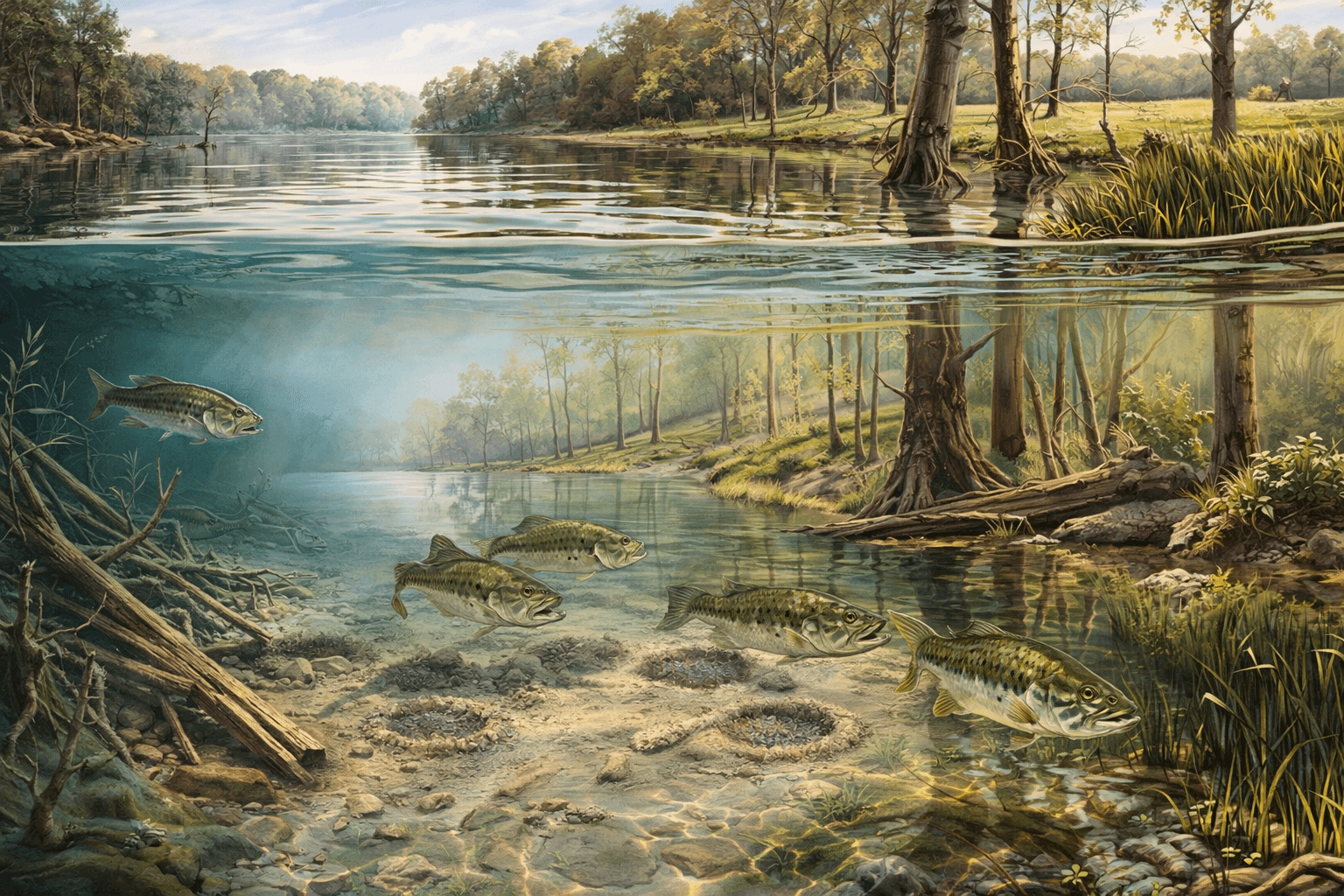
Spring Bass Fishing at a Glance
| Spring Phase | Where Bass Usually Set Up | Best Starting Baits | Best Gear Style |
|---|---|---|---|
| Cold Early Prespawn | Near wintering water, channel swings, secondary points, first drops, rock, deeper grass, current breaks | Jerkbaits, lipless cranks, jigs, underspins, slow swimbaits, finesse worms | Spinning or baitcasting depending on lure size and cover |
| Active Prespawn | Transition banks, staging cover, shallow flats near depth, creek arms, warming pockets, wind-blown banks | Spinnerbaits, chatterbaits, squarebills, swim jigs, Texas rigs, floating worms | Baitcasting with spinning cleanup rod |
| Spawn | Protected pockets, hard-bottom shallows, grass edges, wood, bank corners, calmer river backwaters | Creature baits, stick worms, tubes, Neko rigs, light Texas rigs, wacky rigs | Spinning or accurate casting setups |
| Postspawn | Nearby cover, first breaks, fry-guard banks, shade, docks, outside grass, nearby seams | Topwaters, poppers, walking baits, swim jigs, dock worms, spinnerbaits, cranks | Baitcasting plus spinning follow-up |
| Creek/Small-Water Warm Window | Pools, seam edges, boulders, wood, undercut banks, pocket water, shallow warming shelves | Tubes, finesse jigs, small swimbaits, compact worms, poppers, streamers, bugs | Spinning or tenkara |
| Water Type | What Changes the Most | Best First Thought | Best First Rod Type |
|---|---|---|---|
| Lakes & Reservoirs | Depth change, migration routes, pocket warming, wind influence | Fish the route before the bank | Baitcasting |
| Ponds | Fast warming, short travel distance, subtle cover importance | Quiet approach beats hero casting | Spinning |
| Rivers | Current controls feeding lanes, staging, and spawning water | Fish current breaks, not just current | Casting or spinning |
| Streams & Creeks | Tight casting lanes, stealth, small feeding windows | Precision beats distance | Spinning or tenkara |
Pros and Cons of Spring Bass Fishing
Spring Bass Fishing Pros
- You have a legitimate shot at quality bass when fish are feeding up before the spawn.
- Shallower fish make bass more accessible to bank anglers and kayak anglers.
- Reaction baits, finesse baits, worms, topwaters, and warmwater fly-style presentations all get a chance to shine.
- Lakes, ponds, rivers, and creeks all have productive spring windows if you match the method to the water.
- The season teaches fish movement better than almost any other time of year.
- It is one of the most fun windows for pattern fishing because you can actually watch conditions change and fish respond.
Spring Bass Fishing Cons
- Conditions change fast, so yesterday’s bite can disappear without asking your permission.
- Cold fronts can turn aggressive fish into moody little goblins in a hurry.
- Different sections of the same body of water can be in different phases at once.
- Rising or falling river levels can completely rewrite the day.
- Fishing pressure ramps up because everyone suddenly remembers they own tackle.
- It is easy to misread shallow fish and spend too long in the wrong water if you do not fish the seasonal route.
How Spring Bass Fishing Behavior Changes
Spring Bass Fishing Prespawn: The Move Starts Early
In spring bass fishing, prespawn is where the whole travel story starts. Bass leave deeper wintering areas and work toward spawning zones, but they do not all charge the bank at the same time. Instead, they stage, feed, pause, and then move again. On a reservoir, that usually means channel swings, secondary points, tapering banks, rock transitions, or deeper grass. In a pond, the movement may be shorter, but the fish still use the most efficient path from deeper water to the warm shallow zone. In a river, prespawn often means slower edges, current seams, gravel, wood, and connected backwaters. Meanwhile, in creeks and streams, fish may slide between pools, seam edges, boulders, and quiet pockets that warm more quickly.
Because of that, the biggest prespawn mistake is fishing too far ahead of the fish. If you run straight to the shallowest prettiest bank every trip, you will sometimes be right. However, you will also skip a pile of staging fish that were far easier to catch on the way in.
Spring Bass Fishing Spawn: Shallow but Specific
Once fish commit to the spawn, the map tightens up. Protected water matters more. Harder bottom matters more. Specific cover matters more. Therefore, the best spring bass fishing often shifts from broad search baits to targeted soft plastics. Worms, tubes, creature baits, Neko rigs, and light Texas rigs suddenly make much more sense around beds, pockets, corners, and cover.
At the same time, not every fish is doing the exact same thing. Some bass are bedding. Others are sliding in. Still others are hanging nearby waiting their turn or easing out after the first round. Consequently, one cast away from the obvious target can be just as important as the target itself.
Spring Bass Fishing Postspawn: The Fish Did Not Vanish
Postspawn is where people act like the lake turned off. It usually did not. Instead, the fish moved to nearby recovery cover, first breaks, shade, docks, seams, and food-rich edges. Males may still hang shallow around fry. Females often slide to the nearest useful stopping place where they can recover and feed without spending extra energy. Therefore, postspawn spring bass fishing can be outstanding if you stop mourning the beds and start following the next move.
Spring Bass Fishing Cover Changes With the Phase
Cover means different things in different spring windows. Early on, fish often relate to steeper transitions, rock, grass edges, and places close to depth or reduced current. As warming trends settle in, shallow wood, emergent grass, docks, reeds, and isolated hard spots become more important. Then, during the spawn, cover often turns into part of the nest zone or the nearby security zone. Finally, in postspawn, the nearest shade line, point, drop, dock corner, or food edge becomes the next stopping place.
Spring Bass Fishing Water Temperature, Wind, and Clarity
Spring Bass Fishing Water Temperature: Use It as a Clue
Spring bass fishing always brings out the water-temperature debates. Temperature matters. Still, one number by itself can lie to you. A protected pocket can warm quickly, a dark-bottom pond bank can jump a couple of degrees, and a river backwater can feel ahead of the main channel. Meanwhile, a nearby deeper section may still fish colder than the graph suggests. Therefore, it is smarter to read temperature as a trend and a location clue instead of treating it like a sacred number carved in stone.
Spring Bass Fishing Wind: Annoying, Useful, and Often Important
Wind moves warm surface water, positions bait, changes clarity, and can create the best moving-bait banks in the system. On lakes and ponds, a warming wind pushing into the right bank can stack bait and trigger fish. On the other hand, a cold hard wind can kill a shallow pattern in a hurry. In rivers, current usually matters more than wind, but wind can still change how comfortable fish are in softer pockets and backwaters. So yes, wind is annoying. Nevertheless, it is also useful.
Spring Bass Fishing Clarity: Tells You How Loud to Be
Clear water usually pushes you toward longer casts, more natural colors, and slightly subtler action. Stained water, however, often allows more flash, more vibration, and tighter target casting. Muddy water does not always kill a bite, but it usually shrinks the strike zone. As a result, location and accuracy matter even more than color once the water gets dirty.
Spring Bass Fishing Check Before the First Cast
Before you make the first cast, ask three questions. First, where are these fish in the seasonal move? Next, what kind of water am I on? Finally, what do temperature, wind, and clarity say about how aggressive I should start? That quick check saves a lot of useless casting.
| Condition | What It Usually Means | Best Adjustment |
|---|---|---|
| Cold stable water | Fish are moving, but not always chasing hard | Start with jerkbait, jig, lipless, underspin, finesse worm |
| Warming afternoon trend | Shallower water and cover can suddenly turn on | Add spinnerbait, chatterbait, worm, swim jig, squarebill |
| Clear calm conditions | Fish may see better and spook easier | Natural colors, longer casts, slower follow-up bait ready |
| Wind into warming bank | Bait can stack and fish can get more aggressive | Throw moving baits first, then soft plastics behind them |
| Cold front after warm spell | Fish often tuck tighter and shorten chase windows | Slow down, hit cover precisely, keep a worm or jig ready |
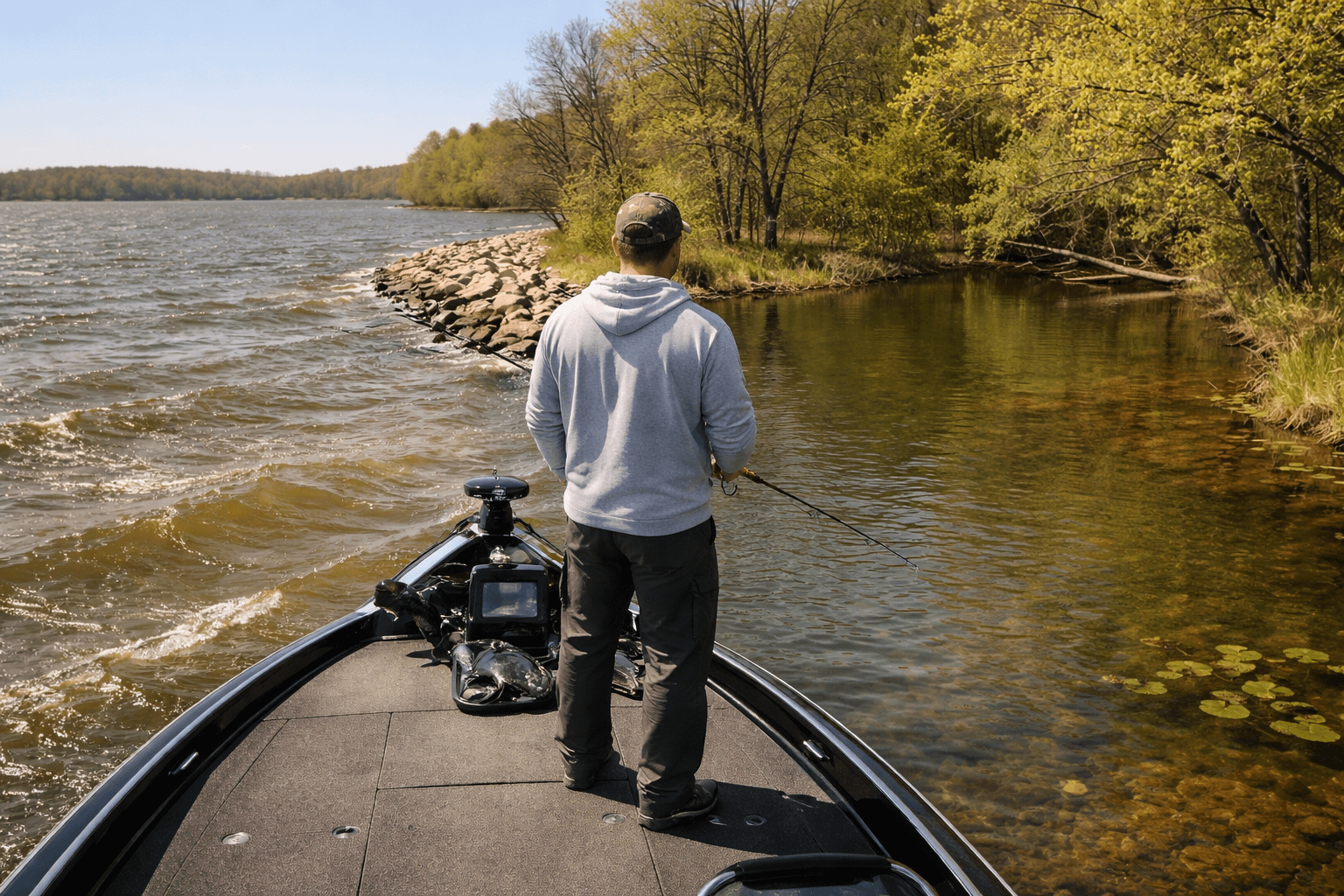
Spring Bass Fishing in Lakes and Reservoirs
Spring Bass Fishing on Lakes Starts With the Route
Spring bass fishing on lakes and reservoirs gets people in trouble because “shallow” is only half the story. Yes, the fish are moving in that direction. However, they still use routes. Secondary points, inside turns, channel swings, drains, grass lines, and cover that connects winter water to spawning water are the real backbone of the pattern. Therefore, if you launch and race straight to the very back of a pocket, you may skip some of the best fish in the system.
Spring Bass Fishing Lake Prespawn Areas
Early in the season, start around structure that gives fish access to depth without forcing them to travel far. Channel bends close to spawning pockets, bluff ends transitioning into flatter banks, the first drop outside a cove, deeper grass edges, and rock transitions all deserve real attention. In those places, jerkbaits, underspins, swimbaits, jigs, and lipless baits make a lot of sense because they cover the lower half of the water column well.
Spring Bass Fishing During a Warming Trend
Once a stable warming trend settles in, the lake usually starts feeling more honest. Protected creek pockets warm up, fish use shallower wood or grass more aggressively, and search baits begin to shine. Therefore, spinnerbaits, chatterbaits, squarebills, swim jigs, and lipless baits can suddenly cover a lot of useful water fast. If fish are active, power fishing finds them. If fish only bump or follow, a worm or jig usually cleans up the leftovers.
Spring Bass Fishing the Middle of a Creek Arm
A lot of anglers either fish the main lake or the very back. Meanwhile, the middle section gets treated like a hallway. That is a mistake. Middle-zone staging fish often set up around secondary points, drains, transition banks, and isolated cover while they wait to move farther. As a result, some of the cleanest spring bass fishing patterns on reservoirs live halfway back instead of at either extreme.
Spring Bass Fishing Wind-Blown Banks and Flat Corners
A secondary point near a warming pocket with some wind on it deserves a lot of respect. Likewise, a flat corner with a drain, rock change, grass line, or little depth wrinkle can be a fish magnet. Those places are travel lanes, feeding lanes, and staging spots all in one. So, even if the shoreline looks plain, keep an eye on the details that make it useful.
Spring Bass Fishing Lake Baits by Phase
Cold early prespawn: jerkbait, jig, underspin, finesse swimbait, lipless crank, finesse worm.
Active prespawn: spinnerbait, chatterbait, squarebill, lipless, swim jig, Texas rig, floating worm.
Spawn: creature bait, tube, stick worm, wacky rig, Neko rig, targeted soft plastic.
Postspawn: popper, walking bait, buzzbait, swim jig, dock worm, first-break crankbait, spinnerbait.
Spring Bass Fishing Lake Gear
A medium-heavy casting rod is usually the workhorse for lake spring bass fishing because moving baits, jigs, and power presentations cover so much of the season. Meanwhile, a medium spinning rod is the ideal running mate because it handles follow-up worms, stick baits, lighter swimbaits, finesse plastics, and clear-water adjustments. Together, those two rods cover a ridiculous amount of spring water without getting silly.
Spring Bass Fishing Lakes From the Bank
Bank anglers on lakes do best when they fish useful water instead of easy standing water. In other words, target corners, points, riprap, inflow, shade lines, drains, and places where deeper water gets close. Skip the pretty empty shoreline. Fish the ugly helpful shoreline. Bass love helpful.
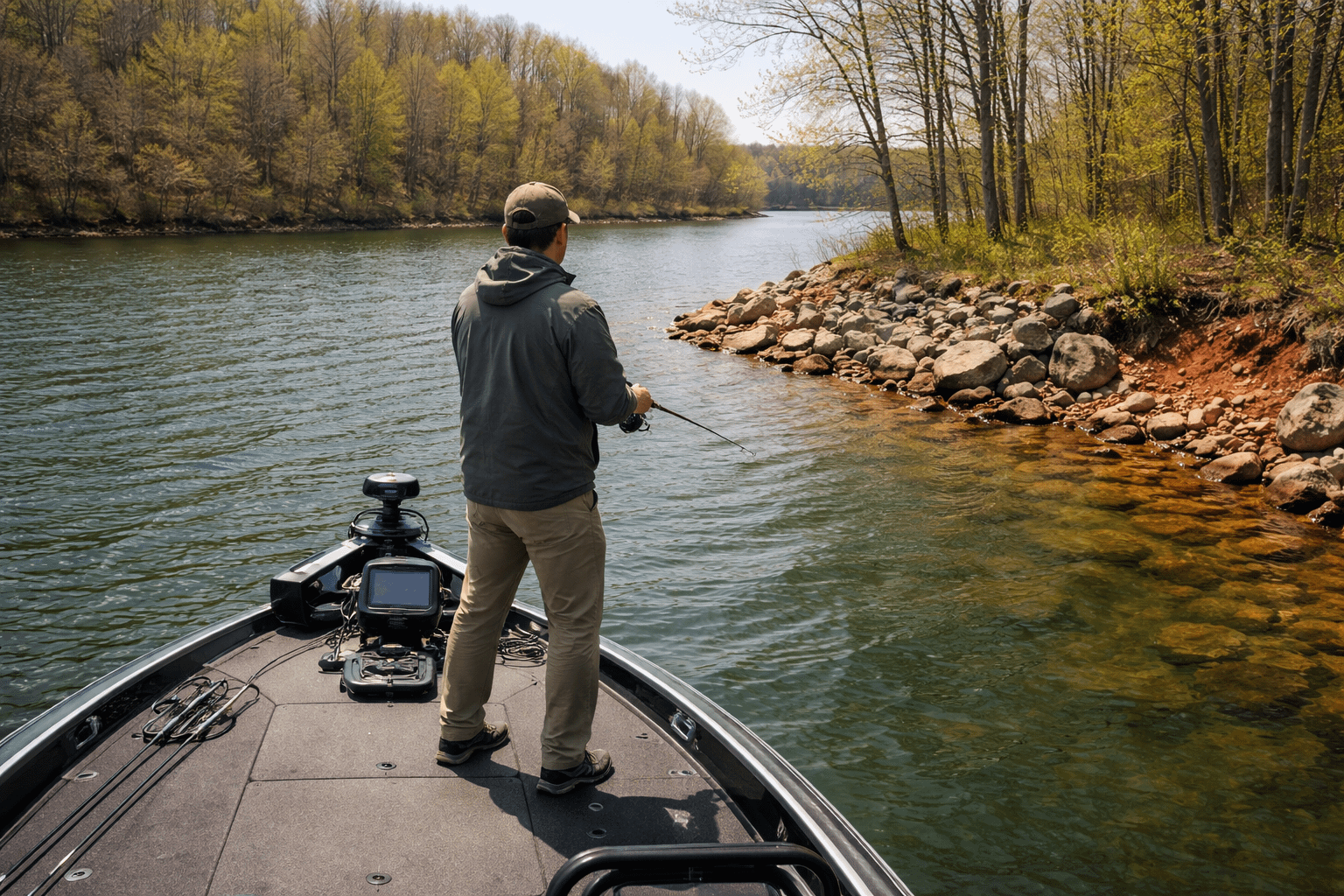
✅ Shop Paradise Bass Lures – Save 10% with code MICHELLEBAHR
Spring Bass Fishing in Ponds and Small Impoundments
Spring Bass Fishing Ponds Warm Faster
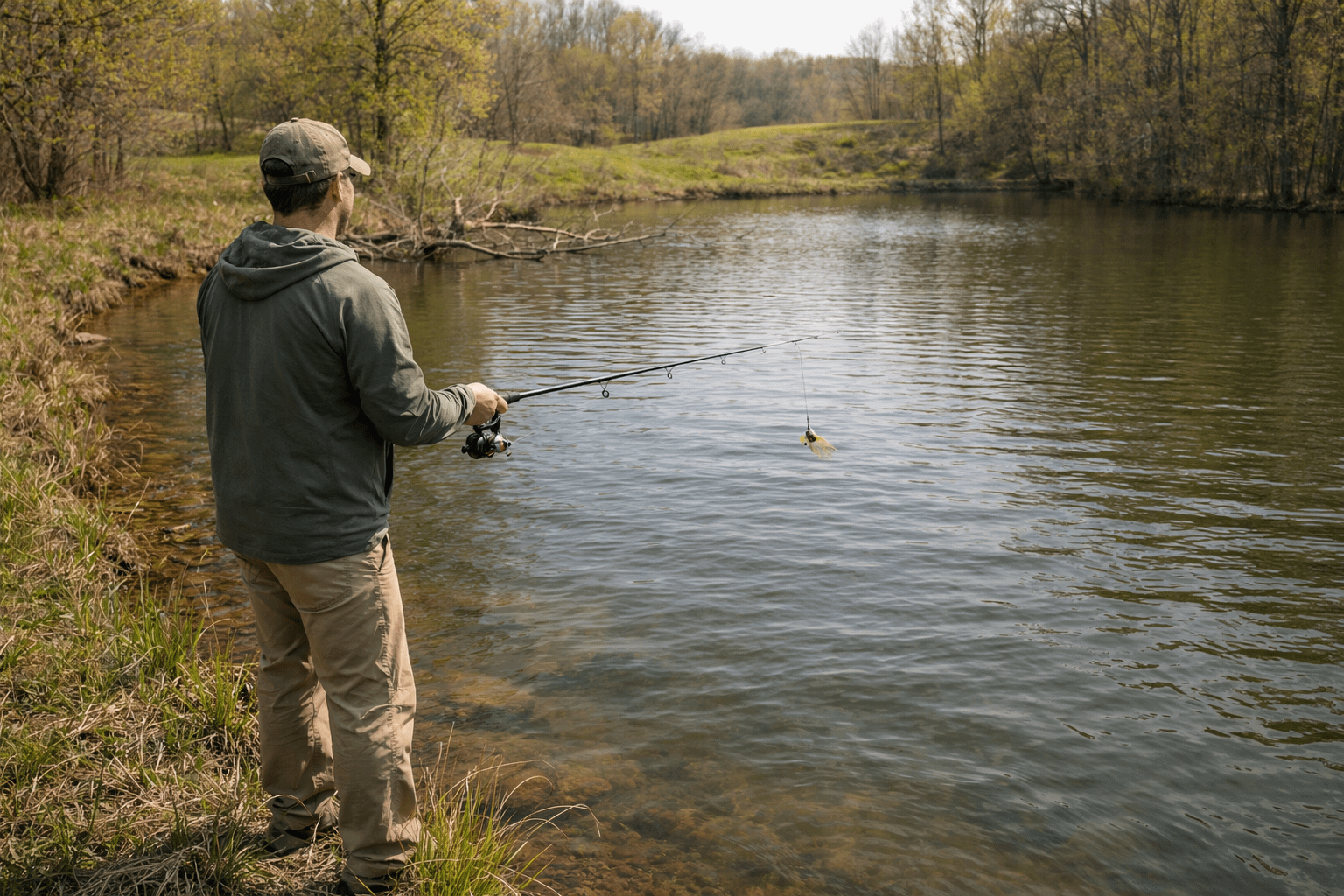
Spring bass fishing in ponds is one of the most fun and most underrated ways to catch bass because small water often warms faster and reveals patterns sooner. However, a pond is not just a shrunken reservoir. Travel routes are shorter, subtle cover matters more, and small changes in sunlight, depth, or bottom color can mean a lot. Consequently, a pond rewards precision more than horsepower.
Spring Bass Fishing Pond Starting Areas
Start with the side that warms first. That often means sun-exposed banks, dark-bottom areas, corners with reduced wind, shallow coves, culvert inflow, runoff, sparse grass edges, and isolated wood. Sometimes one laydown in the right place is the entire deal. Likewise, one deeper edge next to a warming flat can hold the only fish that matter in that pond on that day.
Spring Bass Fishing Pond Approach Matters
Stealth matters more in pond spring bass fishing than many anglers admit. Keep your profile low. In clear water, back off and make longer casts. In stained water, get tighter and fish more confidently. Above all, do not stomp the bank like you are unloading drywall.
Spring Bass Fishing Pond Baits
Weightless stick worms, trick worms, Texas-rigged finesse worms, floating worms, compact spinnerbaits, small chatterbaits, swim jigs, small swimbaits, and poppers all deserve time in spring ponds. The common thread is control. You want baits that fit small-water bass behavior without overdoing it. Therefore, a quiet worm skipped to a shade edge can easily outfish a loud power bait that only looks impressive to the angler holding it.
Spring Bass Fishing Pond Topwater Window
Later in spring, pond bass often get increasingly willing to eat on top, especially around fry, bluegill activity, and stable warm water. Therefore, poppers, walking baits, buzzbaits, and toads can turn on fast. Early in the season, afternoon may be the better window. Later on, morning and evening become stronger again.
Spring Bass Fishing Pond Rod Choice
If you only carry one rod around a pond in spring, make it a medium spinning rod. If you carry two, add a medium-heavy casting rod for spinnerbaits, chatterbaits, buzzbaits, and heavier cover work. That combo gives you both subtlety and punch, which is exactly what good pond spring bass fishing needs.
Spring Bass Fishing in Rivers
Spring Bass Fishing Rivers Start With Current Breaks
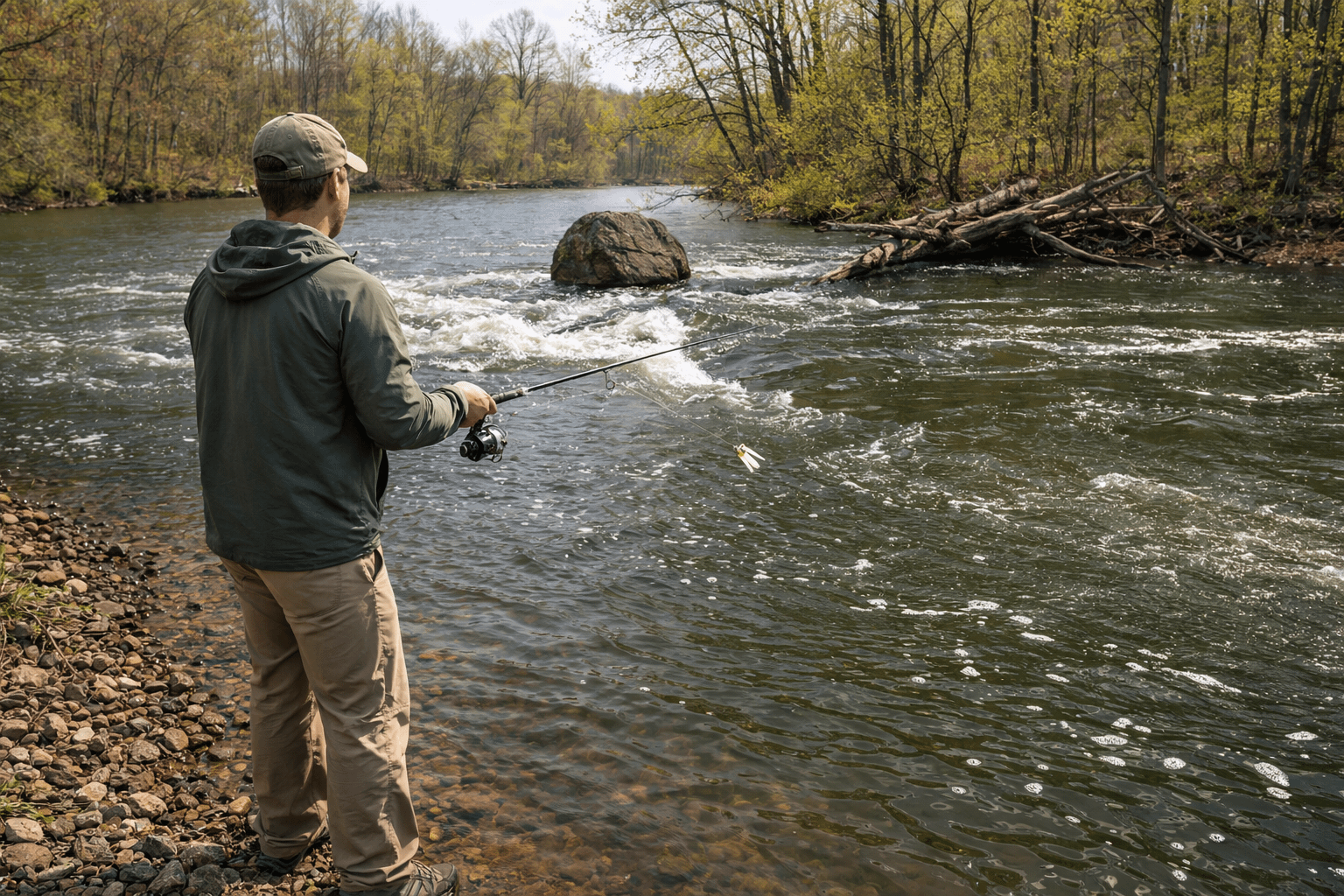
Spring bass fishing in rivers is not just lake fishing with moving water. Current changes feeding lanes, travel routes, water temperature, oxygen, and lure angle. Therefore, the best river water is often not the most dramatic water. Bass usually prefer places where they can rest while food comes to them. That means seams, eddies, downstream pockets, wood, boulders, marinas, cuts, and connected backwaters deserve more attention than fast center-river turbulence.
Spring Bass Fishing River Largemouth vs. Smallmouth
Largemouth in rivers often slide into slower water with wood, vegetation, marinas, flooded bushes, and protected pockets. Smallmouth, by contrast, often use gravel, rock, seams, eddies, current-facing structure, and calmer water adjacent to current. There is overlap, of course. Still, those tendencies give you a solid place to start.
Spring Bass Fishing River Prespawn
In early river spring bass fishing, target places where fish can stage without fighting too much current. Deeper bends, soft seams, slow wood edges, marinas, creek mouths, cuts, and downstream slack pockets are all strong. Consequently, compact spinnerbaits, jerkbaits, tubes, finesse jigs, and small swimbaits all fit beautifully.
Spring Bass Fishing River Spawn Water
River bass generally want reduced current for spawning. That means gravelly backwaters, calm flats, side pockets, cuts, marinas, sloughs, and protected banks connected to the main river. As a result, Texas rigs, tubes, stick worms, and targeted soft plastics become even more important during this phase.
Spring Bass Fishing River Postspawn
Once the spawn begins to fade, fish usually slide to nearby feeding and recovery water. Males may stay shallow around fry. Females often shift to the nearest current edge, dock, seam, shade line, or wood line that lets them feed efficiently. Therefore, spinnerbaits, poppers, walking baits, swim jigs, and finesse follow-up baits all deserve time.
Spring Bass Fishing River Water Level Changes
Rising water can spread fish into fresh cover. Falling water can pull them off shallow targets. Dirty water can push them tighter or force them toward clearer edges. Stable water often produces the cleanest pattern. Even so, the real question is always the same: where is the easiest feeding position now?
Spring Bass Fishing River Rods and Line
On larger rivers, a medium-heavy casting rod gives you control with spinnerbaits, jigs, and reaction baits. On smaller rivers or finesse-heavy stretches, a medium spinning rod may be the smarter starting point. Meanwhile, braid with a leader is excellent where sensitivity matters, while mono still works beautifully on moving baits and topwater.
Spring Bass Fishing in Streams and Creeks
Spring Bass Fishing Small Water Is Pure Fun
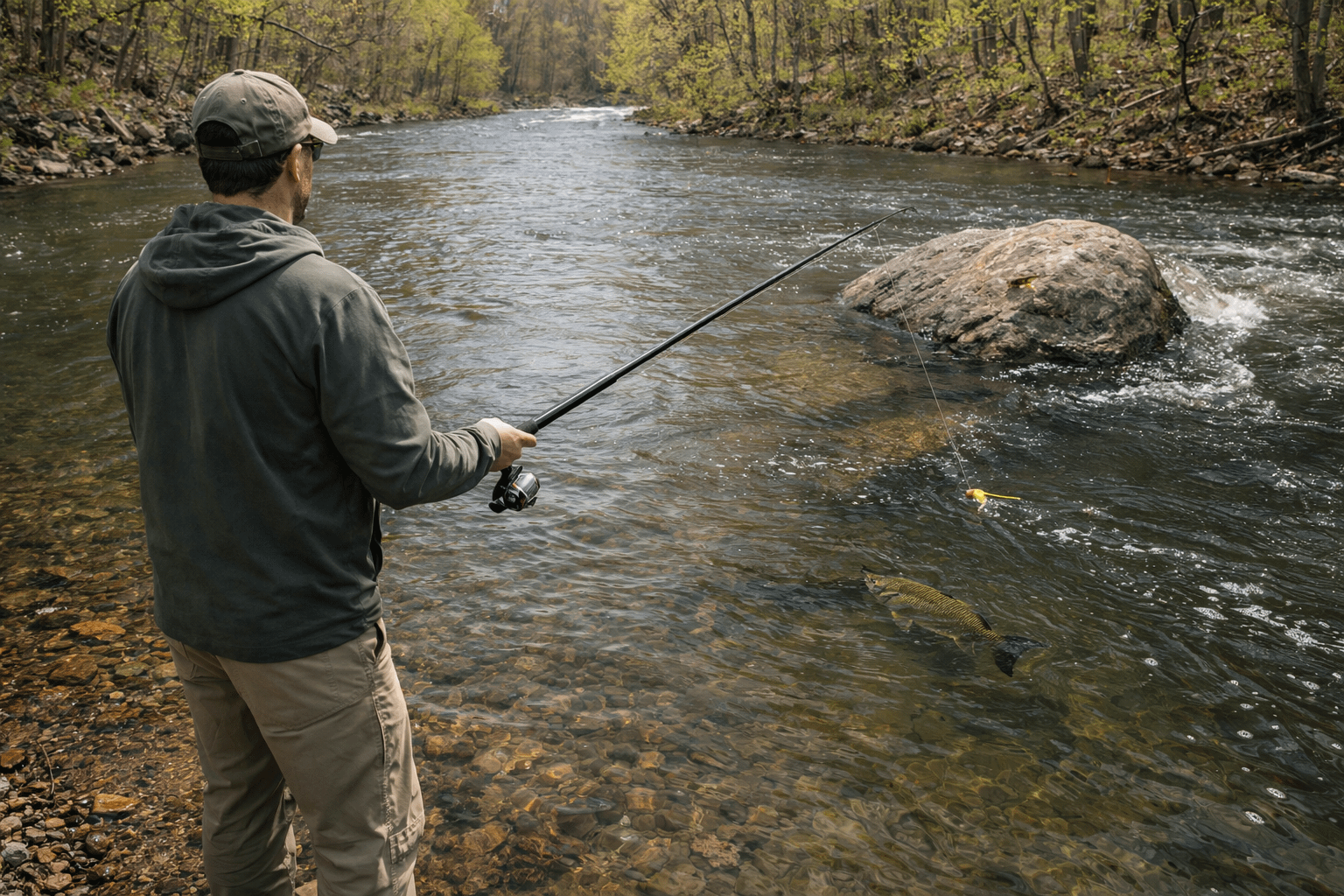
Spring bass fishing in streams and creeks is a blast because the water narrows the puzzle for you. Instead of reading miles of bank, you are reading pools, seam edges, boulders, wood, runs, and warming pockets. In stable conditions, that makes fish easier to understand. On the other hand, clear skinny water also punishes sloppy approaches fast.
Spring Bass Fishing Creek Positioning
Look for runs entering pools, deeper outside bends, undercut banks, boulders, downstream slack pockets, wood cover, and gravel transitions. In spring, slightly warmer calm edges can matter a lot. Bass do not need a giant area to stage. They need a useful one.
Spring Bass Fishing Creeks With Conventional Gear
A medium spinning rod is the king of conventional creek bass gear for most anglers. Tubes, small swimbaits, finesse jigs, trick worms, compact jerkbaits, and lightweight spinnerbaits all fit nicely. Because the water is tighter, accuracy matters more than distance. Therefore, spinning gear earns its keep over and over in creek spring bass fishing.
Spring Bass Fishing Creeks With Tenkara
This is where DRAGONtail fits naturally into the article. In the right creek, stream, small river, or pond-edge scenario, a warmwater tenkara setup makes a ton of sense. You get stealth, clean line control, portability, and the ability to fish bugs, streamers, poppers, and nymph-style flies into narrow bass lanes that can be awkward with conventional gear. No, it is not your windy reservoir chatterbait answer. However, it does not need to be.
Spring Bass Fishing Small-Water Flies and Bugs
Small baitfish streamers, leech-like flies, buggy nymph-style patterns, bigger bugs, and poppers all have a place in spring creek bass fishing. In colder water or deeper pools, go lower and slower. In warmer calmer water, a surface bug or popper can be ridiculous fun. Consequently, a controlled drift, twitch, or short strip often beats a louder more aggressive presentation.
Spring Bass Fishing Creek Stealth
Clear creek fish can be spooky. Therefore, stay low, use the bank cover, and approach from favorable angles when possible. In many ways, small-water spring bass fishing feels more like hunting than blind casting, and that is a big part of its charm.
Best Spring Bass Fishing Lures and Worms by Situation
Spring Bass Fishing Jerkbaits
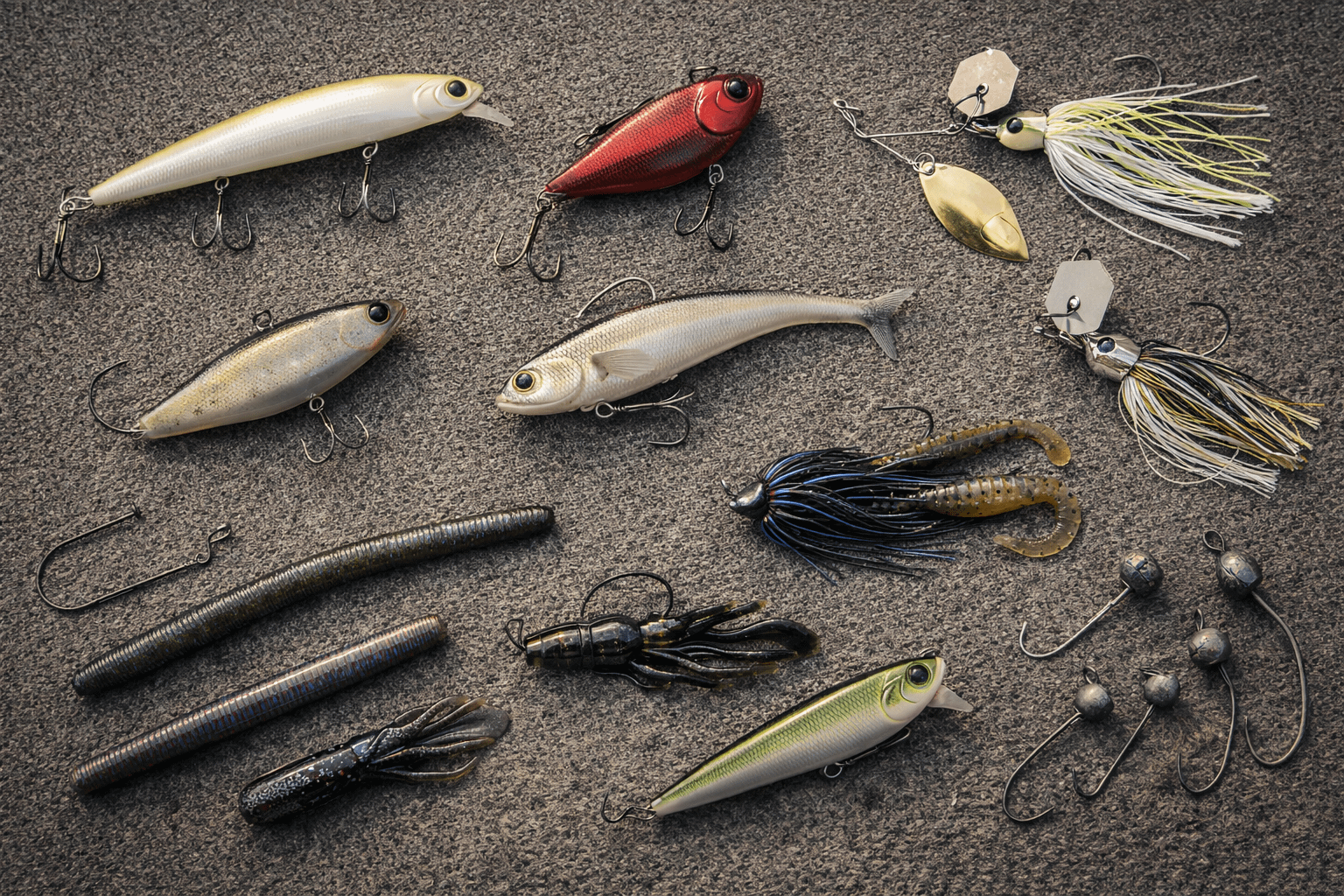
Jerkbaits are one of the best early tools in spring bass fishing because they hang in front of fish that are willing to eat but not always willing to chase far. They are deadly around staging points, channel swings, rock transitions, outside grass, and clearer water. Work them with pauses. Then pause longer than your impatient brain wants to. Early spring bass are often rude on purpose.
Spring Bass Fishing Lipless Crankbaits
Lipless crankbaits cover water, fish multiple depths, and shine around grass, shallow flats, transition banks, and prespawn roaming fish. Therefore, they are one of the cleanest search tools in lake spring bass fishing. Rip them through sparse grass if you have it. Yo-yo them on transitions if fish are deeper. Keep them moving when you need answers.
Spring Bass Fishing Spinnerbaits
Spinnerbaits belong in almost every spring loadout because they handle wind, stain, shallow cover, and rivers so well. Downsized models are excellent for ponds. Full-size blades work beautifully on lakes and bigger rivers. Fish them around cover, through seams, or down transition banks. They are not fancy. Still, they keep earning their keep.
Spring Bass Fishing Chatterbaits
Once the water warms enough for fish to chase harder, chatterbaits become one of the best tools in spring bass fishing. They are great around shallow cover, grass, wood, and transition banks. Just remember they are not magic in every condition. If the water is cold and unstable, you may still need something slower and more deliberate.
Spring Bass Fishing Squarebills
Squarebills are about contact. You want them bouncing off wood, rock, stumps, and cover-rich edges. Consequently, they fit warming lake banks, cover-heavy ponds, and slower river stretches with clean target edges. If you are fishing them through empty open water all day, you are basically using a hammer to stir soup.
Spring Bass Fishing Jigs
A jig belongs in every serious spring bass fishing plan because it catches staging fish, cover fish, sluggish fish, and fish that have already seen your louder baits. It also tells you the truth about the bottom. As a result, it is one of the best fish-finding and fish-catching tools in the whole season.
Spring Bass Fishing Swimbaits
Swimbaits bridge a lot of spring situations. Smaller paddle tails on jigheads or underspins are excellent for colder prespawn fish. Weedless paddle tails and hook-rigged soft swimbaits shine around shallow cover. Compact swimbaits also translate well to rivers and creek scenarios when fish are feeding on bait. Therefore, Paradise’s Stryker Swimbait and SlideBait-style profiles fit this guide very naturally.
Spring Bass Fishing Stick Worms and Trick Worms
There is a reason worms keep saving the day in spring bass fishing. They catch followers. They catch bedding fish. They catch pressured pond bass. They catch fish after a moving-bait bite stalls. Accordingly, Senko-style baits, trick worms, floating worms, and finesse worms all deserve room in the bag.
Spring Bass Fishing Creature Baits and Tubes
When fish lock around beds, wood, dock corners, grass clumps, or other precise targets, slower soft plastics become king. Creature baits on Texas rigs are excellent around spawn and near-spawn cover. Tubes are fantastic in rivers, creeks, rock, and around beds. In short, simple precision baits still do the heavy lifting once fish narrow their strike zone.
Spring Bass Fishing Topwater
Topwater gets increasingly fun in later spring bass fishing once fish guard fry, recover, or start feeding around shallow bluegill and stable warm edges. Poppers, walking baits, buzzbaits, frogs, and toads all have their place. On small water, this is also when warmwater fly and tenkara popper fishing becomes an absolute riot.
Spring Bass Fishing Starting Lure Rule
Use the fastest lure that still matches the fish mood. If the fish are active, cover water. If they are showing themselves but not eating, slow down. If they are locked to targets, get precise. That one rule clears up a lot of confusion fast.
How to Pick Spring Bass Fishing Colors, Line, and Terminal Tackle
Spring Bass Fishing Colors by Clarity
Color matters in spring bass fishing, but not as much as some tackle aisles pretend. In clearer water, lean toward natural baitfish, translucent finishes, green pumpkin, watermelon, natural shad, smoke, and subtle craw tones. In stained water, however, white, chartreuse accents, black and blue, solid greens, and louder craw patterns often help fish find the bait more quickly.
Spring Bass Fishing Red and Craw Colors
Red, orange, and craw-style colors get plenty of spring attention for lipless baits and some cranks because they often fit the seasonal forage picture. They are not mandatory in every lake. Even so, they are absolutely worth having in the mix.
Spring Bass Fishing Line Choices
Mono is still a great choice for spring bass fishing, especially for topwater, crankbaits, beginner setups, and any time you want a little forgiveness. Braid with a leader is excellent on spinning gear, around cover, in current, and where sensitivity matters. Straight braid also has a place in heavier cover. Use what fits the bait and the water instead of turning line choice into a family feud.
Spring Bass Fishing Terminal Tackle
For a spring loadout, you mostly need solid hooks, jigheads, Texas-rig hooks, a few weights, and confidence in your knots. EWG hooks, swimbait hooks, compact jigheads, and sensible worm hooks do more work than piles of weird specialty pieces. Therefore, Paradise’s EWG Mutant Hooks, Heavy Hitter Jig Hooks, Cyclone Swimbait/Toad Hooks, and SlideBait JigHeads fit this article beautifully.
Spring Bass Fishing Simple Rigs
Simple is often beautiful in spring. Texas rig. Weightless stick bait. Jighead swimbait. Compact jig. Spinnerbait. Chatterbait. Jerkbait. Tube. Popper. Those rigs cover a shocking amount of useful water if you use them in the right places. Meanwhile, overcomplicating things usually just means you are shopping harder than you are thinking.
Baitcasting vs. Spinning vs. Tenkara for Spring Bass Fishing
Spring Bass Fishing With Baitcasting Gear
Baitcasting wins when you need power, line control, heavier lures, stronger hooks, or repeated cover contact. On lakes and larger rivers, that means spinnerbaits, chatterbaits, jigs, squarebills, lipless baits, swim jigs, toads, buzzbaits, and many topwaters. Consequently, a baitcaster is usually the backbone of power-style spring bass fishing.
Spring Bass Fishing With Spinning Gear
Spinning wins when you need finesse, versatility, lighter bait control, smaller-water adaptability, or easier casting at weird angles. Weightless worms, trick worms, stick baits, finesse swimbaits, tubes, compact jerkbaits, Neko rigs, wacky rigs, and many pond or bank situations all scream spinning gear. If you could only carry one setup for broad spring bass fishing, a medium spinning rod would be the safest answer.
Spring Bass Fishing With Tenkara Gear
Tenkara wins when the water is small enough and the presentations are short enough that precision, stealth, and clean line control matter more than distance or reel speed. Streams, creeks, some small rivers, and some pond edges fit that description beautifully. Therefore, warmwater poppers, streamers, bugs, and nymph-style flies can make tenkara a real part of spring bass fishing instead of just a quirky side quest.
Spring Bass Fishing If You Own One Rod
Own a medium spinning rod. It covers the biggest slice of spring bass fishing across the widest range of waters and presentations.
Spring Bass Fishing If You Own Two Rods
Add a medium-heavy casting setup. Then you have a real one-two punch: power fishing with the casting rod and follow-up or finesse work with the spinning rod.
Spring Bass Fishing If You Love Small Water
Add a warmwater tenkara setup where it fits. Not because it is trendy. Rather, do it because it is effective and wildly fun in the right places.
| Method | Best Water | Best Spring Jobs | Where It Struggles |
|---|---|---|---|
| Baitcasting | Lakes, larger ponds, rivers, cover-heavy situations | Power baits, jigs, topwater, reaction work, heavier cover | Super light finesse baits, tiny tight creeks |
| Spinning | Ponds, bank fishing, rivers, creeks, mixed-water versatility | Worms, stick baits, tubes, finesse, lighter swimbaits, cleanup work | Heavy cover power presentations all day long |
| Tenkara | Creeks, streams, some small rivers, pond edges | Poppers, bugs, streamers, precise small-water presentations | Windy big-water power fishing and long-range reaction bait work |
Best Spring Bass Fishing Rods, Reels, Line, and Tackle from Our Approved Suppliers
Spring Bass Fishing With DreamCatcher Gear
DreamCatcher is the cleanest conventional backbone for this article. When we talk about practical rod-and-reel systems for spring bass fishing, this supplier makes the most sense for spinning rods, casting rods, reels, and line. That keeps the article grounded instead of pretending every store needs to do every job.
DreamCatcher Picks for Spring Bass Fishing
- ZEUS 2-PIECE SPINNING ROD – excellent for ponds, bank fishing, creek bass, finesse work, and travel.
- ZEUSX ONE-PIECE SPINNING ROD – strong all-around spinning workhorse for worms, stick baits, finesse swimbaits, and tubes.
- CARBONITE 2-PIECE CASTING ROD – a smart pick for spinnerbaits, chatterbaits, swim jigs, lipless baits, and general power work.
- CARBONITEX ONE-PIECE CASTING ROD – ideal for anglers who want a dedicated lake and river casting setup.
- DREAM BRAID 8X FISHING LINE – great for sensitivity, cover, current control, and spinning or casting applications depending on how you rig it.
- MONOX NYLON MONOFILAMENT LINE – very useful for topwater, moving baits, beginner-friendly setups, and a little forgiveness.
- DC-FN SPINNING REEL – easy fit for an all-around spring spinning combo.
- CM SERIES BAITCAST REEL – fits moving baits, jigs, and power fishing well.
If I were building a simple DreamCatcher-only two-rod plan for spring bass fishing, I would go ZEUS or ZEUSX spinning for worms and finesse, plus CARBONITE or CARBONITEX casting for reaction baits and jigs. That gives readers a clean system instead of a shopping list that looks like an IRS audit.
Spring Bass Fishing With Paradise Tackle
Paradise Tackle fits this article best through its freshwater bass collection and the Urban Florida Fishing products that slot naturally into spring bass fishing. That means swimbaits, hooks, jerkbait-style options, worm hooks, and compact presentations. In other words, Paradise is being used where it actually helps the reader instead of being forced into categories it does not need to own.
Paradise Tackle Picks for Spring Bass Fishing
- Urban Florida Fishing Stryker Swimbait – great fit for ponds, lakes, and some river presentations.
- Urban Florida Fishing Heavy Hitter Jig Hooks – strong option for swimbait and jig-style rigging.
- Urban Florida Fishing Urban Jerk Bait – fits the spring jerkbait discussion naturally.
- Urban Florida Fishing Cyclone Swimbait/Toad Hooks – useful for weedless soft plastics, toads, and shallow cover work.
- Urban Florida Fishing EWG Mutant Hooks – a clean fit for worms and creature baits.
- Urban Florida Fishing Mutant Worm – perfect for the spring worm section.
- R&R Tackle SlideBait Tail 3″ – compact profile for smaller waters and finesse swimbait situations.
- R&R Tackle 3″ SlideBait JigHead – logical pairing for smaller swimbait setups.
Spring Bass Fishing With Amazon Staples
Amazon is where familiar named products help the article feel grounded for readers who already know standard bass gear. We do not need to abuse that. Rather, we only need to use it wisely. A few mainstream names go a long way in spring bass fishing because readers instantly understand what role they play.
Amazon-Friendly Spring Bass Fishing Mentions
- Strike King Red Eyed Shad – lipless search bait for prespawn water, grass, and flats.
- Megabass Vision 110 – premium jerkbait for clearer water and staging fish.
- Z-Man Jack Hammer ChatterBait – premium bladed jig option once fish get more active.
- BOOYAH spinnerbait options – versatile spring spinnerbait family.
- Gary Yamamoto Senko – still one of the best spring fallback baits ever made.
- Zoom Trick Worm – excellent for floating-worm and finesse spring presentations.
- Heddon Zara Spook – easy topwater mention for postspawn and warming water.
- Shimano Sedona – solid spinning reel family.
- Abu Garcia Max X – accessible baitcaster family.
- Daiwa Aird-X rods – practical conventional rod option.
Spring Bass Fishing With DRAGONtail
DRAGONtail gets a real seat at the table in this guide because warmwater tenkara belongs in specific spring bass fishing situations. Creeks, streams, some small rivers, and some pond-edge scenarios are exactly where that method shines. Therefore, DRAGONtail is not a gimmick in this article. It is a specialist tool for specialist water.
DRAGONtail Picks for Spring Bass Fishing
- HELLbender Tenkara Rod – built for bigger fish and perfect for bassy small water.
- Tachi Furled Tenkara Line – useful for bigger poppers, bugs, and bass flies.
- Warmwater bugs and fly options – excellent for creek, stream, and pond-edge bass work.
- Streamer and nymph-style fly options – useful when fish are lower in the column or current-oriented.
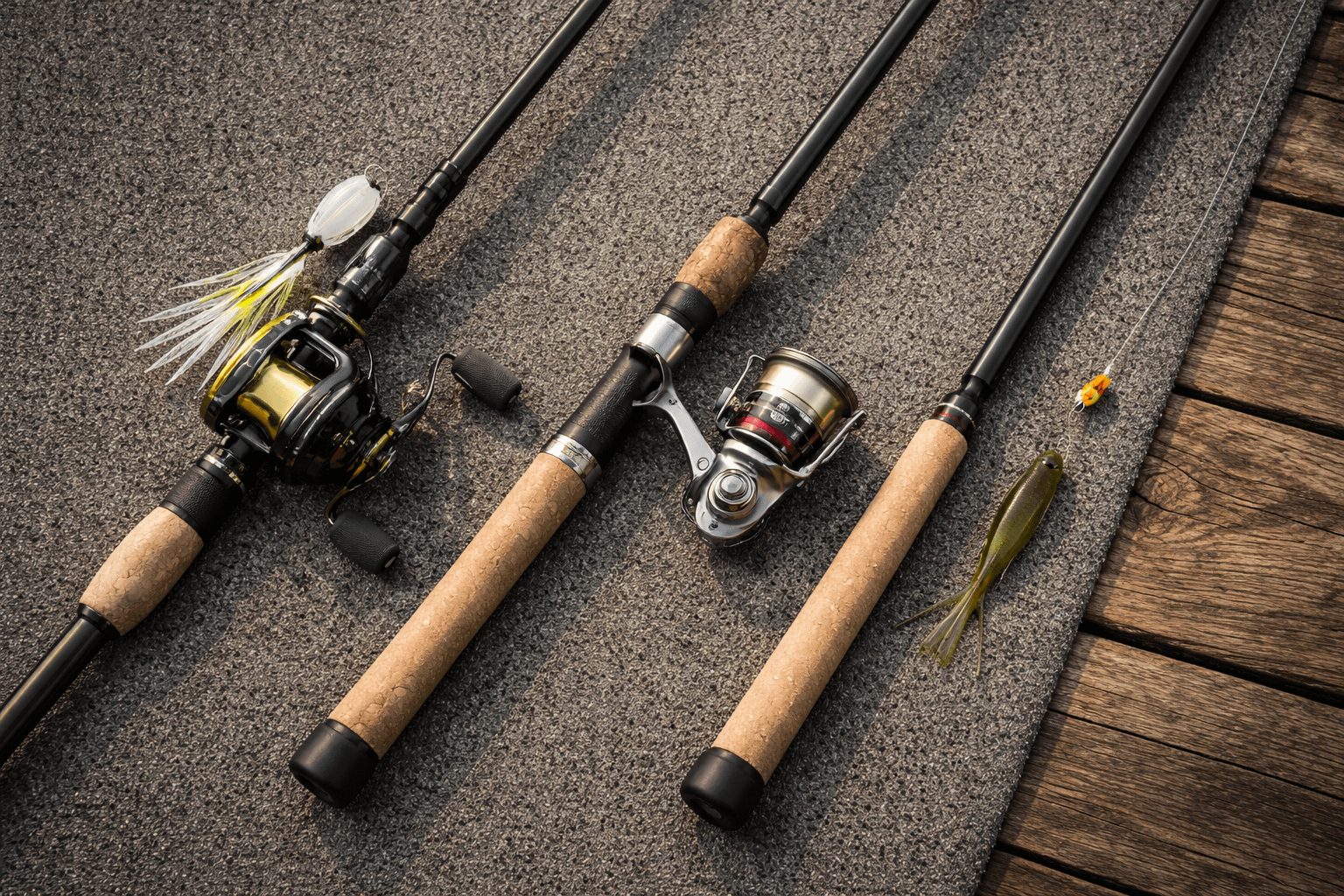
Real-World Spring Bass Fishing Setup Examples
Spring Bass Fishing Setup 1: Reservoir Search and Clean-Up
Where it shines: lakes, reservoirs, creek arms, transition banks, staging fish.
Power rod: DreamCatcher casting setup with lipless, chatterbait, spinnerbait, or squarebill.
Follow-up rod: DreamCatcher spinning setup with Senko, Trick Worm, or finesse swimbait.
Why it works: you find fish fast, then clean up the fish that followed, bumped, or missed.
Spring Bass Fishing Setup 2: Pond Killer
Where it shines: farm ponds, neighborhood ponds, small impoundments, pressured ponds.
Rod: medium spinning setup.
Baits: weightless stick worm, trick worm, compact spinnerbait, small swim jig, popper.
Why it works: it keeps things subtle, accurate, and quiet, which is what many spring pond bass want.
Spring Bass Fishing Setup 3: River Seam Combo
Where it shines: rivers with wood, seams, rock, and protected spawning pockets.
Rod: casting or spinning depending on bait size.
Baits: compact spinnerbait, tube, finesse jig, small swimbait, Texas-rigged worm.
Why it works: it covers active fish but still gives you the tools to pick apart soft edges and eddies.
Spring Bass Fishing Setup 4: Creek Rover
Where it shines: small rivers, streams, tight-access creeks.
Rod: medium spinning setup.
Baits: tube, small swimbait, finesse jig, compact jerkbait, trick worm.
Why it works: it is easy to carry, easy to cast accurately, and deadly in tight water.
Spring Bass Fishing Setup 5: Warmwater Tenkara Bass
Where it shines: creeks, streams, small rivers, pond edges with visible lanes.
Rod: DRAGONtail HELLbender with Tachi line.
Baits: warmwater poppers, bugs, streamer-style flies, nymph-style flies.
Why it works: precision, stealth, and mobility. Also, it is ridiculously fun.
Spring Bass Fishing Setup 6: Spawn and Postspawn Precision
Where it shines: protected pockets, fry-guard banks, docks, cover-rich shallows.
Rod: spinning or accurate casting setup.
Baits: creature bait, tube, Neko rig, stick worm, popper, walking bait.
Why it works: it lets you slow down around key targets and then shift to surface work once fish recover.
Spring Bass Fishing Setup 7: One-Rod Bank Combo
Where it shines: readers who do not want to carry a tackle circus.
Rod: medium spinning setup.
Baits: trick worm, weightless stick worm, finesse swimbait, compact spinnerbait, popper.
Why it works: it covers a silly amount of spring water with minimal gear and maximum practicality.
Spring Bass Fishing Setup 8: Two-Rod No-Nonsense Combo
Where it shines: almost anywhere.
Rod 1: medium-heavy casting combo for reaction baits and jigs.
Rod 2: medium spinning combo for worms and finesse.
Why it works: it is the best all-around two-rod answer for most readers, period.
| Situation | Best First Bait | Best Follow-Up | Best Gear |
|---|---|---|---|
| Cold reservoir secondary point | Jerkbait or lipless | Jig or worm | Casting plus spinning |
| Warming pond bank | Trick worm or compact spinnerbait | Weightless stick worm | Spinning |
| River seam beside wood | Compact spinnerbait or swimbait | Tube or finesse jig | Casting or spinning |
| Creek pool with rock break | Small swimbait or streamer | Bug or tube | Spinning or tenkara |
| Spawn pocket | Creature bait or tube | Stick worm | Spinning or accurate casting |
| Postspawn fry-guard bank | Popper or walking bait | Weightless worm | Casting or spinning |
Spring Bass Fishing for Bank Anglers, Kayaks, and Boats
Spring Bass Fishing for Bank Anglers
Bank spring bass fishing is mostly about access and angle. Fish corners, points, shade lines, drains, culverts, riprap, isolated wood, grass edges, and any place where deeper water gets close. A great cast into useful water beats twenty casts into pretty nothing every time.
Spring Bass Fishing for Kayak Anglers
A kayak lets you cover more water than the bank without turning the day into a floating gear parade. Therefore, it is perfect for ponds, secondary points on lakes, river seams, and calmer creek pockets. Keep it simple. The more cluttered the kayak gets, the faster it starts looking like a garage sale on plastic.
Spring Bass Fishing for Boat Anglers
A boat gives you access, but it can also make you abandon good water too soon. Use it to narrow the pattern. Then, once the clues line up, slow down and actually fish the area instead of running around like the lake owes you answers.
Common Spring Bass Fishing Mistakes
Spring Bass Fishing Mistake 1: Starting Shallow Every Time
Yes, fish go shallow in spring. No, they are not all there already. Fish the route first.
Spring Bass Fishing Mistake 2: Ignoring the Middle of the Move
Middle-zone staging fish on secondary points, drains, seams, and transition banks are some of the easiest spring fish to pattern. A lot of people drive right past them.
Spring Bass Fishing Mistake 3: Fishing Too Fast in Cold Water
If the water still feels cold, your bait probably needs more pause, more control, or more precision than your caffeine level wants to admit.
Spring Bass Fishing Mistake 4: Fishing Too Slow Once Fish Get Active
Once a stable warming trend hits, spring bass fishing can reward search baits fast. Therefore, do not drag a worm all day in water that is begging for a spinnerbait.
Spring Bass Fishing Mistake 5: Treating Every Pond Like a Reservoir
Small water usually rewards smaller, quieter, more targeted fishing. Scale your approach to the water.
Spring Bass Fishing Mistake 6: Treating Every River Like a Lake
Current is not optional. If you ignore seams, eddies, and slower spawning pockets, you are skipping the whole reason river fish are where they are.
Spring Bass Fishing Mistake 7: Standing Too Close in Clear Water
Pond and creek fish can absolutely see your nonsense. Back off.
Spring Bass Fishing Mistake 8: Refusing to Follow Up Misses
If a bass follows or slaps at a moving bait, that is information. Consequently, come back with a worm, stick bait, Neko rig, or finesse jig instead of getting stubborn.
Spring Bass Fishing Mistake 9: Overcomplicating Tackle
You do not need thirty rigs. Instead, you need a few solid simple ones that you actually use correctly.
Spring Bass Fishing Mistake 10: Ignoring Wind and Sun
They move warmth, bait, and fish. So, stop acting like they are background scenery.
Spring Bass Fishing Mistake 11: Falling in Love With One Bait
Confidence is good. Blind loyalty is how you get humbled.
Spring Bass Fishing Mistake 12: Thinking the Spawn Ends Spring
Postspawn still offers excellent spring bass fishing. The fish just move differently.
Trusted Spring Bass Fishing Reading Links
If you like digging deeper into seasonal fish movement, tournament trends, and bass behavior, these are solid places to keep reading:
Spring Bass Fishing FAQs
What is the best bait for spring bass fishing?
There is no one best bait for all spring bass fishing conditions. Early on, jerkbaits, lipless crankbaits, jigs, underspins, and slow swimbaits are hard to beat. As fish get shallower and more aggressive, spinnerbaits, chatterbaits, squarebills, and Texas rigs move up the list. Around the spawn and after it, worms, creature baits, topwaters, and precise soft plastics become more important.
When do bass move shallow in spring?
Bass begin moving shallow during the prespawn when water warms and seasonal conditions line up, but not every fish moves at the same speed. Therefore, good spring bass fishing starts with the route and not just the bank.
What is the best rod for spring bass fishing?
If you want one all-around answer, a medium spinning rod is the most versatile single setup. If you want the best two-rod answer, pair a medium spinning rod with a medium-heavy casting rod.
Are worms good in spring bass fishing?
Absolutely. Trick worms, stick worms, Senko-style baits, finesse worms, and Texas-rigged worms are all huge players in spring.
Is a jerkbait good for spring bass fishing?
Yes. Jerkbaits are one of the best cold-water and early prespawn tools in clear to moderately clear water, especially around staging fish.
Is a spinnerbait good for spring bass fishing?
Yes. Spinnerbaits are fantastic around wind, stained water, shallow cover, river seams, warming banks, and active prespawn fish.
What is the best time of day for spring bass fishing?
Early in the season, warm afternoon windows can be best. As the water stabilizes and warms, morning and evening usually get stronger again, especially for topwater and aggressive shallow feeding.
Do bass spawn in ponds earlier than lakes?
Often, yes. Ponds usually warm faster, so their progression can move earlier than deeper lakes and reservoirs.
Can you catch bass in creeks in spring?
Yes, and sometimes creek fishing is flat-out fantastic in spring. Stable flow, warming water, seam edges, pools, and cover make creeks excellent bass water.
Does tenkara work for spring bass fishing?
Yes, in the right water. Tenkara is especially useful in streams, creeks, some small rivers, and pond-edge situations where short accurate presentations with bugs, streamers, and poppers shine.
What line should I use for spring bass fishing?
Mono is excellent for topwaters and many moving baits. Braid with a leader is excellent on spinning gear and around cover. Use the line that fits the presentation instead of arguing about line online like it is a blood oath.
What water temperature is best for spring bass fishing?
There is no single magic number, but many of the best spring bass fishing windows happen as water climbs through the 50s and into the 60s. Use trends and location differences, not just one number.
How do cold fronts affect spring bass fishing?
Cold fronts often make fish tuck tighter to cover, shorten chase windows, and back off the very bank. Therefore, slow down and get more precise.
What if bass follow but do not bite?
Throw back with a worm, stick bait, Neko rig, finesse jig, or slower soft plastic. Followers are fish telling you they are there but not sold yet.
Do I need expensive gear for spring bass fishing?
No. You need gear that matches the water, the lure, and your budget. A sensible spinning setup, a sensible casting setup, and a handful of confidence baits will beat a giant pile of mismatched fancy stuff every day of the week.
Final Word on Spring Bass Fishing
Read the Phase
Spring bass fishing is not one bite, one bank, or one magic lure. Rather, it is a season of movement. On lakes and reservoirs, that means reading migration routes, staging areas, and warming pockets instead of blindly racing to the back. On ponds, it means slowing down, being quieter, and respecting how quickly small water can shift. On rivers, it means letting current tell you the story. In creeks and streams, it means understanding that precision and stealth can beat brute force all day long.
Match the Method
The good news is that you do not need to overcomplicate spring bass fishing to do it well. Instead, you need a couple of good rod systems, a handful of proven lures and worms, enough sense to read the water before you start slinging hardware everywhere, and the humility to adjust when the fish tell you the truth. Water first. Fish position second. Bait third. Keep that order straight and spring starts making a lot more sense.