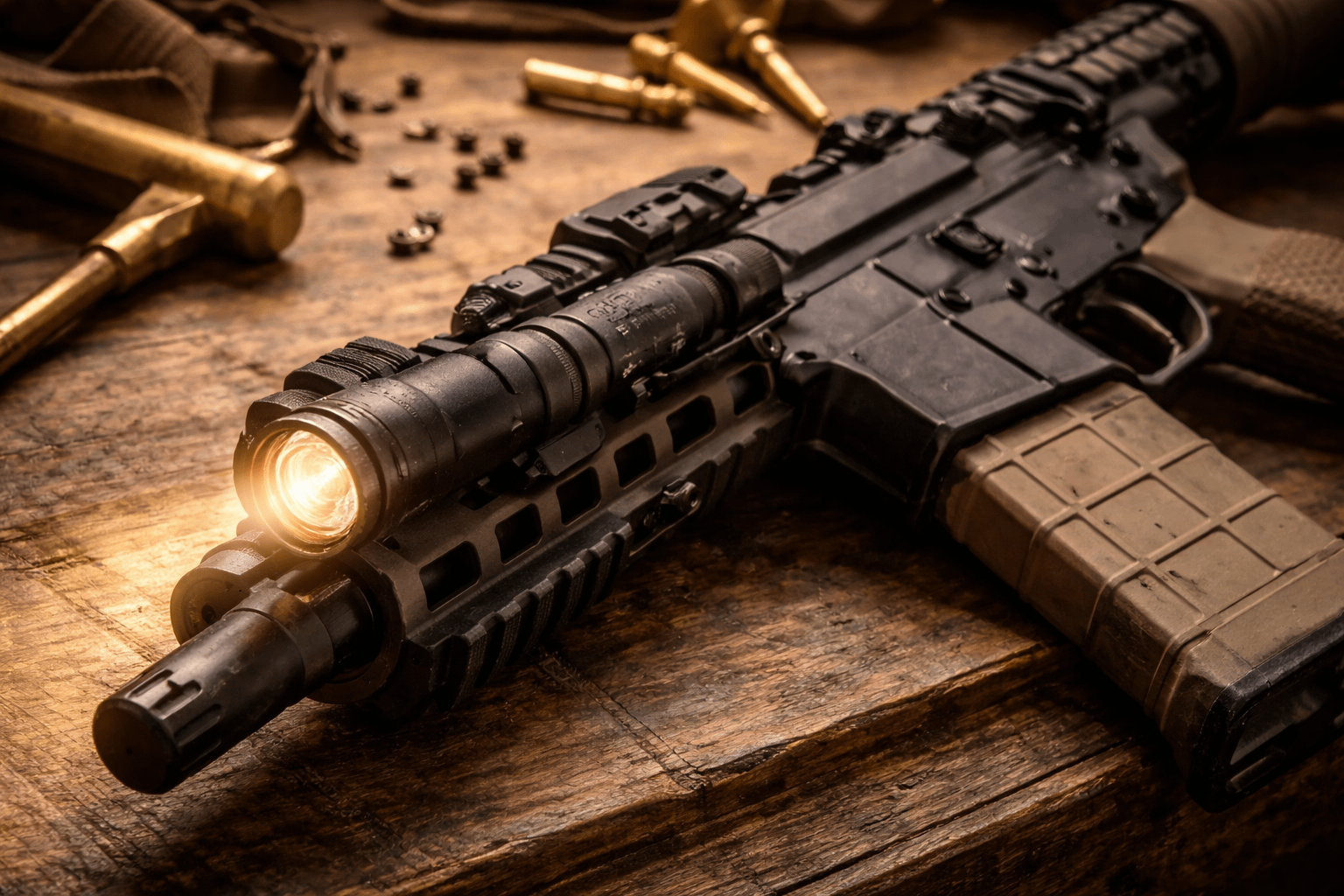
Think of the SureFire Mini Scout as the “compact Scout Pro that still feels duty-grade.” It’s not built to win spec-sheet wars. Instead, it’s built to keep your rifle lighter, cleaner, and faster while still giving you practical illumination for real spaces—hallways, doorways, and the yard outside.
A “Real Home” Walkthrough: How the SureFire Mini Scout Behaves Indoors
Specs are fine. However, the truth of a weapon light is always the same: what happens in your rooms. Indoors, the SureFire Mini Scout has a big advantage—its output is strong enough to identify threats, yet it’s often easier to manage than ultra-bright setups.
SureFire lists the Mini Scout Light Pro at 500 lumens, 7,600 candela, and 175 meters distance.
That combination tends to feel “usable” indoors because you’re not constantly fighting white-wall bounce.
Hallways (the bounce test)
Hallways are narrow, reflective, and brutally honest. If your light is too intense—or you aim it wrong—you’ll get splashback that turns your own vision into a foggy mess. The Mini Scout’s moderate candela helps here. As a result, it’s often less punishing when you use short, momentary bursts.
What you’ll feel in a hallway:
-
A bright enough hotspot to identify a person quickly
-
Enough spill to see the edges of door frames and hands
-
Less “flashbulb effect” than very high-output lights in tight spaces
Beginner habit that matters:
Use momentary more than constant-on. It’s not about being fancy. Instead, it’s about keeping your eyes in the fight.

Doorways (the edge reveal test)
Doorways are where “spill” becomes your friend. A beam that’s too tight can light up the far wall while leaving the doorway edges dim. Meanwhile, a beam with usable spill shows you what matters: hands, hips, and corners.
With the Mini Scout, the beam tends to support practical doorway work because it isn’t just a laser line. Even better, the compact head makes it easier to mount forward without turning the rifle into a snag magnet.
Bedrooms and small rooms (the “don’t blind yourself” test)
In a small bedroom, anything overpowered can become annoying fast, especially with mirrors, glossy frames, and pale paint. The Mini Scout is still bright, but it often feels easier to control.
You don’t need “the sun.” You need:
-
Positive ID
-
Clear hands
-
Clear corners
-
Repeatable switching
And that’s exactly where a compact, simple light can shine.
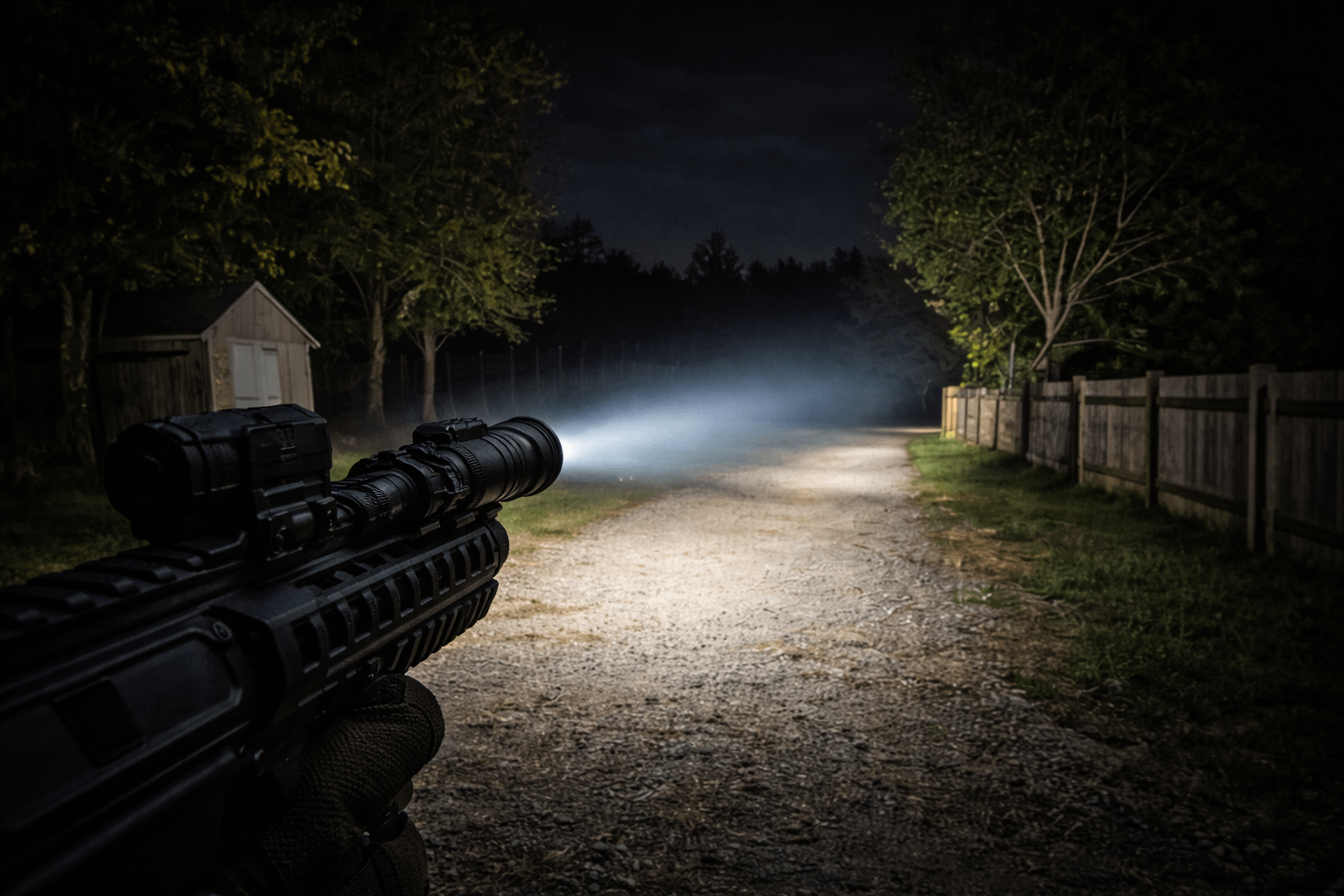
Outdoors: Why the Mini Scout Still Works for Most People
SureFire rates the Mini Scout at 175 meters.
That doesn’t mean you’re doing nighttime observation at 175m like a movie. Instead, it suggests the beam has meaningful intensity for realistic distances—yard, driveway, side yard, and outbuilding distances.
Where it feels strongest outdoors:
-
Yard checks in typical suburban and rural home ranges
-
Driveway scans where streetlights create ambient light
-
“What was that noise?” identification at reasonable distances
Where it’s not meant to be king:
-
Long-range throw-focused use cases
-
Piercing bright ambient light at distance the way Turbo models do
Why the SureFire Mini Scout Feels So Good on a Rifle
This is the part you can’t learn from a spec sheet.
SureFire lists the Mini Scout Light Pro at 4.1 inches long.
Retail listings commonly list it around 4.1 oz and compact overall dimensions.
That compactness changes how the rifle handles:
-
Less front heaviness
-
Less bulk fighting your support hand
-
Cleaner movement around doorways and furniture
Bark & Brass translation:
This is the “pocketknife” light. It doesn’t feel like a billboard. It feels like it belongs.
Mounting the SureFire Mini Scout: Where It Actually Works
Mounting is where beginners lose time and patience. Fortunately, the Mini Scout tends to be forgiving because it’s small.
Quick reminder: clock positions
-
12 o’clock = top
-
3 o’clock = right
-
9 o’clock = left
-
6 o’clock = bottom
-
11/1 o’clock = high offset (top-left/top-right)
If you want the full walk-through, link your post here:
Internal link: Where to Mount a Flashlight on an AR-15
Best “default” mount position for most people: 11 o’clock / 1 o’clock
This placement:
-
keeps the light tucked in
-
reduces snag risk
-
helps your thumb reach the tailcap naturally
Additionally, it often reduces barrel shadow compared to lower mounts.
12 o’clock: clean and ambi-friendly (if you have space)
12 o’clock can be incredibly clean. However, it can also create “top rail traffic jams” if you already have:
-
a front sight
-
a laser/IR device
-
limited rail space
3/9 o’clock: works, but snags more
Side mounts are still valid. Yet in houses, side mounts can bump door frames more often. So, if you pick this route, keep the light tight to the rail and test your setup around actual doorways.
Scout Light Pro Mount Ecosystem: Why It Matters
SureFire supports the Scout Light Pro family with mounting guidance and a mature ecosystem. SureFire even has a detailed “How to Mount Your Scout Light Pro” guide that walks through installation and adjustment steps.
Meanwhile, retailers and accessory makers note that the Pro-style rotating/adjustable mount helps you optimize placement around other gear. Primary Arms describes the Mini Scout Pro’s body and mounting system as versatile for rail types and orientation.
Brownells also discusses the Scout Pro mounting flexibility as a practical way to clear suppressors or other accessories.
Beginner takeaway:
A good mount isn’t glamorous. Still, it’s the difference between a light you love and a light you constantly fight.
Switching: Tailcap Simplicity Is the Mini Scout’s Superpower
SureFire lists the Mini Scout Light Pro with a click tailcap.
That’s a big deal because simple controls scale well under stress.
Why tailcaps work so well for beginners
-
Fewer failure points than wired setups
-
Easier troubleshooting
-
More durable “grab and go” logic
Additionally, tailcap control naturally encourages momentary use, which often helps indoors.
Battery Strategy: Keeping the Mini Scout Ready Without Drama
SureFire lists the Mini Scout using one CR123A lithium battery.
CR123A strengths:
-
strong shelf life reputation
-
predictable performance
-
easy to stage and replace
CR123A drawbacks:
-
not as convenient as rechargeables for frequent training
-
can add cost if you burn through them
My beginner-friendly staging plan
If this rifle is primarily for home defense:
-
pick a battery brand you trust
-
install a fresh cell
-
check function monthly
-
replace on a schedule that matches your comfort (many folks do a regular rotation)
If this rifle is primarily for training:
-
keep spare CR123As in your range kit
-
log runtime habits
-
don’t run it until it’s dead and then “hope” it’s fine later
Simple beats clever.
Heat, Blast, and Lens Gunk: The Stuff Nobody Brags About
If you mount any weapon light too close to the muzzle device, you’ll get:
-
carbon
-
lens haze
-
heat exposure
-
sometimes faster wear
Because the Mini Scout is compact, it’s tempting to push it super far forward. However, “forward” isn’t always “smart.”
Practical rule:
-
mount forward enough to reduce shadowing
-
keep it back enough that blast doesn’t punish the bezel
This matters even more with aggressive muzzle brakes.
The 5-Minute “Does This Setup Actually Work?” Checklist
This is the section beginners love because it removes guesswork.
1) Thumb test
Shoulder the rifle. Now activate the light 10 times.
-
If you miss it twice, move the light.
2) Wall test
Aim (safely, unloaded) at a wall.
-
look for harsh barrel shadow
-
look for dead zones where you expected spill
3) Doorway snag test
Carefully move past a doorway edge.
-
does the light catch?
-
does your sling catch the light?
4) Stress test (simple)
Do 10 reps:
-
shoulder rifle
-
light momentary
-
light off
-
repeat
If you can’t do it without thinking, the setup isn’t finished.
Mini Scout vs M640U: Which One Actually Makes More Sense?
SureFire lists the Mini Scout at 500 lumens and 7,600 candela.
SureFire lists the M640U Scout Light Pro at 1,000 lumens and higher candela (in its product listing). (retailer mirror of specs)
Choose the SureFire Mini Scout if…
-
you care about weight and balance
-
your handguard is shorter
-
you want “enough” light for real distances
-
you want a cleaner rifle profile
Choose the M640U if…
-
you want maximum output in the traditional Scout Pro lane
-
you want more “room fill” for bigger spaces
-
you don’t mind extra size and weight
In short:
-
Mini Scout = compact confidence
-
M640U = full-size muscle
Mini Scout vs Streamlight HL-X: Practical Buyer Reality
This comparison keeps people on your site. It also answers the question everyone asks.
HL-X strengths
-
often more output/intensity-per-dollar
-
frequently sold as “bundle-ready”
-
popular value pick in AR circles
Mini Scout strengths
-
smaller footprint
-
refined mount ecosystem
-
premium simplicity
-
less front heaviness
So if your priority is value-power: HL-X might win.
However, if your priority is balance and long-term premium simplicity: Mini Scout often wins.
Who the SureFire Mini Scout Is Best For
Best for: lightweight AR builds
If your rifle is meant to carry easily, the Mini Scout is a natural match. Shorter and lighter means it doesn’t pull your rifle forward all day.
Best for: home defense realism
Because it’s easier to control in tight rooms, many shooters prefer it for indoor use.
Best for: short rails and compact guns
At 4.1 inches length, it fits where longer lights feel awkward.
Who Should Skip the SureFire Mini Scout
Skip it if you want maximum output
If you want “as bright as possible,” the Mini Scout isn’t built for that. It’s built for compact performance.
Skip it if you demand rechargeable-first workflows
CR123A is reliable. Still, some people prefer 18650/dual-fuel systems for heavy training schedules.
Pros & Cons
| Pros | Cons |
|---|---|
| Compact size (4.1”) keeps rifles lighter and less front-heavy | Lower output than full-size 1,000+ lumen lights |
| Specs are practical: 500 lumens / 7,600 candela / 175m | 1-hour high runtime can feel short for long sessions |
| Simple click tailcap switching is reliable and beginner-friendly | Uses CR123A (not a dual-fuel rechargeable format) |
| Scout Pro ecosystem: mounting options and accessory support | Premium price for a compact 500-lumen weapon light |
FAQ (ONE section only)
-
How bright is the SureFire Mini Scout?
SureFire lists it at 500 lumens. -
What is the candela rating of the SureFire Mini Scout?
SureFire lists 7,600 candela peak beam intensity. -
How far does the beam reach?
SureFire lists 175 meters distance. -
What battery does it use?
SureFire lists one CR123A lithium battery. -
Is the SureFire Mini Scout good for home defense?
Yes—because moderate output can be easier to manage indoors, and the compact size helps keep the rifle nimble.
Final Thoughts
If you want a premium light that doesn’t make your rifle feel like a boat anchor, the SureFire Mini Scout is a smart pick. It’s compact, it’s simple, and it’s built around practical numbers: 500 lumens, 7,600 candela, and a 175m rating that fits real homeowner distances.
More importantly, it feels like a tool—like it expects to be used, bumped, and carried. And in the Bark & Brass world, that matters more than chasing bragging rights.
Links
Streamlight ProTac Rail Mount 2
Streamlight ProTac HL-X Rifle Light Review
Lumens vs Candela for AR-15 Flash Lights
Best AR-15 Flash Lights for Home Defense
Manufacturer specs : SureFire Mini Scout Light Pro