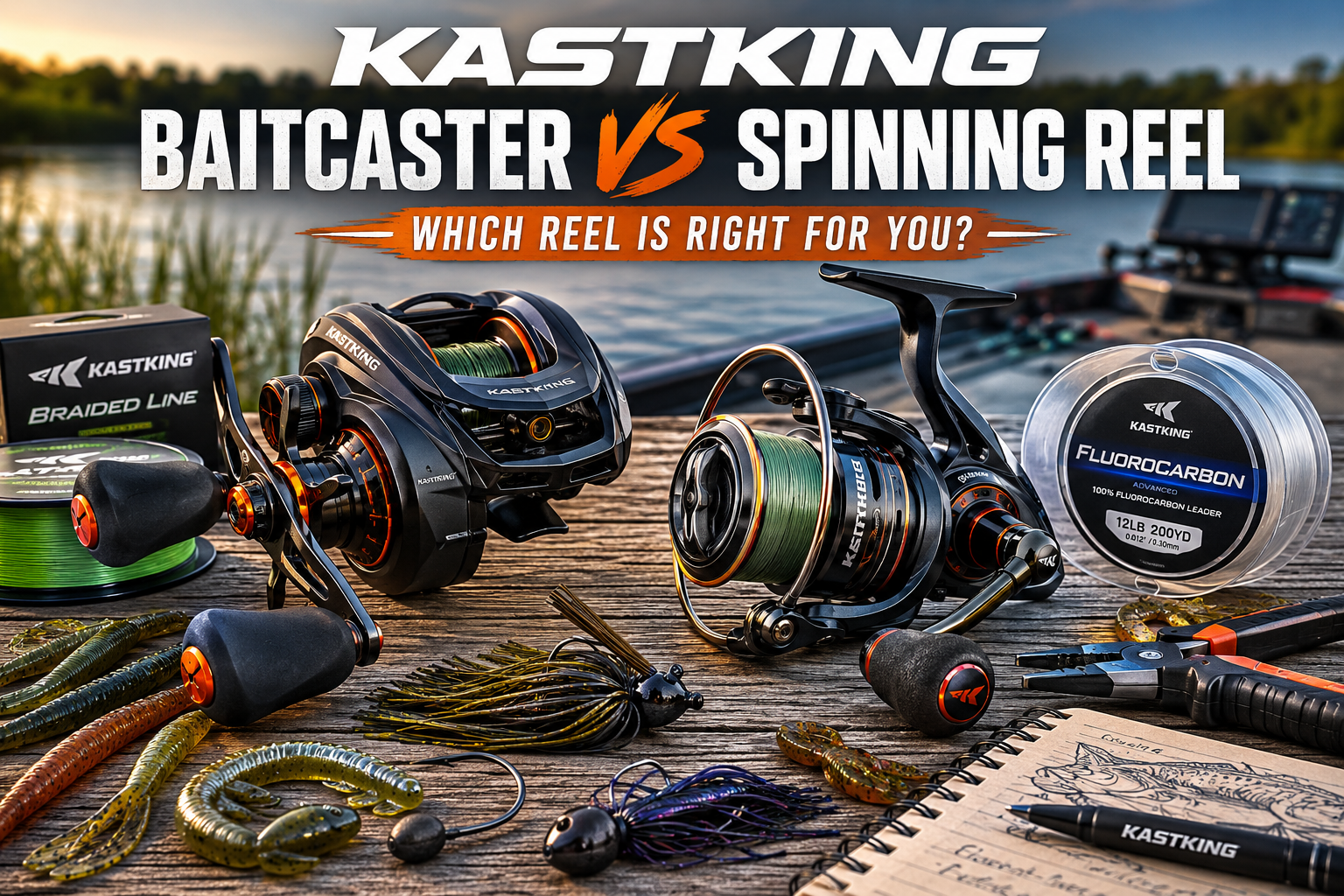
KastKing Baitcaster vs Spinning Reel: Which Should Bass Anglers Buy First?
Affiliate disclosure: Bark & Brass may earn a commission if you buy through links in this article. That does not change the price you pay, and it does not buy a reel a participation trophy. If a setup makes sense, we’ll say so. If it does not, we’ll say that too.
KastKing baitcaster vs spinning reel is one of those bass fishing decisions that sounds simple until you are standing in front of a pile of reels trying to figure out which one actually fits the way you fish. The honest answer is not “baitcasters are better” or “spinning reels are for beginners.” The honest answer is that both reel types catch bass, both have a place, and the right first choice depends on your lures, your water, your patience, and whether you want finesse control or power-fishing efficiency.
I do a lot of fishing, and this guide is written from that real-world angle: what actually makes sense when you are fishing from the bank, working a pond, throwing plastics, covering weed edges, fighting wind, or trying to decide whether your next setup should be a forgiving spinning reel or a more controlled baitcasting reel. However, the product details are not guessed. Every KastKing item mentioned here is a real KastKing.com product, and the specs are based on KastKing’s own published product pages.
How This KastKing Baitcaster vs Spinning Reel Guide Was Built
This guide was built from three things: real fishing experience, practical bass technique matching, and verified KastKing.com product information. I fish enough to know that the reel on the rod matters, but I also know that reel type does not magically catch fish by itself. The lure, line, rod, drag, retrieve, cover, and angler all matter too.
Because of that, this is not a fake lab-test review or a pretend “we tortured every reel for 500 casts” article. Instead, this is a buyer-focused guide that explains when a KastKing spinning reel makes more sense, when a KastKing baitcaster makes more sense, and which specific KastKing reels fit each job. That keeps it honest, useful, and grounded instead of turning into the usual internet tackle-shop fog machine.
Quick Answer: KastKing Baitcaster vs Spinning Reel
Most newer bass anglers should buy a KastKing spinning reel first. A spinning reel is easier to cast, better with light lures, friendlier in wind, and more forgiving when you are still building confidence.
Most anglers who already fish regularly should add a KastKing baitcaster next. A baitcaster gives you better control with heavier baits, more efficient target casting, stronger hookset leverage, and better handling around cover.
The best long-term answer is both. Build one spinning setup for finesse baits and one baitcasting setup for power fishing. That two-reel system covers a huge chunk of bass fishing without turning your garage into a tackle shop with property taxes.
The mistake is treating this like a cage match. A KastKing baitcaster vs spinning reel comparison is not about picking one forever and throwing the other into the lake like it insulted your family. It is about matching the reel to the job.
For example, if you are throwing weightless worms, Ned rigs, drop shots, shaky heads, small swimbaits, finesse tubes, and light plastics, spinning gear usually makes more sense. Meanwhile, if you are pitching Texas rigs, dragging jigs, burning spinnerbaits, throwing chatterbaits, walking frogs, or casting heavier lures around grass and wood, baitcasting gear starts to earn its place.
That is the whole deal. The reel is not the hero. The reel is the delivery system. Some delivery systems are better for envelopes. Some are better for refrigerators. Try delivering a refrigerator on a bicycle and you will understand lure matching real quick.
Internal link: If you have not read the main hub yet, start here too: Best KastKing Reels for Bass Fishing. That guide covers the broader KastKing reel lineup, while this article focuses specifically on the baitcaster-vs-spinning buying decision.
KastKing Baitcaster vs Spinning Reel: The Basic Difference
A spinning reel hangs under the rod. During the cast, the spool stays fixed while line peels off in loops. Because of that design, spinning reels handle lighter lures and lighter line very well. They are also easier for most anglers to learn because there is no rotating spool to control during the cast.
A baitcaster sits on top of the rod. During the cast, the spool rotates as the lure pulls line away. That design gives you excellent casting control, especially with medium and heavier baits. However, because the spool spins, it has to be controlled by the reel’s braking system, spool tension, and sometimes your thumb.
Older baitcasters often demanded a lot more thumb control through the whole cast. However, newer baitcasters with modern braking systems have changed the game. Many current baitcasters, including several KastKing models with advanced brake designs, are built to reduce overruns and make casting much more forgiving. You still need to set the reel correctly, and your thumb is still useful for feathering casts, stopping the lure, and making precision presentations. But you do not always have to ride the spool like an old-school baitcaster from 1987 that wants to punish your optimism.
That difference matters. A modern KastKing baitcaster vs spinning reel decision is not as simple as “baitcasters backlash and spinning reels do not.” It is more accurate to say that spinning reels are naturally easier with light baits, while modern baitcasters are much more manageable than they used to be and still shine with heavier lures and target casting.
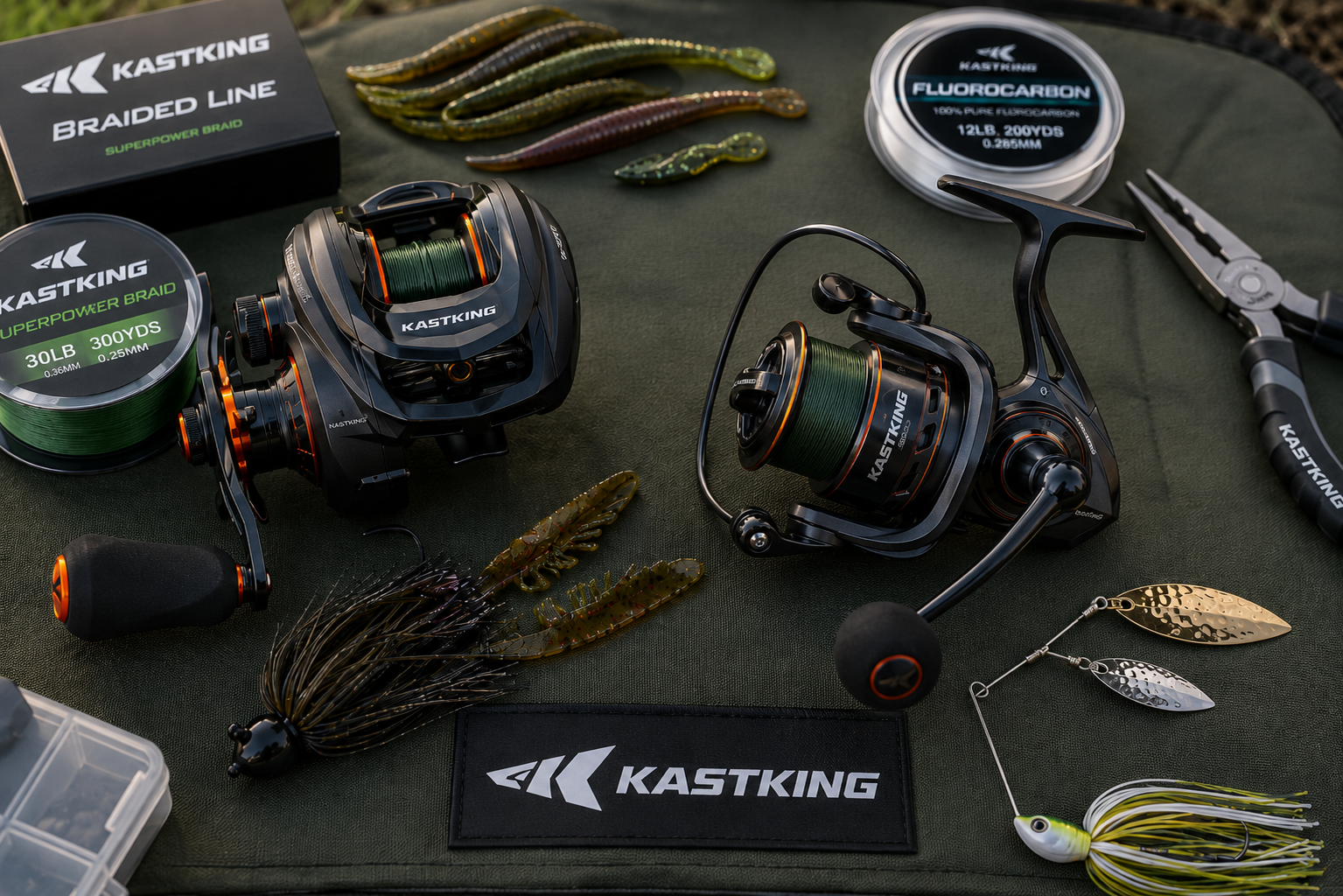
KastKing Baitcaster vs Spinning Reel Comparison Table
This table gives you the fast buyer’s view. On mobile, scroll sideways to see the whole chart.
| Category | KastKing Spinning Reel | KastKing Baitcaster | Best Choice for Most Anglers |
|---|---|---|---|
| Ease of learning | Very beginner-friendly and simple to cast | Much easier than older baitcasters when modern brakes are set correctly, but still has more setup involved | Spinning reel |
| Light lures | Excellent for finesse baits, small plastics, and lighter rigs | Possible with the right reel and setup, but less forgiving for most anglers | Spinning reel |
| Heavy lures | Can handle some heavier baits, but not always the most efficient tool | Excellent for jigs, Texas rigs, frogs, spinnerbaits, chatterbaits, and heavier presentations | Baitcaster |
| Wind management | Usually easier for newer anglers with lighter baits | Modern braking helps, but poor settings and light lures can still cause overruns | Spinning reel for beginners |
| Accuracy around cover | Good with practice | Excellent once the reel is dialed in | Baitcaster |
| Line handling | Great with light braid, fluorocarbon leader, and lighter mono | Great with heavier fluorocarbon, mono, and braid | Depends on technique |
| Bank fishing | Very practical because it handles lots of lure weights and awkward angles | Great if you mostly throw heavier baits from shore | Spinning reel first |
| Boat or kayak fishing | Still useful for finesse and follow-up baits | Very useful for covering water and making repeated target casts | Both |
| Best first purchase | Best for brand-new bass anglers and finesse-heavy fishing | Best for anglers ready to fish heavier baits efficiently | Spinning first for most, baitcaster first for power anglers |
Who Should Buy a KastKing Spinning Reel First?
You should buy a KastKing spinning reel first if you are new to bass fishing, fish from the bank, throw lighter lures, deal with wind, or want the least frustrating path to putting baits in front of fish. That answer is not glamorous, but it is usually correct.
Spinning gear has a reputation for being beginner gear. However, that reputation only tells half the story. Yes, spinning reels are easier for beginners. However, experienced anglers still use spinning setups constantly because finesse fishing flat-out works.
When bass are pressured, cold, suspended, spooky, or just acting like they pay rent in the lake and do not owe you anything, spinning gear can save the day. It handles light line, subtle presentations, and small baits better than most standard baitcasting setups.
Best Techniques for a KastKing Spinning Reel
A KastKing spinning reel makes sense for:
- Weightless stick worms
- Wacky rigs
- Ned rigs
- Drop shots
- Small swimbaits
- Shaky heads
- Finesse tubes
- Small grubs
- Light Texas rigs
- Small topwaters
Those baits catch bass everywhere: farm ponds, subdivision lakes, rivers, creeks, reservoirs, docks, riprap, grass edges, and those little roadside ponds you keep telling yourself you are not going to fish even though you absolutely are.
Why Spinning Reels Are Forgiving
The biggest spinning reel benefit is forgiveness. With a spinning reel, your lure does not have to pull a rotating spool into motion. Open the bail, hold the line, cast, close the bail, and fish.
There are still things to learn. Line twist, drag setting, leader knots, spool fill, and casting mechanics all matter. However, you are not fighting a baitcaster spool while also trying to figure out where the bass are. That makes the learning curve much friendlier.
In a KastKing baitcaster vs spinning reel decision, this is the biggest reason spinning reels win for most newer anglers. They get you fishing faster, and that matters because confidence catches more fish than frustration.
Best First-Reel Logic
If a new bass angler asked which KastKing reel type to buy first, I would usually point them toward a spinning reel in a practical bass size. For many anglers, that means a 2000 or 3000 size depending on the model, rod, line choice, and how much all-around use they want.
This is not because baitcasters are bad. It is because early success matters. Catching fish builds confidence. Confidence keeps people fishing. A bird nest the size of a squirrel condo does not.
Who Should Buy a KastKing Baitcaster First?
You should buy a KastKing baitcaster first if you already understand basic casting, mostly throw medium or heavier bass lures, fish around cover, or want better control for repeated target casting. A baitcaster makes more sense when your fishing style leans toward power, accuracy, and efficiency.
Modern baitcasters are also much more forgiving than many older reels. KastKing models with systems like AutoMag Dual Braking are designed to reduce overruns and make baitcasting less intimidating. Therefore, the old advice that you must constantly keep your thumb glued to the spool is outdated for many newer reels.
That said, your thumb is not useless. It still helps feather a cast, slow the lure before splashdown, stop the spool precisely, and make quiet presentations around cover. Think of your thumb less like an emergency brake and more like fine steering. You may not need it clamped down the whole cast, but you still want it involved when accuracy matters.
Best Techniques for a KastKing Baitcaster
A KastKing baitcaster makes sense for:
- Jigs
- Texas rigs
- Carolina rigs
- Spinnerbaits
- Chatterbaits
- Frogs
- Buzzbaits
- Crankbaits
- Swim jigs
- Heavier swimbaits
The baitcaster advantage is control. Once the reel is set correctly, you can make repeated casts, stop a bait short of cover, pitch into small openings, and handle heavier line better. As a result, baitcasters are extremely useful when bass are buried in grass, wood, pads, reeds, or dock shade.
Modern Baitcasters Are Not Just for Experts
Here is the fair update: baitcasters are not the angry little backlash machines they used to be. Better braking systems, lighter spools, better line guides, and improved reel designs have made them much easier to learn. A properly adjusted modern baitcaster can be surprisingly friendly.
However, it still has to match the lure. If you tie on something too light, cast into wind, and set the brakes like you are trying to win a distance contest behind a gas station, the reel may still complain. The difference is that newer baitcasters give you more help than older ones did.
Honest Baitcaster Warning
A modern KastKing baitcaster can reduce backlash problems, but it does not repeal physics. Brake settings, lure weight, line type, wind, and casting motion still matter. Start with medium-weight lures, set the brakes conservatively, and loosen things as you get comfortable. No shame in learning smart. Pride does not catch fish; it mostly buys replacement line.
KastKing Baitcaster vs Spinning Reel: The Two-Reel System
For most bass anglers, the smartest answer is not one reel forever. It is one spinning reel and one baitcaster.
That does not mean you need twelve rods, a boat deck that looks like a porcupine, and a spreadsheet called “Bass Gear Final Final Updated Again.” It means a simple two-reel system gives you better coverage.
- One KastKing spinning setup for finesse, light lures, tough bites, and bank-friendly versatility.
- One KastKing baitcasting setup for heavier baits, power fishing, cover, and repeated casting.
With that system, you can keep a wacky rig, Ned rig, or drop shot on the spinning rod and a jig, Texas rig, chatterbait, spinnerbait, or frog on the baitcaster. Then, when the fish change moods, you are not standing there retying while the guy next to you catches your fish. Rude, but legal.
This also creates a strong internal link path for Bark & Brass. The broad reel guide lives here: Best KastKing Reels for Bass Fishing. For soft-plastic technique support, link readers into your broader plastic bait content here: Fishing with Plastic Worms and Critters. Together, those internal links help readers move through the silo naturally instead of landing on one post and wandering off into the weeds.
KastKing Spinning Reels for Bass Fishing
The spinning reels below are KastKing.com products that make sense in a KastKing baitcaster vs spinning reel guide because they fit finesse, lighter lures, general bank fishing, and all-around freshwater bass use. Availability, prices, and size options can change, so always check KastKing’s current product page before buying.
KastKing Sharky X Spinning Fishing Reel
The KastKing Sharky X Spinning Fishing Reel is a practical first spinning reel for bass anglers who want a useful reel without jumping straight into a premium price range. KastKing lists the Sharky X with a Nylitech lightweight body, 6.2:1 gearing, a carbon fiber drag system rated up to 39.5 pounds, a long-cast spool, and 10+1 bearings.
For bass fishing, the Sharky X makes sense for wacky rigs, Ned rigs, shaky heads, small swimbaits, light Texas rigs, and general pond or bank fishing. The 2000 and 3000 sizes are especially relevant for many bass anglers, depending on rod length, line choice, and whether you prefer a lighter or slightly more line-capable setup.
Best fit: beginner-to-intermediate bass anglers who want one spinning reel to cover finesse and general freshwater fishing.
KastKing MegaJaws Spinning Reel
The KastKing MegaJaws Spinning Reel is a stronger spinning option for anglers who want more power in the spinning side of the setup. KastKing lists the 2000 and 3000 sizes with a 6.2:1 retrieve ratio, while the 4000 and 5000 sizes use a 5.2:1 ratio. KastKing also lists double-disc carbon fiber drag on the 2000 and 3000 sizes with up to 33 pounds of drag, while the larger sizes are listed with triple-disc carbon fiber drag and up to 39.5 pounds.
For normal bass fishing, the 2000 or 3000 sizes are the more natural fit. The bigger sizes may make sense for heavier freshwater or crossover use, but most bass anglers do not need to overbuild the spinning side unless they have a clear reason.
Best fit: anglers who want a more powerful KastKing spinning reel for finesse bass fishing, bigger water, or heavier freshwater crossover use.
KastKing Royale Legend Pro Spinning Reels
The KastKing Royale Legend Pro Spinning Reel is a good option for anglers who want a faster, smoother spinning reel. KastKing lists it with a 6.2:1 high-speed gear ratio, 10+1 MaxiDur double-shielded stainless steel bearings, lightweight carbon fiber construction, and a hardened aerospace Digi-cut aluminum main gear.
In a KastKing baitcaster vs spinning reel setup, this reel fits the finesse side well. A faster spinning reel helps pick up slack after a long cast, recover line when a fish swims toward you, and quickly reset for another cast.
Best fit: anglers who want a sharper, faster spinning reel for finesse bass fishing and all-around freshwater use.
KastKing Kestrel 1000 Spin Finesse System Ultralight Spinning Reel
The KastKing Kestrel 1000 Spin Finesse System Ultralight Spinning Reel is more specialized. KastKing lists it with a 6.2:1 gear ratio and 28.4 inches per turn, and describes it as a choice for bass, trout, crappies, and other panfish.
For bass fishing, this is not the first reel I would point every beginner toward. It is more of a finesse-focused tool. However, if you love small baits, light line, clear water, pressured bass, creek fishing, or multispecies fishing, the Kestrel 1000 starts making more sense.
Best fit: finesse-focused anglers, creek anglers, and anyone who wants a lightweight spinning setup for smaller baits.
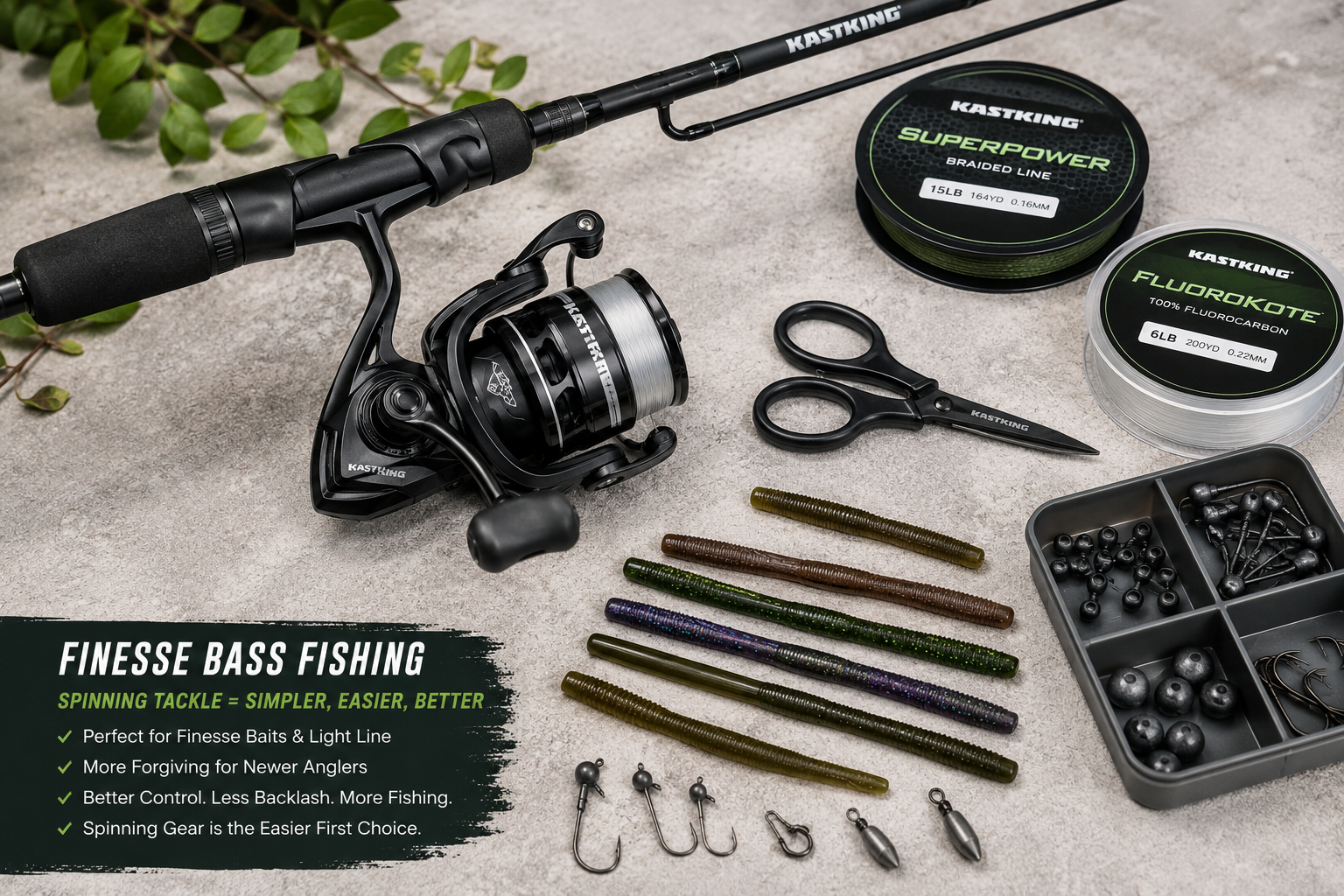
KastKing Baitcasters for Bass Fishing
The baitcasters below are KastKing.com products that make sense for the baitcasting side of the KastKing baitcaster vs spinning reel decision. These reels fit power fishing, faster retrieves, heavier baits, and target-oriented bass techniques.
KastKing Royale Legend Pro Baitcasting Reels
The KastKing Royale Legend Pro Baitcasting Reel is one of the cleaner baitcaster recommendations for anglers who want speed, light weight, and modern braking. KastKing lists it with an 8.0:1 gear ratio, 16 pounds of carbon drag, 11+1 stainless steel bearings, a 5.5-ounce weight, carbon fiber frame and side cover, and an AutoMag Dual Braking System.
For bass fishing, that 8.0:1 speed is useful for Texas rigs, jigs, frogs, buzzbaits, and techniques where fast slack pickup matters. It is not the slow, grinding reel you would choose specifically for deep cranking, but for many modern bass presentations, a faster baitcaster is extremely practical.
Best fit: bass anglers who want a light, fast baitcaster for jigs, Texas rigs, frogs, and versatile power fishing.
KastKing MegaJaws Baitcasting Reels with AutoMag Dual Braking
The KastKing MegaJaws Baitcasting Reel is a strong all-around baitcaster because KastKing lists multiple gear ratios: 5.4:1, 6.5:1, 7.2:1, and 9.1:1. That matters because not every bass bait wants the same retrieve speed.
KastKing lists the MegaJaws baitcaster with 11+1 double-shielded stainless steel bearings, a stainless steel main shaft, a 7075 aluminum main gear, a manganese brass pinion gear, up to 17.6 pounds of carbon drag, and the AutoMag Dual Braking System.
For bass anglers, the gear-ratio spread is the big story. A 5.4:1 version makes sense for crankbaits and resistance baits. A 6.5:1 or 7.2:1 version makes sense for general-purpose work. A 9.1:1 version makes more sense when fast pickup is the point, such as pitching, flipping, and certain topwater or slack-line techniques.
Best fit: anglers who want to match a KastKing baitcaster to a specific technique instead of buying one speed and hoping it does everything.
KastKing Megatron 100 Baitcasting Reel
The KastKing Megatron 100 Baitcasting Reel is listed by KastKing with a low-profile graphite frame, 7.2:1 gear ratio, brass main and pinion gears, 7+1 stainless bearings, an 8-button magnetic braking system, a CNC aluminum spool, and up to 11 pounds of drag.
For bass fishing, the Megatron 100 looks like a practical all-around baitcaster rather than a hyper-specialized reel. A 7.2:1 ratio is a useful middle-fast speed for reaction baits, Texas rigs, swim jigs, spinnerbaits, and general casting.
Best fit: anglers who want an affordable, general-purpose KastKing baitcaster for normal bass fishing techniques.
KastKing Speed Demon Elite Baitcasting Reel
The KastKing Speed Demon Elite Baitcasting Reel is the speed-focused option. KastKing lists one version at 10.5:1 with 42 inches per turn, and another at 8.6:1 with 34 inches per turn. KastKing also describes an exterior centrifugal brake system with a wide adjustment range.
This is not the first baitcaster every beginner needs. It is fast. Very fast. That can be excellent for pitching, flipping, burning slack, quickly picking up line, and making repeated casts. However, it can also be too much reel for someone who already tends to work baits too fast.
Best fit: experienced anglers who specifically want a very fast KastKing baitcaster for high-speed techniques.
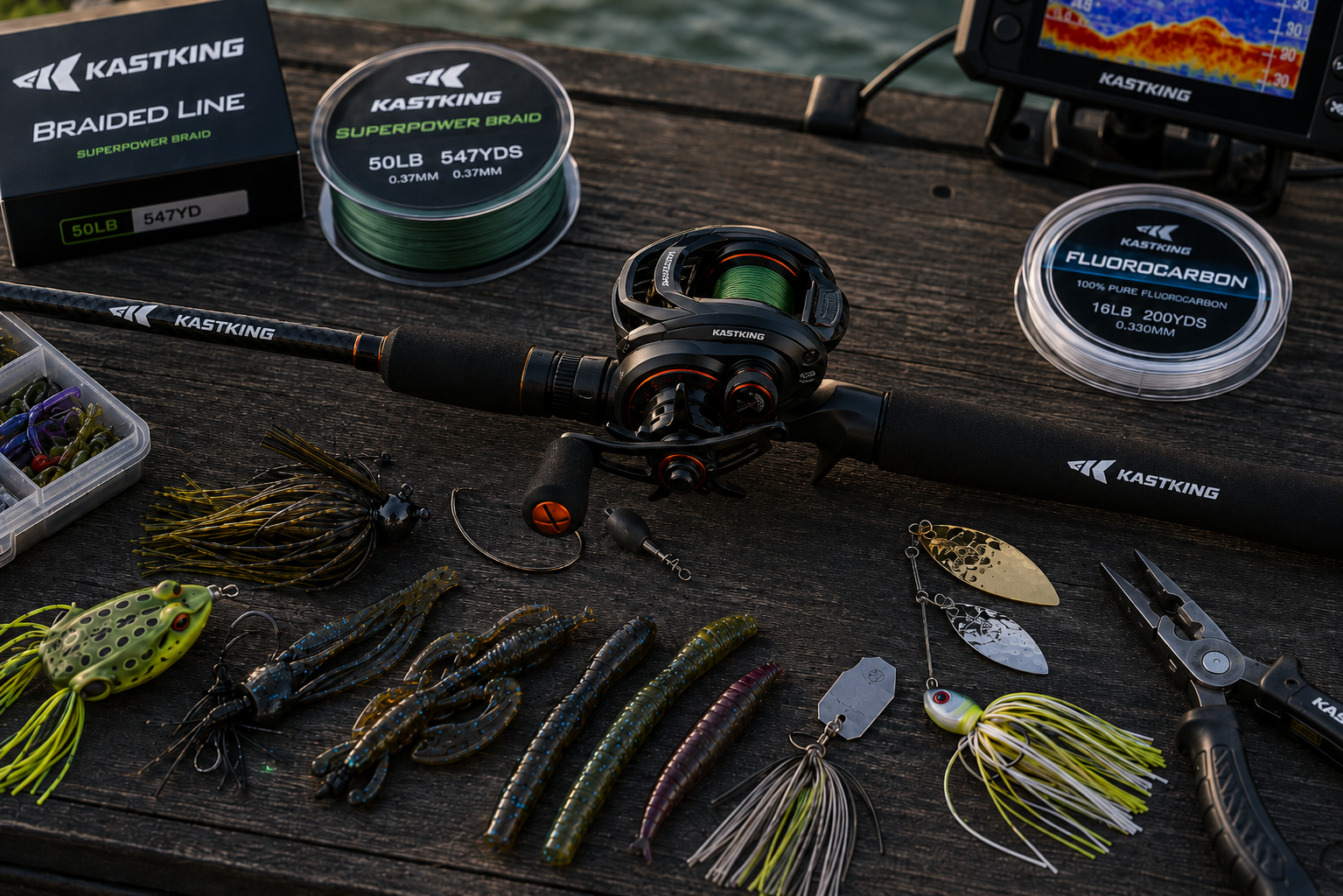
KastKing Baitcaster vs Spinning Reel for Beginners
For most beginners, a KastKing spinning reel is still the better first buy. It is easier to cast, easier to manage with lighter lures, and usually more forgiving when the wind or casting angle is not perfect.
However, a beginner can learn on a baitcaster if they are patient and start with the right setup. Because modern baitcasters have better braking systems than older reels, learning is not as painful as it used to be. Still, the beginner has to match lure weight, line, brake settings, and rod action correctly.
Beginner KastKing Spinning Setup
A beginner-friendly KastKing spinning setup should be simple:
- Spinning reel in a practical bass size, often around 2000 to 3000 depending on the model.
- Medium-light or medium spinning rod.
- 10- to 15-pound braided main line.
- 6- to 10-pound fluorocarbon leader.
- Finesse baits like wacky rigs, Ned rigs, shaky heads, small swimbaits, and light Texas rigs.
That setup is not flashy. However, it catches fish, and that matters more than looking like you raided a tournament boat.
Beginner KastKing Baitcaster Setup
If a beginner wants to start with a baitcaster, keep it forgiving:
- Choose a general-purpose gear ratio around the middle-fast range when available.
- Use a medium-heavy casting rod for common bass baits.
- Start with heavier, more aerodynamic lures like spinnerbaits, chatterbaits, casting plugs, or Texas rigs.
- Avoid tiny light lures at first.
- Set the braking system conservatively until you get comfortable.
- Use your thumb for final lure control and quiet landings, not constant panic-braking.
The first baitcaster lesson is setup. The second is rhythm. The third is that scissors are not a fishing strategy, even though they do occasionally become involved.
KastKing Baitcaster vs Spinning Reel by Technique
The easiest way to choose is to look at the lure. Technique tells you more than ego ever will.
| Technique | Better Reel Type | Why It Makes Sense | KastKing Direction |
|---|---|---|---|
| Wacky rig | Spinning reel | Often light, subtle, and better with lighter line | Sharky X, Royale Legend Pro Spinning, MegaJaws Spinning |
| Ned rig | Spinning reel | Light lure, finesse presentation, easy casting | Kestrel 1000 for finesse, Sharky X for broader use |
| Drop shot | Spinning reel | Light line control and finesse presentation | Royale Legend Pro Spinning, Sharky X |
| Shaky head | Spinning reel | Finesse-friendly but can be upsized | Sharky X or MegaJaws Spinning |
| Small swimbait | Spinning reel | Light jigheads and open-water retrieves | Sharky X or Royale Legend Pro Spinning |
| Texas rig | Baitcaster for medium/heavy rigs | Better hookset power and cover control | MegaJaws Baitcaster, Megatron 100, Royale Legend Pro Baitcaster |
| Jig | Baitcaster | Accuracy, heavier line, stronger hooksets | Royale Legend Pro Baitcaster, MegaJaws Baitcaster |
| Frog | Baitcaster | Heavy braid, cover, fast pickup, and strong control | Royale Legend Pro Baitcaster, Speed Demon Elite Baitcaster |
| Spinnerbait | Baitcaster | Repeated casting, line control, and medium/heavy lure weight | Megatron 100 or MegaJaws Baitcaster |
| Chatterbait | Baitcaster | Efficient casting and better control around grass | Megatron 100, MegaJaws Baitcaster |
| Crankbait | Baitcaster, often slower ratio | Resistance baits often benefit from controlled retrieve speed | MegaJaws Baitcaster in a slower gear ratio where available |
| Topwater walking bait | Usually baitcaster | Line pickup and rod-tip control | Royale Legend Pro Baitcaster or Speed Demon Elite Baitcaster |
KastKing Baitcaster vs Spinning Reel for Bank Fishing
If you fish mostly from the bank, a spinning reel first usually makes more sense. Bank anglers do not always get perfect casting angles. You may have brush behind you, cattails at your feet, wind in your face, and one little opening between branches that looks like it was designed by someone who hates fishing.
Because of that, versatility matters. A spinning setup lets you throw a wacky rig around a dock, switch to a small swimbait along riprap, drag a shaky head down a point, or toss a light Texas rig into sparse grass without changing rods.
A baitcaster can still work very well from shore. In fact, if you throw frogs, jigs, Texas rigs, spinnerbaits, and chatterbaits from the bank, a baitcaster may become your favorite tool. However, as a first all-around bank setup, spinning gear is more forgiving.
Best Bank-Fishing KastKing Setup
For most bank bass anglers, start with a KastKing spinning reel such as the Sharky X, MegaJaws Spinning, or Royale Legend Pro Spinning. Pair it with a medium-light or medium spinning rod and run braid-to-leader.
After that, add a KastKing baitcaster when you find yourself consistently throwing heavier baits. That way, the baitcaster fills a real gap instead of becoming another shiny thing in the garage.
KastKing Baitcaster vs Spinning Reel for Boat and Kayak Fishing
If you fish from a boat or kayak, a baitcaster becomes useful sooner. Boat and kayak anglers often make repeated target casts around docks, laydowns, grass lines, riprap, points, and shoreline cover.
In those situations, baitcasting efficiency is a big deal. A dialed-in baitcaster lets you roll cast, pitch, feather, and stop baits with control. Meanwhile, a spinning reel remains the smart choice for finesse and follow-up baits.
Therefore, boat and kayak anglers should not think of spinning gear as “less serious.” A spinning rod with a finesse bait can save a slow day after moving baits stop working. It is the dependable friend who shows up with tools after the fancy plan breaks.
Line Choice for KastKing Baitcaster vs Spinning Reel Setups
Line choice can make a good reel feel great or make a good reel feel like it needs counseling. The right line depends on reel type, lure weight, water clarity, and cover.
Best Line Setup for KastKing Spinning Reels
For bass fishing, braid-to-fluorocarbon leader is hard to beat on spinning gear. Braid handles well on a spinning spool, casts far, and gives good sensitivity. The fluorocarbon leader adds abrasion resistance and lower visibility near the bait.
A common bass spinning setup looks like this:
- 10- to 15-pound braided main line
- 6- to 10-pound fluorocarbon leader
- Leader length adjusted based on water clarity, cover, and confidence
You can run straight monofilament or fluorocarbon on a spinning reel, but heavier line memory can become annoying. Braid-to-leader keeps the setup cleaner for many finesse presentations.
Best Line Setup for KastKing Baitcasters
Baitcasters tend to play nicely with heavier line. The right choice depends on the bait and cover:
- Fluorocarbon: good for jigs, Texas rigs, spinnerbaits, chatterbaits, and many bottom-contact techniques.
- Monofilament: useful for some topwater and treble-hook baits where stretch can help.
- Braid: strong choice for frogs, heavy grass, and dirty cover where power matters.
For a first baitcaster, avoid going too light on line while learning. Slightly heavier line can be more forgiving and easier to manage. Once the reel feels natural, fine-tune from there.
Gear Ratio in a KastKing Baitcaster vs Spinning Reel Setup
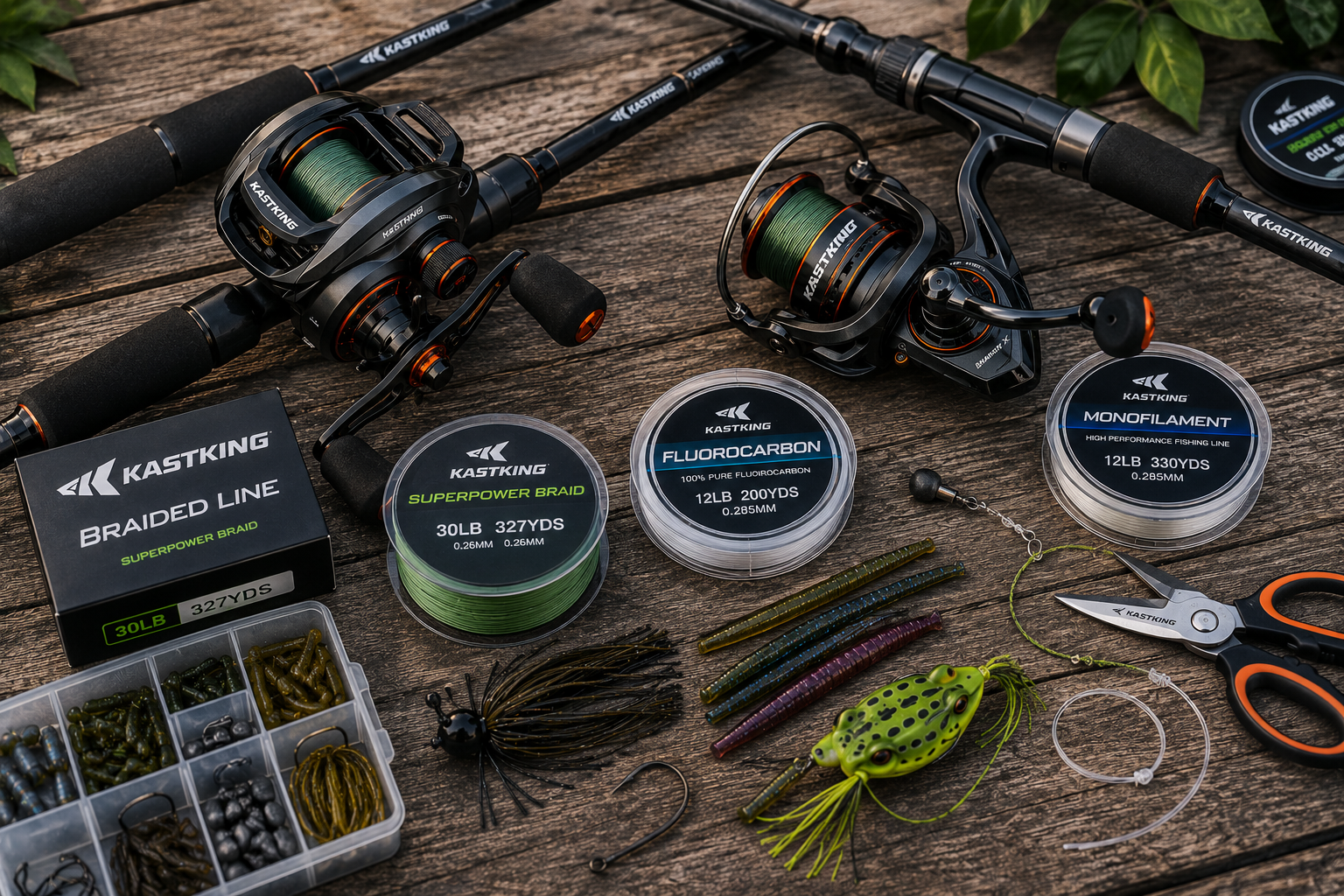
Gear ratio tells you how many times the spool turns with one handle turn. Higher gear ratios usually mean faster line pickup, but inches per turn also depends on spool size. Therefore, gear ratio is useful, but it is not the whole story.
Still, gear ratio helps you choose the right reel:
- Slower baitcaster ratios: often better for crankbaits and resistance-heavy retrieves.
- Mid-speed baitcaster ratios: useful for general-purpose bass fishing.
- High-speed baitcaster ratios: good for jigs, Texas rigs, frogs, pitching, flipping, and fast slack pickup.
- Fast spinning reels: useful for finesse fishing when quick slack pickup matters.
This is where KastKing gives you useful options. The MegaJaws baitcaster is listed with multiple gear ratios, which lets anglers pick based on technique. The Royale Legend Pro baitcaster is listed as an 8.0:1 reel, which leans fast and versatile. The Speed Demon Elite baitcaster is speed-focused, with KastKing listing versions at 10.5:1 and 8.6:1.
Do not buy speed just because it sounds cool. Speed is useful when the technique calls for it. However, if you constantly overwork baits, a screaming-fast reel may make that problem worse.
Drag in a KastKing Baitcaster vs Spinning Reel Setup
Max drag numbers look good in product specs, and they do matter to a point. However, bass fishing usually does not require locking down a reel like you are winching a truck out of a ditch. Smooth drag and proper adjustment matter more than bragging rights.
On spinning gear with lighter line, drag protects your leader and keeps small hooks from tearing free. On baitcasting gear with heavier line, drag helps control fish around cover. If you are using braid in heavy grass, you may run the drag tighter. If you are using a light fluorocarbon leader on a drop shot, do not set the drag like you are towing a pontoon boat.
The practical question is not “which reel has the biggest drag number?” The better question is: can the reel apply smooth, controlled pressure with the line and technique you are using?
Casting Distance: KastKing Baitcaster vs Spinning Reel
Spinning reels are usually easier for distance with light lures. If you are throwing a small swimbait on a light jighead, a weightless stick worm, or a Ned rig, spinning gear generally sends it farther with less drama.
Baitcasters can cast far too, especially with the right lure weight and brake setup. However, where baitcasters really shine is controlled accuracy with medium and heavier baits.
Once a baitcaster is dialed in, you can feather the bait, stop it short, and place it into tighter windows. That makes a big difference around docks, laydowns, shade pockets, isolated grass clumps, and other targets where bass love to sit like little green ambush goblins.
Wind: KastKing Baitcaster vs Spinning Reel
Wind exposes bad casting setups. It also exposes overconfidence. There is nothing like a little breeze in your face to remind you that physics does not care about your fishing hat.
In windy conditions, spinning gear is often easier for newer anglers, especially with lighter lures. Since the spool is not rotating during the cast, the lure can slow down without creating the same overrun problem.
With a baitcaster, modern braking helps a lot. However, wind can still slow the lure while the spool wants to keep moving. Good settings, heavier lures, better casting angles, and a trained thumb all help. Therefore, newer anglers should be honest about where and how they fish before choosing baitcasting first.
Cover Fishing: KastKing Baitcaster vs Spinning Reel
When the fishing gets heavier, baitcasters start to pull ahead. Cover changes the rules. Grass, wood, pads, docks, reeds, laydowns, brush piles, and riprap all demand more control.
A baitcaster paired with heavier line and a medium-heavy or heavy casting rod gives you better leverage for:
- Driving single hooks home
- Pulling fish away from cover
- Pitching accurately into small targets
- Fishing heavier baits efficiently
- Managing slack line quickly
That is why serious bass anglers often use baitcasters for jigs, Texas rigs, frogs, and spinnerbaits. Spinning gear can still catch fish around cover, but baitcasting gear usually gives you better control when the situation gets ugly.
Finesse Fishing: KastKing Baitcaster vs Spinning Reel
Finesse fishing is where spinning gear earns its keep. Light line, small hooks, subtle baits, and pressured bass all point toward spinning tackle.
Common finesse situations include clear water, cold fronts, pressured ponds, suspended bass, smallmouth fishing, and fish that follow but will not commit. In those situations, a spinning reel lets you throw light presentations naturally.
A finesse baitcaster can work with the right reel, spool, lure weight, and skill. However, for the average bass angler trying to decide what to buy first, spinning is simpler and more dependable.
Recommended KastKing Baitcaster vs Spinning Reel Setups by Angler Type
Here is the practical buying direction based on who you are and how you fish.
| Angler Type | Buy First | Why | KastKing Reels to Consider |
|---|---|---|---|
| Brand-new bass angler | Spinning reel | Easier casting, fewer headaches, better for learning and finesse | Sharky X, Royale Legend Pro Spinning |
| Bank pond angler | Spinning reel | Versatile with light lures and awkward casting angles | Sharky X, MegaJaws Spinning |
| Finesse angler | Spinning reel | Better for light line, small baits, and pressured fish | Kestrel 1000, Royale Legend Pro Spinning |
| Power fisherman | Baitcaster | Better for heavier baits, cover, and stronger hooksets | MegaJaws Baitcaster, Royale Legend Pro Baitcaster |
| Frog fisherman | Baitcaster | Heavy braid, fast pickup, and cover control matter | Royale Legend Pro Baitcaster, Speed Demon Elite Baitcaster |
| Crankbait angler | Baitcaster | Controlled retrieve with resistance baits | MegaJaws Baitcaster in a slower gear ratio where available |
| Kayak bass angler | Both, but spinning first if newer | Kayaks benefit from versatility and quick technique changes | Sharky X plus Megatron 100 or MegaJaws Baitcaster |
| Intermediate angler upgrading gear | Baitcaster if you already own spinning gear | Adds power techniques and casting efficiency | Royale Legend Pro Baitcaster, MegaJaws Baitcaster, Megatron 100 |
Best All-Around KastKing Baitcaster vs Spinning Reel Buying Path
If I were building a sensible KastKing bass setup from scratch, I would not start with a wall of rods. I would build in stages.
Stage 1: KastKing Spinning Setup
Start with a KastKing spinning reel that fits finesse and general bass fishing. This setup gets you on the water quickly and lets you throw proven bass catchers like wacky rigs, Ned rigs, shaky heads, drop shots, and small swimbaits.
Good KastKing directions:
- KastKing Sharky X Spinning Fishing Reel
- KastKing Royale Legend Pro Spinning Reel
- KastKing MegaJaws Spinning Reel
Stage 2: KastKing Baitcaster Setup
Once you want to fish heavier baits more efficiently, add a baitcaster. This gives you better control for jigs, Texas rigs, spinnerbaits, chatterbaits, frogs, and heavier cover work.
Good KastKing directions:
- KastKing Megatron 100 Baitcasting Reel
- KastKing MegaJaws Baitcasting Reel
- KastKing Royale Legend Pro Baitcasting Reel
Stage 3: Technique-Specific Reels
After that, you can get more specialized. That might mean a slower baitcaster for crankbaits, a high-speed reel for pitching and frogs, or a finesse spinning reel for small baits and light line.
Good KastKing directions:
- KastKing Speed Demon Elite Baitcaster for high-speed baitcasting work
- KastKing Kestrel 1000 for finesse and light spinning applications
- KastKing MegaJaws baitcaster in a gear ratio that matches a specific technique
Pros and Cons: KastKing Baitcaster vs Spinning Reel
✅ KastKing Spinning Reel Pros
|
❌ KastKing Spinning Reel Cons
|
✅ KastKing Baitcaster Pros
|
❌ KastKing Baitcaster Cons
|
Common KastKing Baitcaster vs Spinning Reel Buying Mistakes
Mistake 1: Buying a Baitcaster for the Wrong Reason
A baitcaster looks cool. It feels serious. It makes you feel like you are about to skip a jig under a dock and become mayor of Bass Town. However, if you mostly throw light baits from the bank, a baitcaster may not be your best first reel.
Buy the reel for the fishing you actually do, not the fishing you imagine yourself doing in slow motion while country music plays.
Mistake 2: Thinking Spinning Reels Are Only for Beginners
This is nonsense. Spinning reels catch piles of bass. Experienced anglers use spinning gear because finesse fishing works. Bass do not inspect your reel before biting.
Mistake 3: Buying Too Fast of a Reel Without a Reason
High-speed reels are useful, but they are not automatically better. If you fish a bait that needs to be crawled, slow-rolled, or steadily retrieved, too much speed can make you overwork it.
Mistake 4: Ignoring Rod Pairing
A reel does not work alone. Pairing a good reel with the wrong rod is like putting steak sauce on a Pop-Tart. Technically possible. Spiritually troubling.
Spinning reels usually pair with spinning rods in medium-light to medium power for bass finesse work. Baitcasters usually pair with casting rods in medium to medium-heavy power for common bass techniques. Match the rod to lure weight and hook style.
Mistake 5: Overbuilding the First Setup
New anglers often buy too much gear too fast. Start with one setup that matches your real fishing. Learn it. Catch fish. Then add the next tool when you understand what problem it solves.
Bark & Brass Field Notes
Here is the no-nonsense Bark & Brass take: the KastKing baitcaster vs spinning reel answer depends on what you throw most.
If you are still building your bass setup, fish from the bank, or throw a lot of finesse plastics, start with a spinning reel. It is easier, more versatile with light lures, and more forgiving when real fishing conditions get messy.
However, if you already throw jigs, Texas rigs, spinnerbaits, chatterbaits, and frogs, a baitcaster is not just a fancy upgrade. It is the right tool. Modern baitcasters are also easier than old ones, especially when the braking system is set correctly.
Best honest answer: buy the spinning reel first if you are still building your foundation. Buy the baitcaster first if your techniques already demand power and control. Own both if you want a bass setup that does not fight you every time conditions change.
Final Verdict: KastKing Baitcaster vs Spinning Reel
The KastKing baitcaster vs spinning reel decision comes down to lure weight, cover, skill level, and fishing style.
Buy a KastKing spinning reel first if you are new to bass fishing, fish from the bank, use lighter lures, throw finesse rigs, or want the easiest setup to learn. Reels like the KastKing Sharky X, Royale Legend Pro Spinning, and MegaJaws Spinning are all worth considering depending on your budget, preferred size, and how much power or speed you want.
Buy a KastKing baitcaster first if you already fish heavier lures, want better casting control, or spend more time around cover. Reels like the KastKing Megatron 100, MegaJaws Baitcaster, Royale Legend Pro Baitcaster, and Speed Demon Elite Baitcaster all fit different power-fishing needs.
Build both over time if you want the most useful bass setup. A spinning reel covers finesse. A baitcaster covers power. Together, they give you a practical system that handles most bass fishing situations without pretending one reel type is supposed to do every job perfectly.
Recommended Buying Path
First setup: KastKing spinning reel for finesse and all-around bass fishing.
Second setup: KastKing baitcaster for jigs, Texas rigs, frogs, spinnerbaits, chatterbaits, and heavier cover work.
Best long-term system: one spinning setup plus one baitcasting setup. Simple, effective, and not ridiculous.
Shop KastKing Reels
Check Sharky X Spinning
Check MegaJaws Baitcaster
FAQ: KastKing Baitcaster vs Spinning Reel
Is a KastKing baitcaster or spinning reel better for beginners?
A KastKing spinning reel is usually better for beginners because it is easier to cast, handles lighter lures well, and does not require baitcaster setup knowledge. However, modern baitcasters are much easier to learn than older ones when the braking system is set correctly.
Can you bass fish with only a spinning reel?
Yes. You can catch plenty of bass with only a spinning reel, especially if you fish finesse baits, small swimbaits, wacky rigs, Ned rigs, drop shots, shaky heads, and light Texas rigs.
Can you bass fish with only a baitcaster?
Yes, especially if you mostly throw jigs, Texas rigs, spinnerbaits, chatterbaits, frogs, crankbaits, and other medium-to-heavy bass lures. However, you may struggle more with very light finesse presentations.
Which KastKing spinning reel is best for bass fishing?
For general bass fishing, KastKing spinning reels like the Sharky X, Royale Legend Pro Spinning, and MegaJaws Spinning are worth considering. The best choice depends on your budget, preferred reel size, and whether you want a lighter finesse setup or a stronger all-around spinning reel.
Which KastKing baitcaster is best for bass fishing?
For general bass fishing, the KastKing Megatron 100, MegaJaws Baitcaster, and Royale Legend Pro Baitcaster all make sense for different anglers. The MegaJaws stands out for gear-ratio options, the Royale Legend Pro leans fast and light, and the Megatron 100 fits general-purpose bass use.
Do newer baitcasters still need thumb control?
Newer baitcasters with modern braking systems usually need less constant thumb control than older reels. However, your thumb is still useful for feathering casts, stopping the spool at the end of the cast, and making quiet, accurate presentations around cover.
Is a baitcaster better for jigs?
Usually, yes. A baitcaster is better for most bass jig fishing because it handles heavier line, target casting, slack pickup, and stronger hooksets well.
Is a spinning reel better for wacky rigs?
Yes. A spinning reel is usually the better choice for wacky rigs because the bait is often light, subtle, and fished on lighter line.
Should I use braid on a spinning reel?
For bass fishing, braid-to-fluorocarbon leader is a very practical spinning reel setup. Braid handles well on spinning gear and casts easily, while the fluorocarbon leader adds abrasion resistance and lower visibility near the bait.
Should I use braid on a baitcaster?
Braid works well on baitcasters for frogs, heavy grass, and thick cover. For jigs, Texas rigs, spinnerbaits, and chatterbaits, many anglers also use fluorocarbon. The right line depends on the lure, water clarity, and cover.
What should I buy first for bass fishing: baitcaster or spinning reel?
Most new bass anglers should buy a spinning reel first. Anglers who already fish heavier baits and cover may be better served by buying a baitcaster first. Long term, most bass anglers benefit from owning both.